Alexandria still lives in my imagination as a city of beauty and heritage. It is both a recent history as a cosmopolitan city of diverse cultures and a distant past carrying a special fragrance and flavor—one we eagerly awaited to savor every summer, from San Stefano to Sidi Bishr, from Midan El Raml to Al-Maamoura and Montaza… between the yellow taxis and the tramway, between summer and winter cinemas… Alexandria has its own unique taste.
Over the past thirty years, my visits to Alexandria have been limited to specific purposes—I would go to attend a conference, deliver a lecture, or participate in the Board of Trustees of the Bibliotheca Alexandrina. Most of the time, I stayed at the Palestine Hotel or the Four Seasons, and recently I stayed at the grand Cecil Hotel.
Each time, I taste the essence of Alexandria in a different way.
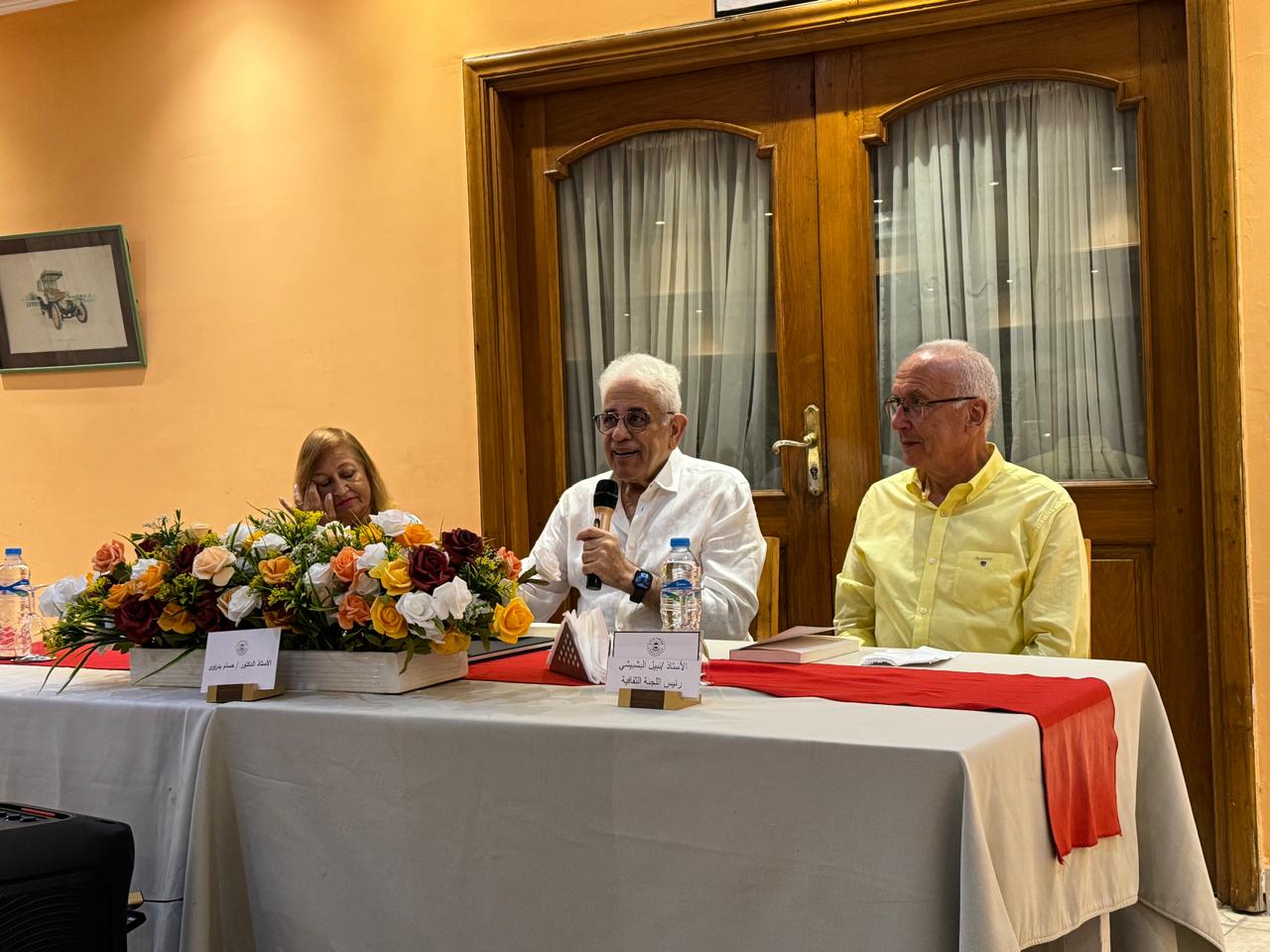
This time, I was invited by the prestigious Automobile Club of Egypt in Alexandria to speak about my latest book “Ana Bent Meen” (Whose Daughter Am I) at the kind invitation of my friend Nabil El Beshbeishi and the club’s cultural committee.
The Automobile Club was established in 1905 and was among the founding members of the International Automobile Federation (FIA) in 1922. It is considered one of the oldest and most prominent automobile clubs in the world. It was established under the patronage of Khedive Abbas Helmy II, with the first headquarters located at 25 El-Madabagh Street (now Sherif Street). Prince Aziz Hassan was the first president of the club. Membership fees were about six Egyptian pounds, with an annual subscription of five pounds.
The club’s goal was to bring together Egyptian and foreign automobile enthusiasts. Naturally, owning a car was a basic requirement for joining, which meant that membership was initially limited.
The club took it upon itself to teach its members driving skills and educate them on the car’s parts and how they work.
Since its founding, the club has organized many races, including Egypt’s first car race in Shubra in 1905, followed by races at the base of the pyramids, in Heliopolis in 1908, and another in 1911.
The club was reestablished later with royal approval from King Fouad, who granted it the title “Royal Egyptian Automobile Club.” In 1924, it moved to its current headquarters on Kasr El Nil Street, donated by Princess Fatma Ismail, daughter of Khedive Ismail.
Prince Mohamed Ali, the Crown Prince and the first to introduce the automobile to Egypt, presided over the club.
The Alexandria branch of the club is elegant and beautifully maintained. I applaud its administration for preserving its charm and style.
I was warmly welcomed by the club members, especially Engineer Nabil El Beshbeishi, the heart and mind of the Automobile Club of Egypt, Dr. Dalia Mounsef Soliman (Board Member), Ms. Rania Madkour (Head of the Social Committee), Engineer Sherif Abu Seif, and the energetic club director Dr. Abdel Aziz Badrawi.
We had a wonderful discussion about my book Ana Bent Meen, its themes like the superficondition, the story of Hajj Khaled, Ashour and moral decay, the tale “Am I Free?”, the character Mina across different eras, and a dialogue with a fairy about sleep.
Moroccan writer and critic Dr. Khalid Fathi said the following about the book:
“In this work, Hossam Badrawi adopts an innovative literary style, skillfully blending the narrative structure of short stories with the analytical depth of intellectual essays. He doesn’t merely tell stories in a linear fashion; he weaves into them philosophical reflections, clever political insights, and carefully selected quotes from great thinkers and intellectuals.
His stories and dialogues are not just for amusement—they are effective tools for understanding the world, dissecting Egyptian reality with all its complexity, and raising urgent, thought-provoking questions.
Thus, he invents a new hybrid form—what might be called the ‘story-essay’—where plot and characters merge with abstract concepts and critical perspectives. This unique style gives the reader both the pleasure of narrative and the depth of thought, transforming them from a passive recipient into an active participant in the thinking process.”
That evening, before sleeping and traveling, I took a solo stroll around Cecil Hotel, through Midan El Raml and Safia Zaghloul Street.
People, like most Egyptians, were incredibly kind. Some locals sitting in front of shops greeted me with warm smiles and unexpected hospitality.
What caught my eye was the large number of shoe stores that outnumber all other kinds of shops—I don’t know why.
I was also surprised by the way merchandise was displayed—densely packed in shop windows, prioritizing quantity over modern presentation techniques. At the same time, the street wasn’t very clean despite the visible number of sanitation workers.
It pained me to see the famous Elite Café deserted and poorly lit—I hope that was just a coincidence and not its usual state.
Most young women wore headscarves, in varying styles—from full coverage including the neck, to partial coverage with hair showing. Despite the hijab, most of them were stylishly dressed.
As for men and boys, the majority wore T-shirts and ripped jeans, in line with Western fashion. But the way people talk—how Egyptian slang has changed over the past 30 years—deserves a deeper social study.
I believe the chaotic feeling in Midan El Raml comes largely from the loud microbuses and their drivers shouting out destinations, blending with the noise of engines and loud music—resembling Egyptian versions of rap—which matches the newer slang language.
I think if organized and respectable public transportation were provided, the street might regain the dignity worthy of such a historic city.
The brightly lit advertising columns on both sides of the street also stood out—a visual overload with a strange mix of product ads and medical ads listing doctors and their specialties, putting the noble medical profession on the same level as shoe ads. For the record, this kind of advertising is unethical and illegal.
Passing by Trianon and having a cup of coffee at Delices—both still have their charming ambiance and unique elegance.
It was a story-worthy experience. Unlike the rest of the street, there was more variety and balance there.
I enjoyed sitting both outdoors and inside Delices, greeted kindly by passersby. I insisted on paying for my coffee, even though the manager wanted to offer it as a gesture of hospitality in Alexandria.
At the Cecil Hotel, I was warmly welcomed by the staff and some guests.
It was a pleasant and smooth experience, with elegance, heritage, and capable management. Everyone—from the policeman at the door to the porter, Yasser the kind Nubian who escorted me to my room, Nadine who surprised me with her cultural awareness, to Wasif, Islam, Abdelrahman, Ali, Mr. Raymond, and also translator Mohamed, Kyrillos, Nancy, Mohamed, and Ahmed the bell captains.
Also, Roqaya, Hesham, and Ahmed at reception, as well as the restaurant staff—Ahmed, Mahmoud, Eid, Abdel Sattar, and the chef. And Iman, the housekeeping attendant, all under the leadership of the capable and respectful General Manager Islam Sabry and the global management of Steigenberger.
Everyone welcomed the guests with utmost elegance that matches the beauty and heritage of the hotel and the breathtaking sea view from the room’s balcony.
How deep your history is, Alexandria…
How sweet you are, my country…
And how beautiful your people are.