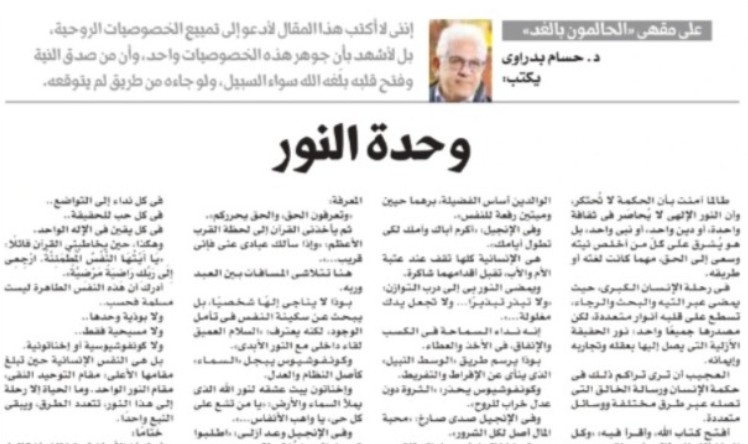
I have always believed that wisdom is not exclusive, and that divine light cannot be confined to a single culture, religion, or prophet. Rather, it shines upon anyone who purifies their intention and seeks truth—regardless of their language or path.
In the great journey of humanity, as we wander in search, longing, and discovery, many lights shine upon the heart. Yet all these lights come from one source: the eternal truth that one reaches through intellect, experience, and faith.
It is remarkable to witness this accumulation of light in human wisdom and in the Creator’s message that reaches us through different ways and diverse means.
I open the Book of God and read:
“And every person, We have fastened his fate to his neck.”
And I realize that life is but a mirror of what lies within us. Every step, every choice, every intention we make, weaves the threads of our destiny.
This voice does not sing alone. It harmonizes with voices echoing through the depths of history:
Buddha, seated beneath the tree of enlightenment, says:
“We are what we think. All that we are arises with our thoughts.”
Confucius, in his calm, paternal tone, reminds his students:
“He who plants goodness will harvest goodness, and he who sows evil will reap its bitterness.”
And in the Bible, the eternal voice resounds:
“Each of us will give an account of ourselves to God.”
As though the universe itself echoes one truth: human freedom is a responsibility.
Then verses whisper to my soul:
“And be kind to parents…”
And I feel the warmth of the mercy that the Creator has planted in our depths.
Buddha says:
“No gift is greater than the gift of life: mother and father. Be an endless river of compassion to them.”
Confucius teaches his children:
“Filial piety is the foundation of virtue. Honoring them in life and after death uplifts the soul.”
In the Bible:
“Honor your father and mother so that your days may be long.”
All of humanity stands at the threshold of the mother and father, kissing their feet in gratitude.
Then the light leads me to the path of balance:
“Do not be wasteful… and do not keep your hand chained to your neck.”
It is a call for moderation in earning and spending, in giving and receiving.
Buddha outlines the “noble middle way,” avoiding extremes.
Confucius warns:
“Wealth without justice is the ruin of the soul.”
And in the Bible:
“The love of money is the root of all evil.”
Even Akhenaten, in his prayers to the one sun disk, says:
“Pure-hearted giving is your offering, O Aten.”
Then the Qur’an gently calls:
“And do not walk upon the earth arrogantly…”
Humility is the crown of the wise, the robe of the enlightened.
Buddha echoes:
“As heavy-laden wheat bends low, so does the wise bow with the fruit of knowledge.”
Confucius reminds:
“The truly great are those who acknowledge their shortcomings and do not boast of their virtues.”
In the Bible, God promises:
“Whoever exalts himself will be humbled, and whoever humbles himself will be exalted.”
Then the light returns me to the essence of wisdom:
“And do not pursue that of which you have no knowledge…”
There is no place for assumption and ignorance where the light of reason shines.
Buddha teaches:
“Do not believe anything simply because you heard it; test it, contemplate, let your mind be your guide.”
Confucius advises:
“Wisdom begins when you realize how much you do not know.”
And in the Bible, freedom is born through knowledge:
“You will know the truth, and the truth will set you free.”
Then the Qur’an takes me to the most intimate moment of nearness:
“And when My servants ask you concerning Me, indeed I am near…”
Here, the distance between servant and Lord disappears.
Buddha does not pray to a personal deity but seeks inner peace through contemplation of existence, yet he confesses:
“Deep peace is an inner encounter with eternal light.”
Confucius reveres “Heaven” as the source of order and justice.
Akhenaten pours out his love to God’s light that fills the heavens and earth:
“O You who shine upon all living things, O Giver of breath…”
And the Bible offers the eternal promise:
“Ask and it will be given to you; seek and you will find; knock and the door will be opened to you.”
And the sweetest of Qur’anic calls flows in my veins:
“So do not oppress the orphan, and do not repel the beggar.”
All religions melt into a river of mercy.
Buddha whispers:
“Extend your hand to those who suffer, for in their salvation lies your own.”
Confucius lays the foundations of compassion:
“The noble cannot bear to see others in pain.”
And in the Bible:
“Blessed are the merciful, for they shall receive mercy.”
Before the grandeur of pure monotheism, the Qur’an proclaims:
“God—there is no deity except Him, the Ever-Living, the Sustainer of existence…”
In Akhenaten’s heart:
“There is no one but You, my Lord, the light of life, the One and Only.”
And in the Bible:
“The Lord our God, the Lord is one.”
Here I stand at the threshold of this unifying light, and I see that wisdom—though its forms may differ—is one in essence.
The religion of innate nature (fitrah) shines in every sincere soul…
In every quest for justice…
In every call to mercy…
In every invitation to humility…
In every love of truth…
In every certainty in the One God.
And so, when the Qur’an addresses me:
“O tranquil soul, return to your Lord, well-pleased and pleasing.”
I understand that this pure soul is not exclusively Muslim…
Nor only Buddhist…
Nor solely Christian…
Nor Confucian or Akhenatenian.
It is the human soul when it reaches its highest station: the station of pure monotheism, the station of the One Light. Life is but a journey toward this light—paths may differ, but the source remains one.
In conclusion:
I understand that religions may differ in appearance, but they all open onto the same light. That humanity, in every time and place, carries within it one question: Who am I? And what gives my existence meaning?
And because God does not deprive a sincere heart of guidance, revelations came—diverse in form, unified in essence—to tell every lost soul:
“Take heart… the path to Me is open.”
I do not write this to dissolve spiritual distinctiveness, but to testify that the core of these distinctions is one. That whoever is sincere and opens their heart, God will lead them to the straight path—even if it comes from a direction they never expected.
This chapter is a bridge—not only between religions, but between pure souls that, in a moment of truth, realized that what they thought was difference… was merely variation in the great symphony of oneness.
And as I place the final period, I surrender myself—not to a doctrine, nor to a sect—but to that light that encompasses all things, the light of the One Creator, the All-Hearing, the All-Knowing… the Sufficient.