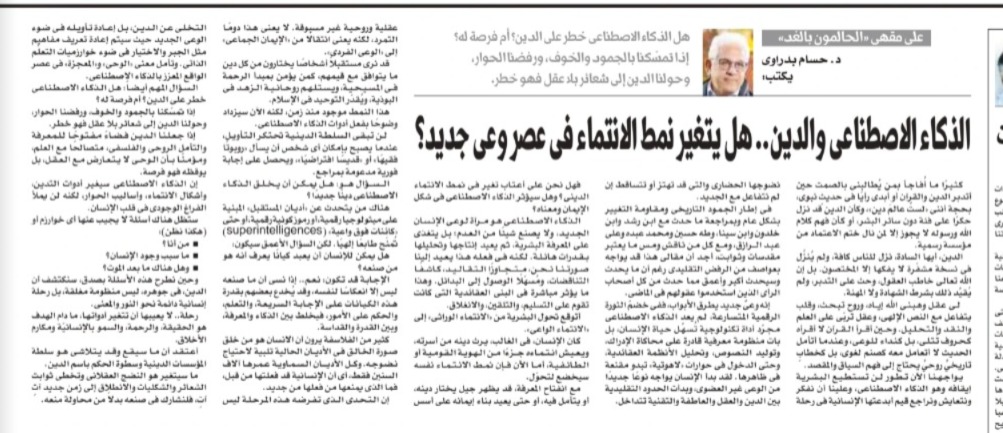
I am often surprised by those who demand my silence when I reflect on religion and the Qur’an or express an opinion about a prophetic hadith, on the pretext that I am “not a religious scholar.” As if religion were revealed exclusively to a certain group of people, or as if understanding the words of God and His Messenger were permissible only for those who have obtained an official stamp of approval from a recognized institution.
Religion, ladies and gentlemen, was revealed for all people. It was not sent down in an encrypted version that only specialists can decipher. God Almighty addressed the human mind, urged contemplation, and did not condition this on possessing a degree or a particular profession.
I have a mind that God has gifted me, a soul that seeks, and a heart that interacts with the divine text. My mind was raised on knowledge, criticism, and analysis. When I read the Qur’an, I do not read it as mere letters to be recited, but as a call to awareness. When I contemplate a hadith, I do not treat it as a linguistic idol, but as a historical and spiritual discourse that needs to be understood within its context and intent.
We are now facing a development that humanity will not be able to stop: artificial intelligence. We must think, adapt, and review values humanity has created in its civilizational maturity—values that may be shaken or fall away if we do not engage with the new reality.
Looking at the historical stagnation and general resistance to change—and reviewing what happened with Ibn Rushd, Ibn Khaldun, Ibn Sina, Taha Hussein, Muhammad Abduh, Ali Abdel Raziq, and every thinker who discussed or touched what were considered sacred and unchangeable—I find that this article may face storms of traditional rejection, even though what is happening and will happen is greater and deeper than what all those past intellectuals faced.
A new awareness is knocking at the door. In the midst of the accelerating digital revolution, artificial intelligence is no longer just a technological tool that makes human life easier—it has become a cognitive system capable of simulating perception, generating texts, analyzing doctrinal systems, and even engaging in “theological” dialogues that may seem convincing on the surface. Humanity has begun to face a new kind of non-organic awareness, and the traditional boundaries between religion, reason, emotion, and technology are starting to blur.
So, are we on the threshold of a change in the pattern of religious belonging? Will artificial intelligence affect the form and meaning of faith?
Artificial intelligence is a mirror of humanity’s new awareness. It creates nothing out of nothing; it feeds on human knowledge, then reproduces and analyzes it with immense capabilities. In doing so, it reflects back to us our own image—surpassing traditions, revealing contradictions, and facilitating access to alternatives. This directly affects doctrinal structures that were built on submission, indoctrination, and isolation.
I expect humanity to shift from “inherited belonging” to “conscious belonging.”
In the past, a person would mostly inherit their religion from their family, living their religious identity as part of their national or sectarian identity. But now, the pattern of belonging itself is about to undergo a transformation.
With the openness of knowledge, a generation may emerge that chooses its religion, reflects on it, or even rebuilds its faith on unprecedented intellectual and spiritual foundations. This does not always mean rebellion—it means moving from “collective faith” to “individual awareness.”
In the future, we might see individuals selecting elements from different religions according to their values—someone who believes in the principle of mercy from Christianity, draws inspiration from the spiritual asceticism of Buddhism, and appreciates the monotheism of Islam.
This pattern has existed before, but now it will become more visible thanks to artificial intelligence tools.
Religious authority will no longer monopolize interpretation when anyone can ask a “robot scholar” or a “virtual saint” and receive an immediate answer supported by references.
The question is: Can artificial intelligence create a new religion?
Some speak of “religions of the future” based on digital mythology, cosmic digital symbols, or even “superintelligences” that are granted a divine status. But the deeper question is: Can a human worship an entity they know they created?
The answer may be: Yes—if they forget that what they created is only a reflection of themselves. Some might be deceived by these entities’ ability to answer quickly, learn, and make judgments, confusing intelligence with knowledge, and capability with holiness.
Many philosophers believe that humanity has created the image of God in existing religions to meet its needs during its maturation. All the revealed religions are only thousands of years old—which means humanity has done this before, so what would prevent it from doing it again?
The challenge of this stage is not to abandon religion, but to reinterpret it in the light of new awareness—where concepts like predestination and free will are redefined through the lens of self-learning algorithms, and where “revelation” and “miracle” are contemplated in the age of AI-augmented reality.
Another important question: Is artificial intelligence a threat to religion—or an opportunity for it?
If we cling to stagnation and fear, refuse dialogue, and turn religion into rituals without reason—it is a threat.
If we make religion an open space for knowledge, spiritual reflection, and philosophy, harmonizing with science and believing that revelation does not contradict reason but awakens it—it is an opportunity.
Artificial intelligence will change the tools of religiosity, the forms of belonging, and the methods of dialogue—but it will not fill the existential void in the human heart.
There will always remain questions that no algorithm can answer (or so we believe):
- Who am I?
- What is the reason for human existence?
- Is there life after death?
When we ask these questions sincerely, we will discover that religion, at its core, is not a closed system but a continuous human journey toward light and meaning—a journey that is not diminished by changing its tools, as long as the goal remains truth, mercy, and the elevation of humanity and noble ethics.
I believe that what may vanish is the authority of religious institutions and the dominance of governance in the name of religion.
What will change is rational maturity, the transcending of ritualistic rigidity, and the launch into a new era that is coming—coming inevitably. Let us participate in shaping it instead of trying to prevent it.