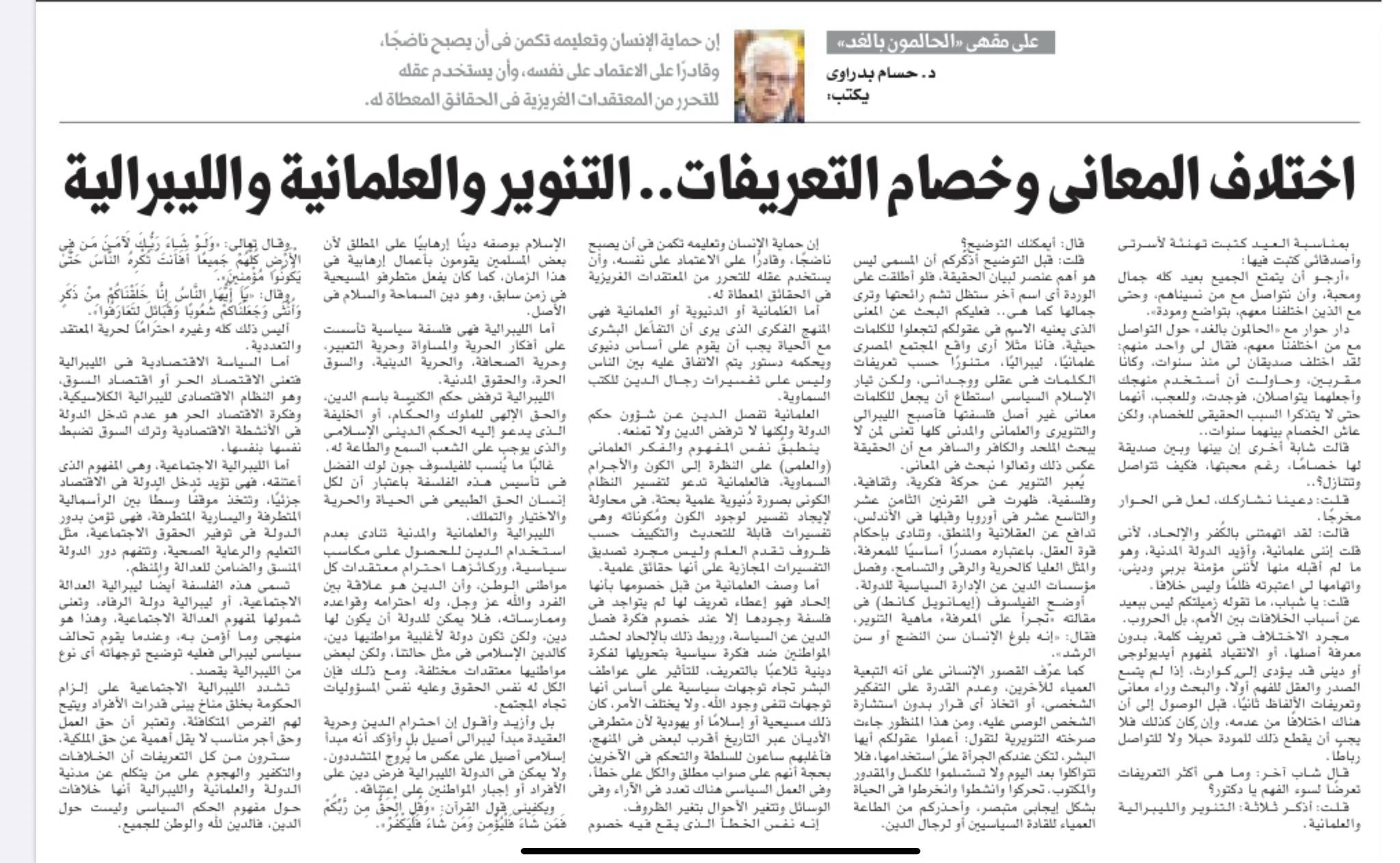
Differences in Meanings and the Dispute over Definitions
Enlightenment, Secularism, and Liberalism
By Hossam Badrawi
A mere difference in defining a word—without knowing its origin, or by submitting to an ideological or religious interpretation—can lead to disasters, unless one’s mind and heart remain open to understanding first, and to seeking the meanings and definitions of terms second, before concluding whether there is disagreement or not. And even if there is, such disagreement should not sever the bonds of affection or communication.
A young man once asked me: “Doctor, which words are most frequently misunderstood?”
I said: “Three come to mind: Enlightenment, Liberalism, and Secularism.”
He said: “Could you explain?”
I replied: Before I explain, let me remind you that the name is not the most important element in revealing the truth. If you called a rose by any other name, it would still smell just as sweet and look just as beautiful. What matters is the meaning that the name holds in your minds—this is what gives words their weight. For me, when I look at Egyptian society, I see it as secular, liberal, and enlightened, according to the definitions of these terms as I understand them. But the political Islamist current has managed to distort these words from their original philosophy, making “liberal,” “enlightened,” “secular,” and “civil” synonymous with “atheist,” “immoral,” or “godless” to those who do not dig deeper. The truth, of course, is the exact opposite. Let us look at the real meanings.
Enlightenment refers to an intellectual, cultural, and philosophical movement that arose in the 18th and 19th centuries in Europe, preceded by Andalusia, advocating rationality and logic, and calling for the empowerment of reason as the primary source of knowledge, along with ideals such as freedom, progress, and tolerance, and the separation of religious institutions from the political administration of the state.
The philosopher Immanuel Kant explained the meaning of enlightenment in his essay “Dare to Know.” He described it as humanity’s emergence from immaturity into maturity. He defined human immaturity as blind dependence on others and the inability to think independently or make decisions without consulting a guardian. Hence his call: “Have the courage to use your own reason.” His enlightenment cry was for people to use their minds, to refuse blind obedience to political leaders or religious figures, and to live actively, positively, and thoughtfully.
Secularism (from saeculum, meaning worldly or temporal) is the intellectual approach that human interaction with life should be based on worldly foundations governed by a constitution agreed upon by people—not by clerical interpretations of holy texts. Secularism separates religion from the governance of the state, but it neither rejects nor forbids religion.
Its opponents often misrepresent it as atheism, equating the call for separating religion from politics with denying God’s existence. This is a distortion intended to stir emotions and rally people against a political idea by framing it as a religious threat. Extremists across religions have always done this, seeking power and control by claiming absolute truth.
This is the same error made by some opponents of Islam, who describe it as a religion of terrorism simply because some Muslims commit acts of terror—just as extremists in Christianity once did—though both religions are, in essence, faiths of peace and compassion.
Liberalism is a political philosophy founded on ideas of freedom and equality: freedom of speech, press, religion, civil rights, and free markets. It rejects the rule of church by divine right or the absolute obedience demanded by religious caliphates.
The philosopher John Locke is often credited with founding this philosophy, with his emphasis on each person’s natural rights to life, liberty, choice, and property.
Liberalism, secularism, and civic governance share a commitment to preventing the use of religion for political gain. Their foundation is respect for all citizens’ beliefs, recognizing that religion is a personal relationship between the individual and God. A state cannot have a religion; rather, it governs citizens of various faiths equally. In Egypt, for example, Islam is the religion of the majority, but minorities have different beliefs—yet all must enjoy equal rights and bear equal responsibilities.
Indeed, respect for religion and freedom of belief is a core liberal principle, and I affirm it is also an authentic Islamic principle, contrary to what extremists propagate. No liberal state can impose religion on its citizens. The Qur’an itself affirms freedom of belief:
- “The truth is from your Lord; let him who wills believe, and let him who wills disbelieve.” (18:29)
- “And had your Lord willed, all the people on earth would have believed—all of them entirely. Then, would you compel the people in order that they become believers?” (10:99)
- “O mankind! We created you from a male and a female, and made you into nations and tribes, that you may know one another.” (49:13)
Is this not, in itself, respect for diversity and freedom of belief?
Economically, classical liberalism advocates free markets and minimal state intervention. Yet social liberalism—which I embrace—supports partial state intervention in the economy, striking a balance between extreme capitalism and extreme leftism. It emphasizes the state’s role in providing social rights such as education and healthcare, ensuring justice, equality, and freedom, and safeguarding security and sovereignty.
This philosophy, often called liberalism of social justice or the welfare state, obliges governments to build capacities and ensure equal opportunities. It upholds the right to work and fair wages as equally fundamental as the right to property.
However, state intervention in the economy must have limits, recognizing the private sector’s primary role in development, investment, and job creation—not as a government favor, but as a philosophical right to economic freedom. Experience has shown that when the state monopolizes ownership of production without accountability, as under communism, it destroys individual initiative, stifles freedom, and achieves only equality in poverty and corruption.
From these definitions, it becomes clear that the disputes, takfir (accusations of disbelief), and attacks against advocates of a civil state, secularism, or liberalism are not about religion at all. They are about political systems of governance. Religion is for God, and the homeland is for all.