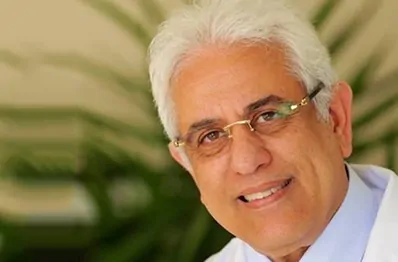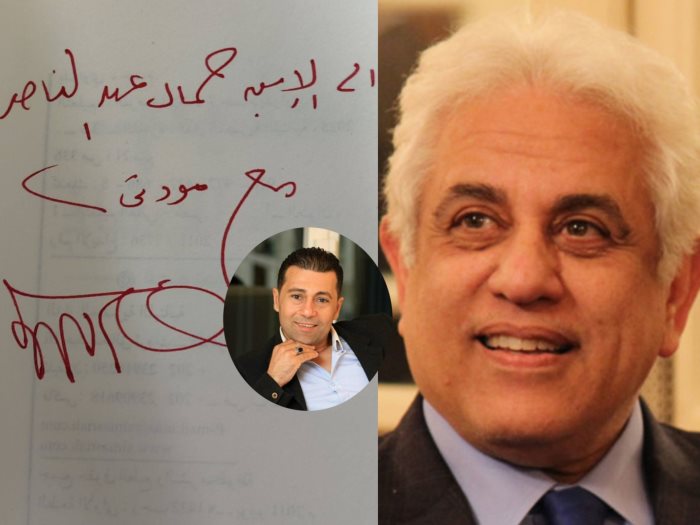
Dr. Hossam Badrawi presented me with his book Education: The Opportunity for Salvation during my attendance at the salon of the artist and writer Dr. Hussein Nouh. This salon has become a luminous window for intellectual, artistic, and political dialogue, where figures from diverse fields gather to enrich discussions on national issues.
I must begin by extending my sincere thanks to Dr. Hussein Nouh for this opportunity, which brought me into rich encounters—foremost among them my meeting with Dr. Hossam Badrawi, in the presence of distinguished figures such as journalist and writer Mohamed El-Gheity, publisher Fatma El-Boudy, writer Fatma Naoot, my friend and writer Essam Naguib, intellectual and politician Osama Kamel (head of the Misr El-Fatah Party), the acclaimed actor Sherif Khairallah, and my friend, director Ahmed Fathy Shams, alongside an elite group of intellectuals and thinkers whom Dr. Nouh carefully selected. The salon was, in truth, a miniature image of Egypt—diverse, rich with intellect and creativity.
My encounter with Dr. Badrawi’s book was not a fleeting event, but the beginning of an intense intellectual journey. The moment I returned home, I began reading, and could not sleep until I had devoured its pages in full. It was no ordinary book—it was a cry of intellect and conscience, a reformist call that warns and inspires at once. It confirms that the chance for salvation is still present—perhaps even the last chance—if we know how to employ its great levers: science and knowledge, research and innovation, quality and precision, passion and persistence, resilience and determination.
In the introduction, Dr. Badrawi clarifies that any great idea is destined to be forgotten if it does not transform into action within society, or is not documented in a book that grants it life. Herein lies the value of this work: it is not merely a theoretical study, but a historical testimony and a rich personal journey—political, professional, and academic—rooted in lived experience of Egypt’s complex reality, while also opening broad horizons for thinking about the future.
The book begins with a general chapter on renaissance and hope in reform, presenting twelve pillars which he views as the foundation of any renaissance, all of which are interwoven with culture and education. The subsequent chapters address central issues: universities as builders of civilization rather than mere service providers; reforming higher education in line with international standards; foreign scholarships as a path to enlightenment; student life as the axis of character building; technical and vocational education as a pillar of development; the teacher as the cornerstone of reform; the national qualifications framework; private universities; challenges of implementation; missed opportunities; issues of identity and the integration of education systems; the relationship between education and citizenship; combating corruption in the education system; and finally, the philosophy of beauty in education.
What distinguishes this book is that it does not stop at diagnosis, but offers policies and solutions—anchored in decades of practical experience in politics, academia, medicine, and social work. What struck me particularly was the chapter on “missed opportunities,” which vividly shows how delaying or distorting implementation squanders the energy of an entire nation and drags us back to square one. His repeated emphasis on academic independence, institutional integrity, and alignment with labor market needs makes the book a clear roadmap for any genuine reform.
Education: The Opportunity for Salvation arrives at a critical juncture: it is both an illumination and a warning. It holds up a clear mirror, showing that our true battle is not merely against funding shortages or bureaucracy, but against a mindset of stagnation and repetition that has trapped us in closed circles for decades. The book asserts that Egypt’s victory in its struggle against ignorance, conspiracies, and civilizational decline will only be achieved through education in its broadest sense: education that builds the free, cultured, creative human being—one who loves beauty, is rooted in identity, yet open to the world.
I believe this book must be read carefully by every official and decision-maker, and adopted as a key reference in shaping Egypt’s education policies. Indeed, it should be a national priority in reform plans. For it not only presents bold visions, but also offers practical, implementable solutions backed by evidence and experience. This book ought to be taught to administrative elites in the Ministries of Education and Higher Education, and debated in universities and research centers. Simply put, it is not just a book on education—it is a blueprint for saving the nation.
I finished reading the book more convinced than ever that Egypt truly has a real opportunity—one contingent on our ability to turn vision into action, will into policies, and policies into practical measures. Only then will education become the key to renaissance and the shield of salvation, and Dr. Hossam Badrawi’s words the echo of a future that awaits us.
Therefore, my direct call through this article is for the concerned ministries and the Egyptian parliament to adopt this book as an official working document, placing it on the agenda of educational and research committees, to serve as a guide for shaping education policies in the coming years. We do not have the luxury of waiting, nor the indulgence of recycling the same crises. Education: The Opportunity for Salvation is not merely a title—it is a powerful message to the state and society: that education is our only path to renaissance, and that Egypt lacks nothing but the will to turn vision into action.