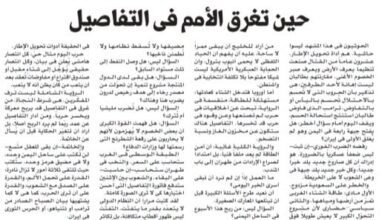
I recently read an article about the Moulid of Ibrahim El-Desouky and the suspension of classes in 38 schools, and as I reflected on the description, I felt compelled to complete the picture.
When people crowd into the moulids (saints’ festivals), carrying incense and flags, chanting prayers or singing folk songs, the scene cannot be read superficially—reduced to either simple faith or deep-rooted ignorance.
In truth, the moulid is neither a purely religious event nor a merely social ritual; it is a complex human condition, where the need for joy intersects with the need for meaning, the desire for participation with the fear of isolation, and the search for blessing with the escape from reality.
My question was: Is it habit or need?
Do people go to the moulid out of habit, or is there a deeper psychological and social need driving them? Habit explains repetition, but it does not explain insistence. People don’t attend merely because they are used to doing so, but because they find in the moulid what official society fails to provide — joy, connection, attention, and a fleeting sense of equality.
It is a temporary moment of “supervised liberation,” where social, religious, and political repression takes a breath — before people return to their heavy, constrained reality.
We can look at the moulid as a form of psychological compensation. At its core, there lies a psychological dimension worthy of analysis. When real hope fades, symbolic hope is created. When doors of justice close, the door of the shrine opens.
People do not venerate the saint for his own sake, but rather seek through him a sense of reassurance and meaning for their daily suffering. It is the religion of the poor, and the hope of the simple, when the system fails to provide dreams.
To be clear, moulids are not an exclusively Egyptian phenomenon — though Egypt has given them their unique color, warmth, and festive soul. In India, similar celebrations are held for saints and Sufis; in Latin America, people take part in “Carnivals of the Saints”; in Europe, pilgrims visit shrines of saints and folk heroes.
This is a universal human phenomenon, reflecting humanity’s tendency to turn sacred memory into a living social ritual — and the constant need to experience faith not as an idea, but as a celebration.
What makes the phenomenon striking in Egypt, however, is its politicization and exploitation. The state has found in moulids a “safe” outlet for releasing social tension. The citizen who dances in the saint’s presence does not demand his rights. He who interprets poverty as divine fate does not question social justice.
Thus, faith is transformed from a force of liberation into a tool of domestication. The saint’s shrine becomes an officially licensed opiate, and schools and educational institutions in surrounding areas are even shut down — as if in a gesture of governmental approval.
So the question is: Should we, as a society, resist this phenomenon — or find value within it?
Violent resistance could deprive society of one of its psychological outlets, replacing religious chaos with a spiritual void. Conscious utilization, however, means redirecting collective energy toward good — turning moulids into cultural festivals that honor figures of thought and humanity, and teaching people that true blessing lies not in touching the shrine, but in work, compassion, and reason.
Man needs ritual — but he needs awareness even more, to understand the meaning behind the ritual. Nations do not rise by abolishing their celebrations, but by redefining them.
The psychologist Carl Jung believed that every human carries within him a collective unconscious — a shared reservoir of symbols and archetypes representing humanity’s experience since the dawn of history.
The saint, in this sense, is not merely a religious figure, but a symbol of the protective father and savior; the moulid is not a passing event, but a collective invocation of lost security.
When societies are troubled, people instinctively return to ritual — to rhythm, to collective unity, to symbols that bind them together, even if those symbols belong to the past or have lost meaning in modern terms. Jung called this “the return to origins” — the collective consciousness retreating to its primal symbols when reality fails to provide meaning.
Thus, the moulid is not simply an expression of popular religiosity, but of a deep psychological need for belonging — to be part of a group that prays, sings, cries, and rejoices together.
In that brief merging with the crowd, the individual rediscovers himself within the whole — perhaps healing, even slightly, from his daily alienation within communities that have lost their soul.
Religious ritual, in its essence, is not wrong. It is a symbolic language through which the psyche expresses its existential needs. The danger begins when the ritual becomes a substitute for awareness — when individual responsibility is replaced by collective dependency.
Therefore, the solution is not to abolish moulids, but to revive their human meaning — to make them platforms for education, awareness, and compassion, rather than arenas of spiritual numbness.
Every ritual repeated without consciousness is a circle in the void, but when illuminated by knowledge, it becomes a source of collective creativity. Awareness is what separates liberating faith from enslaving faith — the difference between worshiping God in the heavens or being imprisoned on earth in His name.
When people understand that blessing lies not in shrines but in minds, and that true remembrance is conscious responsibility, not mere recitation, then moulids can be reborn as festivals of the spirit, not as opiates for the masses.
The thinker’s role is not to destroy moulids, but to awaken the light within hearts, so that celebrating God becomes a celebration of life itself.
Man does not seek God through ritual as much as he seeks himself. When awareness is found, every ritual becomes a path to creation; when awareness is lost, every ritual becomes a circle of nothingness.
God is not found in crowds or incense, but in the wakefulness of consciousness that recreates the world anew in every moment.