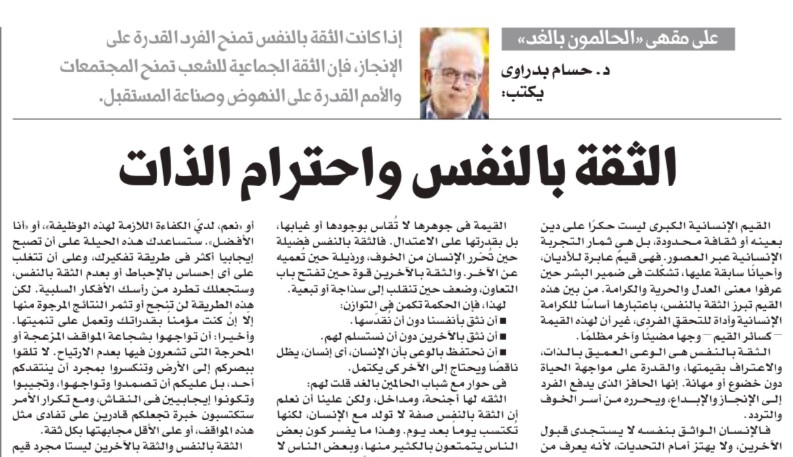
The great human values are not the monopoly of any single religion or culture — they are the fruit of the human experience across ages. These are values that transcend religions, sometimes even preceding them, taking shape in the human conscience when mankind first understood justice, freedom, and dignity.
Among these values, self-confidence stands out as a foundation for human dignity and a tool for personal fulfillment. Yet, like all values, it has both a bright and a dark side.
Self-confidence is the deep awareness of oneself — the acknowledgment of one’s worth and the ability to face life without submission or humiliation. It is the driving force behind achievement and creativity, freeing a person from fear and hesitation.
A confident person does not beg for others’ approval and does not crumble in the face of challenges, for they know who they are and what they can do.
However, confidence is a virtue only when coupled with humility and awareness of others. When it is detached from critical thinking, it becomes arrogance; when separated from conscience, it turns into fanaticism.
The confident person may then become a jailer of others instead of a companion — defending their ego even against the truth itself.
There is indeed a dark side to self-confidence: the fanatic is overly confident in their opinions to the point of blindness — seeing themselves as the sole standard of truth and denying the existence of multiple paths to goodness.
The selfish person, too, is confident to the extent that they see no one but themselves — turning confidence into a wall that isolates them from others.
Thus, a value that is inherently human becomes a tool of oppression when stripped of empathy and awareness of one’s limits.
Self-confidence is not complete unless it is balanced with confidence in others. Mutual trust is what builds bridges between people and enables cooperation and collective creativity.
Trusting others means recognizing that truth cannot be confined to one person — it is the sum of many minds, diverse experiences, and continuous dialogue.
It means seeing in others a reflection of part of ourselves — not an enemy threatening our existence.
A value’s worth lies not in its mere presence or absence but in its balance.
Self-confidence is a virtue when it frees one from fear, but a vice when it blinds one to others.
Trust in others is a strength when it fosters cooperation, but a weakness when it turns into naivety or dependency.
Thus, wisdom lies in balance:
-
To trust yourself without idolizing it.
-
To trust others without surrendering to them.
-
To remain aware that every human being is incomplete — needing others to become whole.
In a dialogue with young dreamers of tomorrow, I told them:
“Confidence has wings and pathways — but remember: self-confidence is not innate. It is built day by day.”
This explains why some people have it in abundance, while others lack it. Each of you must ask: Which type am I? Can you strengthen your self-confidence further — and how?
Psychologists have found that low self-confidence usually takes root in childhood or adolescence. Parents, teachers, siblings, or the surrounding environment often play a major role — when they mock a child’s looks, failure in school, or any weakness, instead of encouraging and helping them improve.
This is worsened by constant negative criticism instead of constructive, positive feedback.
I told the youth that there are five keys to strengthening self-confidence:
-
Be distinguished: Every person has unique qualities. Develop, express, and build upon them.
-
Be steadfast: Do not change your personality just to please others — you can’t be a copy of someone else just to win their approval.
-
Set small daily goals: Based on your abilities, make realistic and achievable goals. Divide tasks into steps and gradually raise the challenge.
-
Affirm yourself positively: Keep repeating positive phrases internally or aloud — “I can do this,” “I have the skills for this job,” “I’m the best.” These affirmations help you think positively and fight frustration. But they only work if you truly believe in your abilities and work on improving them.
-
Face discomfort bravely: Don’t lower your gaze or crumble when criticized. Stand firm, respond positively, and learn through repetition to handle such situations confidently.
Self-confidence and trust in others are not merely personal traits — they are the foundation of a healthy society, one that believes an individual’s dignity is incomplete without freedom, and that freedom itself is incomplete without responsibility toward others.
Only then does confidence evolve from a personal feeling to a universal human value — one that enlightens the path rather than darkens it.
Collective Confidence
If self-confidence empowers the individual to achieve, then collective confidence empowers societies and nations to rise and shape the future.
It is the shared awareness of a community’s worth — the deep belief in its ability to face challenges and accomplish great goals.
Nations that trust themselves do not collapse in crises; they see them as opportunities for innovation and renewal.
Collective confidence is not just an emotion — it results from a whole system:
-
Education that instills awareness,
-
Media that strengthens identity,
-
Leadership that inspires hope,
-
Civil society that encourages participation.
Conversely, the absence of collective confidence produces submissive nations, dependent on others, losing the will to initiate.
Just as a person cannot thrive without self-confidence, a nation cannot rise without collective self-belief — the faith that turns crises into achievements and dreams into reality.