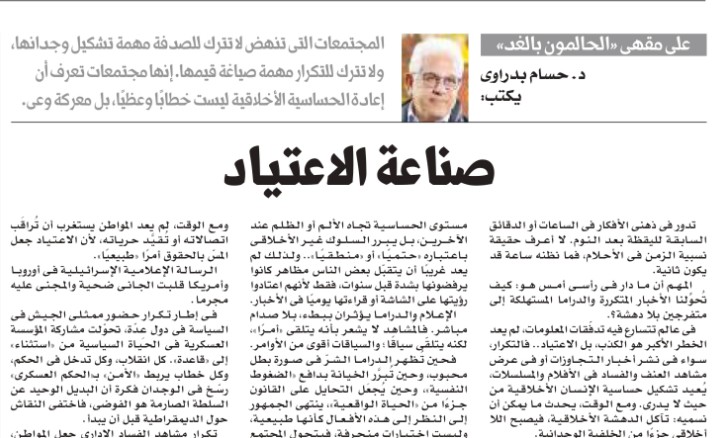
Thoughts swirl in my mind in the hours—or minutes—right before waking up. I don’t really know the true relativity of time in dreams; what we think is an hour could be a second.
What mattered yesterday was the idea that ran through my head: how repeated news and recycled drama turn us into spectators without wonder.
In a world where information flows at dizzying speed, the greatest danger is no longer lies, but habit.
Repetition—whether in publishing news of violations or in presenting scenes of violence and corruption in films and series—reshapes a person’s moral sensitivity without them noticing. Over time, something happens that we might call the erosion of moral astonishment. What is unethical becomes part of the emotional background.
Human beings, by nature, adapt. Continuous exposure to a pattern of behavior—even if deviant—makes it familiar, and with familiarity the intensity of rejection fades.
The flood of crime reports, the constant magnification of scandals, the portrayal of corruption as “cleverness” or “street-smartness,”
and the repeated scenes of betrayal, violence, and manipulation in artistic works—
all of these gradually create a kind of life-on-a-stage, where the public becomes a passive spectator—more receiving than acting, more “understanding” than rejecting.
Art by nature condenses reality and reshapes it. But at some point, it shifts from being a mirror of reality to a hammer that forms reality.
When violent scenes are repeated across dozens of films, when the corrupt man becomes a popular hero, and when the swindler is portrayed as having “social intelligence,” values begin to shift—with no official announcement.
Young minds start seeing what they watch as natural, or “part of the game,” or “realism,” as though morality has become a luxury that can be abandoned in the name of “life as it is.”
This is the psychological theory known as Normalization:
what is abnormal becomes familiar through continuous exposure.
Studies show that the mind gradually becomes less responsive to moral shocks, reducing sensitivity to others’ pain or injustice, and even justifying unethical behavior as “inevitable” or “logical.”
That’s why it’s no longer surprising that some people accept things they once strongly rejected—simply because they’ve gotten used to seeing them on screens or reading about them daily.
Media and drama influence slowly, without direct confrontation. The viewer doesn’t feel he is receiving an “order,” but rather a context—and contexts are stronger than orders.
When drama portrays evil as a lovable hero,
when betrayal is justified by “psychological pressure,”
and when circumventing the law is shown as part of “real life,”
the audience eventually comes to see these actions as normal, not deviant choices.
Thus society shifts from guarding its values to consuming their erosion.
This is the most dangerous stage a society can reach: when the sense of wrongdoing disappears, the voice of conscience weakens, and the immoral becomes “part of the scenery,” not even worth stopping at.
In politics, by the same mechanism, the exception becomes the rule.
The making of habit isn’t limited to art and media—it’s one of the most powerful tools political systems have used throughout history, locally and globally, to turn abnormal behaviors into “normal” practices.
In 1930s Germany, the catastrophe didn’t begin with a world war, but with creating a sense of German racial superiority and their right to conquer others. Through continuous media messages demonizing Roma, opponents, and Jews, daily repetition made hatred “logical,” preparing society to accept crimes unimaginable only a few years earlier.
In the United States after 9/11, millions accepted restrictive laws like the Patriot Act because the media repeated hourly that security could only come at the cost of privacy. Over time, people no longer found it strange that their communications were monitored or freedoms curtailed—habit made the violation of rights seem “normal.”
The Israeli media narrative in Europe and the U.S. reversed roles: the perpetrator became the victim, and the victim was labeled a criminal.
In many countries, the repeated presence of military figures in politics gradually transformed military involvement in governance from an “exception” to a “norm.” Each coup, each intervention, each speech linking “security” to “military rule” embedded the idea that the only alternative to strict authority is chaos—killing any discussion about democracy before it even starts.
The repeated portrayal of administrative corruption made citizens, year after year, see corruption rewarded with promotions or silence. The initial shock faded into indifference, and the question became “So what?” instead of “How is this happening?” This normalization is what allows corruption to become a stable structure, not an occasional incident.
In some local contexts, security campaigns, arrests, and the silencing of voices are presented in the media as actions “to protect the nation.” With daily repetition of these messages, moral sensitivity weakens, and the lines blur between protecting the state and protecting the regime. Citizens then accept procedures they would have refused in different circumstances.
How do we protect our awareness from erosion?
The solution is not to fight art or hide the news, but to teach critical thinking—to see and understand without surrendering.
The solution is to raise children and youth to ask:
Why is this happening? Is it morally right?
To diversify sources of awareness so we’re not prisoners of a single media pattern.
Drama may depict evil—but society’s real role is to remain able to reject it.
Thriving societies do not leave the shaping of their conscience to chance, nor allow repetition to dictate their values. They know that restoring moral sensitivity is not moral preaching but a battle of awareness that begins with a single question:
Do I truly recognize that what I see is not normal?
Or have I simply… gotten used to it?