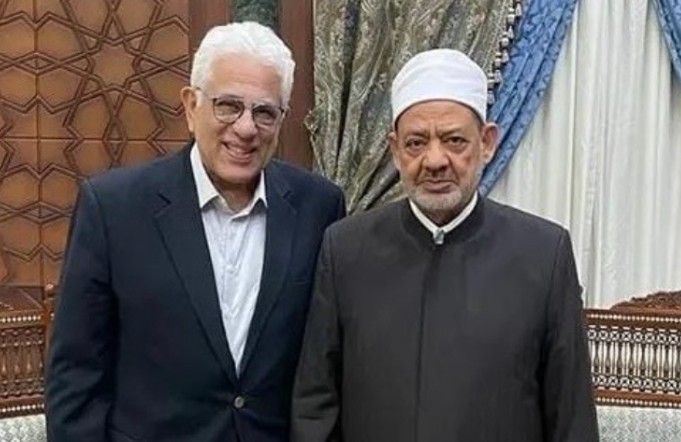
This year marks eighty years since the birth of my dear friend, His Eminence the Grand Imam Dr. Ahmed El-Tayeb, and sixteen years since he assumed the leadership of Al-Azhar. These two occasions invite reflection and appreciation for an exceptional personality who has combined profound scholarship, intellectual openness, and a wisdom that inspires calm and reassurance in all who encounter him.
Friendship and Knowledge: My acquaintance with Dr. Ahmed El-Tayeb
Before he became Grand Imam of Al-Azhar, I had known him closely, when he was President of Al-Azhar University and an active member of the Education Committee for which I was responsible. From our first meeting, I was struck by his enlightened mind, the breadth of his thinking, and his flexibility in dialogue — qualities that are rare in someone holding such a high religious position in an institution as significant as Al-Azhar.
Dr. Ahmed El-Tayeb is not merely a scholar of Islamic jurisprudence. He is a philosopher, a Sufi, and a widely cultured intellectual who is unafraid to engage deeply with difficult questions, grounded in rigorous scholarship, and who possesses a remarkable ability to understand disagreement and manage it with wisdom.
Since assuming the office of Grand Imam in March 2010, he has led a reform movement within Al-Azhar, seeking to reinforce its role as a moderate institution that calls for tolerance, coexistence, and the rejection of extremism and fanaticism. His impact has been evident in several key areas, including:
-
Reviving Al-Azhar’s role as an independent authority, free from political instrumentalization, and restructuring it to meet the challenges of the modern age.
-
Promoting interfaith dialogue, most notably through the “Document on Human Fraternity” signed with Pope Francis, which represented one of the most important steps toward rapprochement between Islam and Christianity.
-
Confronting extremist thought with sound scholarly arguments and solid religious foundations, making him — still — a rational voice against fanaticism and rigidity.
-
Developing Al-Azhar’s educational curricula to ensure they are compatible with the demands of the modern world while preserving the constants of Islam.
Al-Azhar in decisive moments
After the January 2011 revolution, at a time when the first signs of chaos were emerging, the Grand Imam invited a group of Egyptian intellectuals of diverse ideological and religious backgrounds, together with senior scholars and thinkers at Al-Azhar. In several meetings, they examined the requirements of that pivotal historical moment through which Egypt was passing, and its importance in directing Egypt’s future toward noble goals and toward the people’s rights to freedom, dignity, equality, and social justice.
The document that was issued laid down the guiding principles for understanding the relationship between Islam and the state during this delicate phase. It was part of a consensus-based strategy that outlined the desired form of the modern state and its system of governance, pushing the nation toward civilizational progress, achieving democratic transition, ensuring social justice, and enabling Egypt to enter the age of knowledge and science, prosperity, and peace — while preserving spiritual and human values and cultural heritage.
This was meant to protect Islamic principles, as settled in the conscience of the nation and its scholars and thinkers, from neglect, distortion, extremism, or misinterpretation, and to shield them from exploitation by deviant currents that might raise sectarian or ideological religious slogans that contradict the constants and shared foundations of the nation and deviate from the path of moderation and the essence of Islam in freedom, justice, and equality — and from the tolerance of all divine religions.
The document spoke of establishing a modern constitutional democratic nation-state based on a constitution accepted by the people, separating the powers and institutions of the state, defining the framework of governance, and guaranteeing equal rights and duties for all citizens. Legislative authority would belong to elected representatives of the people — in accordance with the true Islamic concept, since Islam, in its law, civilization, and history, never knew the kind of clerical theocratic state that dominated people in other cultures and caused humanity much suffering. Islam left people to manage their societies and choose the institutions that realize their interests, provided that the overarching principles of Islamic law are the primary source of legislation for Muslims, while guaranteeing followers of other revealed religions the right to refer to their own religious laws in matters of personal status.
The participants also affirmed the adoption of the democratic system based on free and direct elections as the modern form of realizing the Islamic principle of shura (consultation), ensuring pluralism, peaceful transfer of power, defined responsibilities, oversight of performance, accountability of officials before the people’s representatives, governance by law — and law alone — combating corruption, ensuring full transparency, and guaranteeing freedom of access to information.
The document committed itself to fundamental freedoms of thought and expression, full respect for human, women’s, and children’s rights, affirmation of pluralism and respect for the revealed religions, and the principle of citizenship as the basis of responsibility in society. It stressed respect for the ethics of disagreement and dialogue, the rejection of takfir (declaring others unbelievers), treason-mongering, and the exploitation of religion to sow division and hostility among citizens. It considered incitement to sectarian strife and racist calls a crime against the nation, and emphasized reliance on equal dialogue and mutual respect in relations among all segments of society, with no discrimination in rights and duties.
The Imam also affirmed full commitment to safeguarding the dignity and national honor of the Egyptian people, protecting and respecting places of worship of the three revealed religions, guaranteeing the free practice of all religious rites without obstruction, and respecting all forms of worship without belittling the culture of the people or distorting their authentic traditions. He also stressed the protection of freedom of expression and artistic and literary creativity within the framework of our established civilizational values.
He did not forget to emphasize education, scientific research, and entry into the age of knowledge as the engine of Egypt’s civilizational progress, calling for mobilizing all of society’s energies to eradicate illiteracy, invest in human capital, and achieve major future projects.
The Document on Human Fraternity
In 2019, the world witnessed the signing of the Document on Human Fraternity between Sheikh of Al-Azhar Dr. Ahmed El-Tayeb and Pope Francis in Abu Dhabi — an unprecedented step in interfaith dialogue. The document promotes:
-
Global peace and coexistence
-
Rejection of hatred and extremism in the name of religion
-
Human rights and social justice
Among its most important statements — which reflects the Imam’s own conscience — is:
“Religions have never been, and must never become, a cause of war, conflict, or hatred. Rather, they must always be a force for spreading love and fraternity among human beings.”
It also emphasizes full citizenship and rejects the term “minorities,” which carries implications of marginalization and diminished rights.
I regarded this document not merely as an agreement between two religious leaders, but as a civilizational vision expressing a deep awareness that the challenges facing the world today — extremism, violence, and division — can only be confronted through unity and cooperation among all religions and cultures.
The man behind the office
Those who know the Grand Imam personally realize that his outward calm conceals intellectual firmness, a deep commitment to principles, and a generous openness to dialogue.
In my meetings with him, I always felt a sense of tranquility. He does not become easily agitated, and he raises his voice only through reason and argument.
He has a remarkable ability to listen attentively and give every viewpoint its due weight, without fanaticism or exclusion.
His deep faith in knowledge and thought has made him open to modern philosophy, scientific theories, and contemporary intellectual developments.
What next?
After sixteen years at the helm of Al-Azhar, there is no doubt that the Grand Imam has left an indelible mark on the institution and on the course of religious and intellectual reform in the Islamic world.
Yet challenges remain. With the rise of hate speech, distorted interpretations of religion, and ideological conflicts within Muslim societies, the role of Al-Azhar — under Dr. Ahmed El-Tayeb’s leadership — remains essential in promoting moderate religious discourse, combating extremism, and entrenching the values of peaceful coexistence.
A final word
In a world overflowing with conflicts and crises, the presence of a figure like Dr. Ahmed El-Tayeb in a position of religious leadership is not merely a necessity — it is a source of hope for preserving the balance of Islamic thought.
Some may disagree with him, but no one can deny that he is a voice of reason, wisdom, and moderation at a time when the need for balance and tolerance is acute.
For this reason, today — after sixteen years of his leadership of Al-Azhar and eighty years since his birth — I offer him my salute of appreciation and respect, wishing him success in his ongoing mission.
I also take this opportunity to thank Al-Azhar Magazine for inviting me to write this article on this important occasion, and for their courage in publishing pieces by me that contain intellectual and philosophical critique of religion that daily newspapers sometimes hesitate to publish.
My greetings, appreciation, love, affection, respect, and deep esteem to my friend, Imam Ahmed El-Tayeb.