“The Age of Choices”
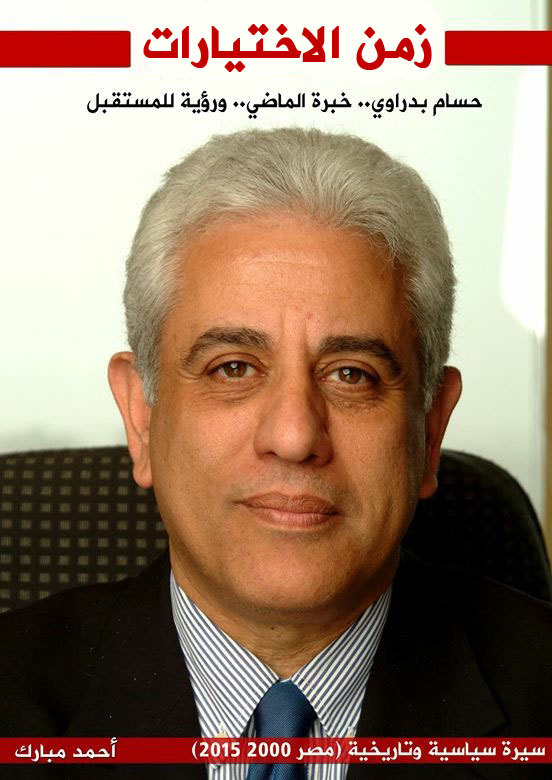
“The Age of Choices” is a new book by journalist and writer Ahmed Mubarak, documenting Dr. Hossam Badrawy’s political journey over the past two decades, covering all major political milestones—from the lead-up to the January Revolution, through the Muslim Brotherhood’s rule, to the June 30 Revolution.
What follows is the book’s introduction as written, the story of the book as narrated by journalist Ahmed Mubarak, in addition to the table of contents.
Book Introduction
By journalist Ahmed Mubarak
Dear reader,
Before you lies a book that documents a critical stage in the journey of a nation and the path of a man—a nation that, over the past twenty years, has witnessed momentous events that threatened its very existence as never before, and a man who never ceased to give, whose rich career left its mark in every field through which he chose to serve his country and humanity.
Fate decreed that his path would intersect with a decisive era in Egypt’s history, as a constant presence at major turning points over the past two decades—through what he advocated, warned against, or actively participated in.
He is Professor Dr. Hossam Badrawy—the distinguished physician, thinker, and reformist politician—one of the few in Egypt who truly possesses vision. What sets him apart is that his vision is neither rigid theory nor impractical idealism, but rather a vision drawn from lived experience and from scientific, humanitarian, and political engagement with Egyptian reality—in medicine, education, health, sports, politics, and their interconnected fields of action, research, and study.
This book may appear to be about a person—but in truth, it is about a nation.
It may seem to speak of the past—but in reality, it speaks of the future.
The book consists of four chapters, documenting Dr. Hossam Badrawy’s journey and recording his positions and views on decisive historical events and turning points over the past twenty years. These include the end of the Mubarak era, the January 25 Revolution, the June 30 Revolution, and Egypt’s entry into the era of the New Republic, as well as aspects of his vision for political reform, educational development, and social justice.
Chapter One: “The Mubarak Regime – Years of Experience and Lessons”
Drawing on the wisdom that “those who do not learn from history are doomed to repeat it,” this chapter examines the Mubarak era, which—though now in the past—continues to cast a powerful shadow over both present and future developments.
The chapter discusses key turning points and critical mistakes committed by the ruling authority, with Dr. Hossam Badrawy present as a unique model representing reformist opposition ideas from within the corridors of the ruling National Democratic Party.
Chapter Two: “January 25 – Revolution and Conspiracy”
This chapter addresses the new phase Egypt entered with the outbreak of the January 25 Revolution and the critical events that accompanied it—some of which rose to the level of conspiracy—along with the dangers that compromised the revolution’s purity.
During this time, Dr. Hossam Badrawy was part of the events and a direct witness to them, striving to convey the revolution’s demands to the highest levels of authority within a framework of legitimacy, while preventing the Egyptian state from collapsing into chaos.
The importance of studying Dr. Badrawy’s testimony in this chapter stems not only from his prominence as a political thinker, but from the fact that he occupied the highest political position in Egypt at the most critical moment, serving as Secretary-General of the National Democratic Party from February 5 to February 10, 2011—placing him at the heart of power during some of the most dangerous days of the revolution and making him an eyewitness to historical truths that remain partially concealed to this day.
Chapter Three: “The Muslim Brotherhood – Tyranny in the Name of Religion”
This chapter documents the Muslim Brotherhood’s rise to power, confirming Dr. Hossam Badrawy’s earlier warning during the January Revolution:
“Democracy without a disciplined system that ensures equal opportunities becomes a theatrical performance that manipulates people in favor of active dark forces—those with money, power, influence, or superior organization—allowing them to win elections at the expense of the most qualified. What if those forces cloak themselves in religion to mobilize support?”
This is precisely the model followed by the Muslim Brotherhood after the fall of the Mubarak regime. The chapter examines Dr. Badrawy’s assessment of their rule, their path to power, and the major mistakes they committed during their single year in office—ending in their downfall.
Chapter Four: “Aspects of Dr. Badrawy’s Vision: Social Justice, Reform, and Educational Development”
Through a collection of articles, this chapter moves from reading the past to anticipating the future. If political reform is the gateway to economic, social, and security reform, then crafting a future vision is the only way out of the vicious cycles and failed experiments imposed on the people—experiments that either drag society backward or keep it stagnant.
The Story of the Book
As told by journalist Ahmed Mubarak
The story began with the documentary film “Corridors of the Palace.” A few months after January 25, I was working on a documentary to record the 18 days from the start of the protests until President Mubarak’s resignation—the first film of its kind to dramatize Mubarak’s final days.
Among the names suggested for interviews was Dr. Hossam Badrawy, the last Secretary-General of the National Democratic Party (February 5–10, 2011).
I found his phone number in Al-Masry Al-Youm’s archives and called—expecting no answer. To my surprise, a calm voice responded.
That moment marked the beginning of a journey of discovery—of a man marked by simplicity, openness, and rare political credibility.
Our meeting revealed behind-the-scenes state management, his efforts to connect revolutionary youth with Mubarak, the release of Wael Ghonim, the conditions under which he accepted party leadership, and the reasons for his resignation.
What struck us most was his exceptional acceptance across opposing political camps—so much so that he sought to turn political “fantasy” into reality.
As I researched further, I found that many of his warnings had come true—on political reform, education, military intervention, and the danger of religious rule.
From this realization emerged the idea to document his journey in a book—not merely as a biography, but as a record of a decisive national phase, and a roadmap for the future, rooted in human development through knowledge, innovation, and creativity.
Table of Contents
Chapter One: The Mubarak Regime – Years of Experience and Lessons
-
Political succession (The Butterfly Theory)
-
The philosophy of political reform
-
The inevitability of change
-
Democracy alone is not enough
-
Bitter choices and reform from within
-
Power monopolization
-
Alliance of power and capital
-
Electoral manipulation (2005–2010)
-
Emergency law and human rights
-
Article 77 and presidential term limits
-
Exclusion of reformist voices
Chapter Two: January 25 – Revolution and Conspiracy
-
Revolution or conspiracy?
-
Respecting popular will
-
The role of security and government
-
Internet shutdown
-
Party leadership during collapse
-
Youth meetings
-
The resignation and transition phase
Chapter Three: The Muslim Brotherhood – Tyranny in the Name of Religion
-
Morsi’s decisions and early warnings
-
The invalid constitutional declaration
-
Brotherhood constitution
-
Undermining judicial independence
-
Failure of governance
-
Support for June 30
Chapter Four: Dr. Badrawy’s Vision – Social Justice, Reform, and Education
-
Social justice
-
Education: the chance for salvation
-
Funding education
-
Combating corruption in education
-
Suez Canal Development Project
-
Messages to the world
-
The Arab Spring: truth and illusion
-
Conclusion