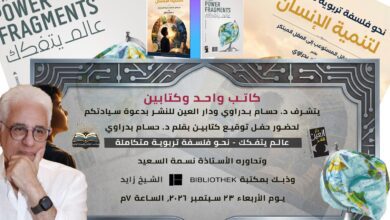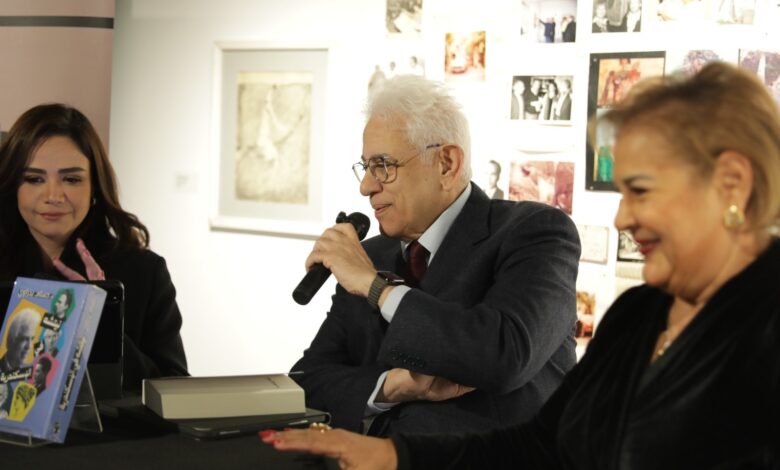
At the invitation of Dar Al-Ain Publishing, a dialogue seminar was held yesterday, Tuesday, January 20, 2026, at Bibliotheca Arkan – Sheikh Zayed, discussing the latest release by Dr. Hossam Badrawi, his book “Nietzsche in Alexandria.” The work is distinguished by its deep philosophical character and was published by Dar Al-Ain under the leadership of Dr. Fatma El-Boudi.
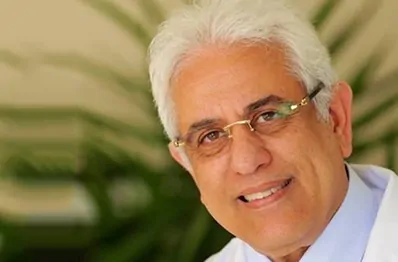
Dr. Fatma El-Boudi introduced Dr. Badrawi as one of the pioneers of modern thought, possessing unique and profound philosophical orientations that have had a tangible impact across diverse cultural and intellectual circles in Egypt. She expressed her great pleasure in publishing this intellectually rich work.
The seminar then began, masterfully moderated by the refined and cultured journalist Nesma El-Saeed, whose precise and insightful questions—drawn from various chapters of the book—prompted Dr. Badrawi to open broad intellectual horizons through his deep responses. His reflections captivated the audience, drawing their minds into a unique state of imagination and contemplation, and at times even provoking questioning and intellectual disorientation.
The discussion lasted for more than two hours, yet it passed as though it were only two minutes of intellectual pleasure and suspense. At the same time, it felt like years of accumulated experience and knowledge generously offered by Dr. Badrawi to the audience. This was achieved through his blending of the ideas of great philosophers across history with the reality we live in today—beginning with Socrates and Descartes, passing through Hypatia and Ibn Khaldun, and culminating with Nietzsche.
Dr. Badrawi also wove together elements of wonder and imagination, exploring how we perceive ourselves and how we view the universe around us through an imagined dialogue between two cells. He addressed the origins of values and how they have endured despite humanity’s moral decline across the ages. He then carried the audience into profound reflections on time and space, before concluding with music and its influence—explaining how the greatest melodies were created from a limited musical scale, and how modern science has led us to perceive the universe as infinite strings whose vibrations embody our lived reality.
Following this, Ms. Nesma El-Saeed opened the floor for discussion, prompting enthusiastic participation from the audience. Among the attendees was a distinguished group of figures from the worlds of science, art, and culture, including Dr. Osama Hamdy, Professor of Medicine at Harvard University and one of Egypt’s leading scientists; actor Hussein Fahmy; actresses Laila Eloui and Elham Shahin; artist Hussein Nouh; Dr. Ahmed El-Sharqawi; along with many other prominent cultural and social figures.
A wealth of rich philosophical questions and comments followed, reflecting diverse perspectives and cultural backgrounds within a refined and respectful dialogue. Dr. Badrawi expressed his happiness and appreciation for all contributions, responding thoughtfully to every question raised.
The seminar concluded amid a shared sense that it had been an exceptional experience—one that combined intellectual enjoyment with deep contemplation, enriching both the hearts and minds of those in attendance.