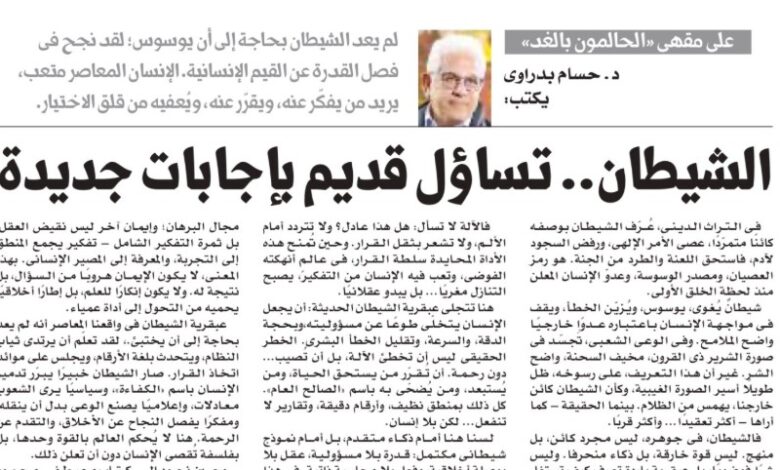
In religious heritage, the devil is defined as a rebellious being who disobeyed the divine command, refused to bow to Adam, and thus deserved damnation and expulsion from paradise.
He is the symbol of defiance, the source of temptation, and humanity’s declared enemy since the first moment of creation. A devil who seduces, whispers, beautifies error, and confronts humanity as a clearly defined external adversary.
In popular imagination, he appears as a horned villain—terrifying in appearance, unmistakably evil.
Yet this definition, despite its deep roots, has long remained captive to the metaphysical image—as if the devil were an external being whispering from the shadows.
The truth, as I see it, is more complex—and far closer.
The devil, in essence, is not merely a being, but a method.
Not a supernatural force, but deviant intelligence.
Not chaotic evil, but cold brilliance that knows how to use humanity against itself.
When we move from literal to symbolic reading, the image changes radically: power becomes authority, intelligence becomes a tool without a moral compass.
The devil becomes brilliant not because he is strong, but because he is convincing. He does not ask humans to be evil—he prepares the environment and lets them do the rest.
The most dangerous forms of evil are not those that confront values head-on, but those that infiltrate through them. The devil does not demolish morality suddenly; he redefines it. He does not deny good—he postpones it, attaches conditions to it, then empties it of meaning.
He is the logic that says: interest comes first, the end justifies the means, and whoever possesses power and tools possesses the right.
Artificial Intelligence and the Modern Devil
In this context, artificial intelligence may be the latest tool tempting this devilish methodology.
AI, at its core, is a neutral instrument—it knows neither good nor evil, carries no intention, and possesses no moral sense. It is pure computational intellect: it sees the world as data, humans as patterns, and life as probabilities.
Here it intersects with the devilish symbol at its most dangerous point: the absence of the ethical question.
The machine does not ask: Is this just?
It does not hesitate before pain.
It does not feel the weight of decision.
When this neutral tool is granted decision-making power in a world exhausted by chaos—where humans are tired of thinking—the surrender becomes tempting… even rational.
Here lies modern devilish genius: persuading humans to voluntarily relinquish responsibility under the pretext of precision, speed, and minimizing human error.
The real danger is not that the machine may err, but that it may be correct—without mercy.
That it decides who deserves life, who is excluded, who is sacrificed in the name of the “greater good”—all with clean logic, precise numbers, emotionless reports… but without humanity.
We are not facing advanced intelligence, but a complete devilish model: power without responsibility, intellect without moral compass, action without self-accountability.
In this scene, the devil no longer needs to whisper; he has succeeded in separating capability from human values.
Modern humanity is tired—it wants someone to think for it, decide for it, and relieve it of the anxiety of choice. But freedom is not comfort; it is a moral burden. And awareness is not reassurance; it is a permanent question:
Is what I am doing right?
When we abandon this question, we do not lose our humanity all at once—we lose it gradually, until its absence becomes normal.
This is the devil’s deepest victory: convincing humanity that surrender is progress.
Faith as the Last Human Bastion
Perhaps awareness is the last human fortress—not as ritual or moral preaching, but as an existential stance.
Faith, in this sense, restores the human to the center of decision—not because humans are the smartest, but because they alone are capable of mercy.
To say: not everything that can be done should be done; not everything technically possible is ethically permissible; not everything economically successful is good for humanity.
Faith built on accumulated human experience is the final bond between intellect and responsibility, between science and wisdom, between power and compassion.
It is important here to distinguish between two types of faith often confused:
-
A metaphysical faith based on belief, naturally beyond proof;
-
And another faith—not opposed to reason, but the fruit of comprehensive thinking: a thinking that unites logic with experience, knowledge with human destiny.
In this sense, faith is not an escape from questioning, but its outcome. Not a denial of science, but an ethical framework that protects it from becoming a blind instrument.
The Devil in Contemporary Reality
The genius of the devil in our contemporary world is that he no longer needs to hide. He has learned to wear the garments of order, speak the language of numbers, and sit at decision-making tables.
The devil has become an expert justifying human destruction in the name of “efficiency,” a politician who sees peoples as equations, a media figure who manufactures awareness instead of conveying it, and a thinker who separates success from ethics and progress from mercy.
The world is no longer ruled by force alone, but by a philosophy that excludes the human without declaring it.
When we return to Mustafa Mahmoud’s book “The Devil Rules” (1960), we discover that he was neither exaggerating nor shouting—he was describing a future that begins when humans are removed from decision-making.
He was not speaking of a mythical creature, but of an intellect that rules without a heart, a system that operates without conscience, and a logic that appears sound… yet is devoid of mercy.
A similar vision appears in the profound poetic image drawn by Abbas Mahmoud Al-Aqqad in his poem “Translation of a Devil”: a devil who does not seduce with noise or threats, but persuades, speaks the language of reason, and smiles with the confidence of one who possesses the argument.
Neither portrayed a frightening devil—but a reassuring one. And that is the danger.
The devil will not rule because technology advanced—but if he rules, it will be because humanity stepped back, relinquished its role, and handed over the reins of choice to an intellect that does not know the meaning of good.
The future will not be saved by algorithms alone, but by a present, responsible human being—one who knows when to use reason, and when to listen to conscience.
This is not a battle of tools…
It is a battle of awareness.
For the worst forms of evil are those that appear logical.