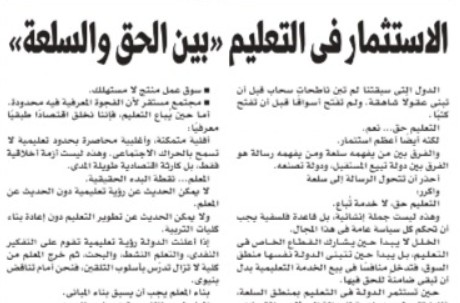
When we speak of “investment in education,” perspectives diverge and concepts become blurred. Some understand investment as a financial project seeking quick returns, while I—and many others—see it as investment in the human being, not the market; in awareness, not profits.
Education is not a commodity to be bought and sold; it is a fundamental right of every citizen, guaranteed by the state just as it guarantees healthcare, dignity, and justice. When a right becomes a product, imbalance begins—because quality is measured by the ability to pay, not the ability to understand.
Believing education is a right does not contradict investing in it. On the contrary, the greatest investment any state can make is in the minds of its people. The essential distinction is this:
Do we invest to gain money?
Or do we invest to build a human being?
Noble investment in education means:
-
Building modern schools worthy of children’s dignity
-
Preparing teachers who are respected materially and morally, trained in thinking rather than rote instruction
-
Developing curricula that foster critical thinking, not mechanical memorization
-
Linking education to the labor market without reducing it to the market
A state that spends on education does not “lose”—it plants seeds. The return does not appear in next year’s budget, but in societal stability decades later. Every pound spent on a child today saves many times its value tomorrow in security, health, employment, and extremism prevention.
When education becomes a purely profit-driven industry, we create a dangerous knowledge-based class divide: education for elites and education for necessity, widening the gap between those who possess knowledge and those deprived of it. This is not only an economic gap, but a gap in awareness, belonging, and participation in nation-building.
I do not oppose private-sector participation in education; I consider it necessary. But it must operate within a clear national philosophy:
Profit is acceptable—but not at the expense of justice.
Development is required—but not at the cost of excluding the poor.
Education is not a burden on the state—it is its most powerful tool for shaping the future.
If economic investment is measured by financial return, investment in education is measured by awareness, creativity, and the ability to differ without violence.
Countries that advanced did not build skyscrapers before building great minds. They did not open markets before opening books.
Education is a right—yes.
But it is also the greatest investment.
The difference between those who see it as a commodity and those who see it as a mission is the difference between a state that sells the future and one that creates it.
A Warning: Do Not Turn the Mission into a Commodity
I repeat: Education is a right, not a service for sale.
This is not a rhetorical slogan—it is a philosophical principle that must govern all public policy in this field.
The problem does not begin with private-sector participation in education; it begins when the state itself adopts market logic and becomes a competitor selling educational services instead of remaining the guarantor of the right.
When the state invests in education with a commodity mindset, it shifts from guardian of justice to economic player. Here lies the dangerous deviation: success becomes measured by enrollment numbers and revenue, rather than expanding awareness, narrowing knowledge gaps, and building creative, thinking citizens.
The state is not a company.
Its mission is not to generate educational profits, but to generate civilizational returns.
Education is a long-term investment whose returns are developmental, not immediate financial gains.
The True Economic Dimension of Investing in Education
The economic return of education does not appear in annual budgets, but in the structure of the entire economy:
-
Each additional year of education raises individual productivity
-
Early childhood investment reduces future healthcare, crime, and unemployment costs
-
Strong education systems attract quality investment—not fragile capital
Countries that achieved major economic leaps did not start with taxes or megaprojects—they started by reforming schools.
The greatest return on educational investment is:
-
A knowledge-based economy, not a rent-based one
-
A productive labor market, not a consumptive one
-
A stable society with limited knowledge gaps
Selling education creates a stratified knowledge economy: a capable minority and a constrained majority—an ethical failure and a long-term economic disaster.
The Teacher: The True Starting Point
No educational vision can succeed without addressing the teacher.
No reform is possible without rebuilding faculties of education.
If a state declares a vision based on critical thinking and active learning, yet graduates teachers trained in rote methods, we face a structural contradiction.
Building the teacher must precede building the buildings.
The teacher is not a content transmitter—but a consciousness shaper.
True investment in humanity begins with investing in those who shape human beings.
This requires:
-
Updating education college curricula to align with declared philosophy
-
Continuous, meaningful professional training
-
Improving teachers’ material and social conditions to make teaching a respected profession
-
Careful selection of teacher candidates based on competence and influence
Investing in teachers yields the highest educational return possible.
Final Word
Education is not a field for economic bidding wars.
The state must not abandon its role as guarantor of rights to become a market competitor.
Investing in education is not a profit project—it is a long-term national mission.
It is an investment in collective consciousness, national security, and the future of the economy.
A state that sells education may balance a budget.
But a state that builds education builds a nation.