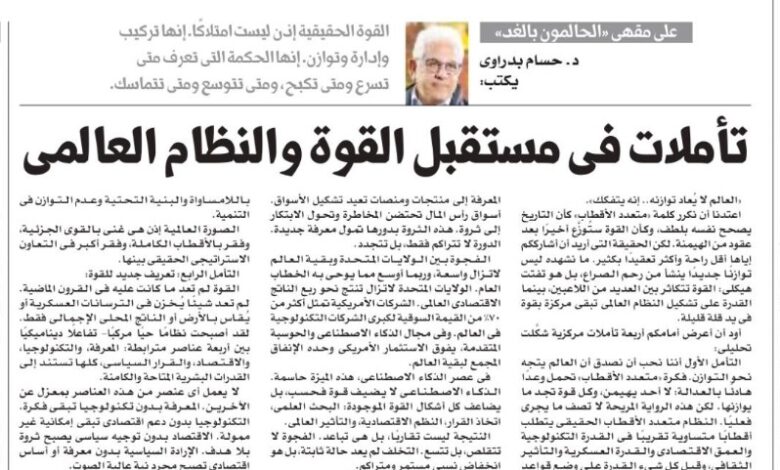
“The world is not rebalancing… it is fragmenting.”
We have grown accustomed to repeating the term “multipolar” as if history is gently correcting itself, as if power will finally be distributed after decades of dominance. But the truth I want to share is less comforting and far more complex. What we are witnessing is not a new balance emerging from conflict, but rather a structural fragmentation: power is spreading across many actors, while the ability to shape the global order remains strongly concentrated in the hands of a very few.
I would like to present four central reflections that have shaped my analysis:
First reflection: we like to believe that the world is moving toward balance. The idea of “multipolarity” carries a quiet promise of fairness: no one dominates, and every power has something to counterbalance it. But this comforting narrative does not describe what is actually happening. A true multipolar system requires powers that are roughly equal in technological capability, economic depth, military strength, cultural influence, and—above all—the ability to set and rewrite the rules of the international system.
Instead, we see dozens of influential states, but the number of true poles remains extremely limited—sometimes only one.
Power is spreading, but it is not equal. Conflicts are multiplying, yet no actor possesses the full legitimacy or capacity to resolve them or impose a lasting order.
We confuse surface movement—industrial expansion here, military assertion there, the rise of regional players—with structural change. We confuse appearance with capability, and presence with dominance.
This is a dangerous misunderstanding. States overestimate their own weight and underestimate others, building policies on inaccurate assumptions. Misperception turns into miscalculation, and miscalculation leads to poor decisions whose consequences may echo for decades.
Second reflection: Why does American dominance persist?
Not every form of hegemony is temporary. Some powers fade because their sources of strength are finite: exhausted land, depleted resources, defeated armies. The American model works differently. It is not built on a stockpile of power, but on a continuous, self-renewing system that constantly produces power.
Its universities redefine knowledge. Its companies transform that knowledge into products and platforms that reshape markets. Its capital markets absorb risk and turn innovation into wealth. That wealth, in turn, funds new knowledge. The cycle does not merely accumulate—it regenerates.
The gap between the United States and the rest of the world remains wide—perhaps wider than public discourse suggests. The United States still produces about a quarter of global economic output. American companies represent more than 70% of the market value of the world’s largest tech firms. In artificial intelligence and advanced computing, U.S. investment alone exceeds the combined spending of the rest of the world.
In the age of artificial intelligence, this advantage is decisive. AI does not merely add power—it multiplies all existing forms of power: scientific research, decision-making, economic systems, and global influence.
The result is not convergence, but divergence. The gap is not narrowing—it is widening. Lagging behind is no longer a fixed condition, but a continuous and cumulative relative decline.
What we are witnessing, then, is not a simple transition from one dominant power to several equal ones, but a different configuration of the global order, where power is unevenly distributed and competition unfolds across multiple domains.
Third reflection: incomplete global projects
China has achieved one of the greatest catch-up successes in modern history. In just a few decades, it moved from the margins to becoming the world’s second-largest economy, a global manufacturing hub with vast export networks, massive infrastructure, and an unparalleled domestic market. But global leadership requires more than scale. It demands the ability to generate ideas, not merely absorb and refine them; to set rules, not just operate within them.
China is approaching the summit—but approaching is not arriving.
Russia is a military power without economic or technological depth—capable of disrupting international crises, but not of leading the global system.
Europe possesses enormous economic and regulatory influence, but is constrained by fragmented strategic decision-making and the absence of unified political will.
India carries great promise, supported by sustained growth, yet still faces deep internal constraints related to inequality, infrastructure, and uneven development.
The global picture, then, is rich in partial powers, poor in complete poles, and even poorer in genuine strategic cooperation among them.
Fourth reflection: a new definition of power
Power is no longer what it was in previous centuries. It is no longer something stored in military arsenals or measured solely by territory or GDP. It has become a complex, living system—a dynamic interaction among four interconnected elements: knowledge, technology, the economy, and political decision-making, all grounded in available and latent human capabilities.
None of these elements functions in isolation. Knowledge without technology remains an idea. Technology without economic support remains an unfunded possibility. An economy without political direction becomes wealth without purpose. Political will without knowledge or economic foundation becomes little more than loud intent.
This leads us to a crucial distinction: between productive power and consumptive power.
Productive power creates its own tools, develops alternatives, builds relative independence, and generates the conditions for its own continuity. Consumptive power depends on what others produce. It may appear formidable for a time—especially if supported by wealth, geography, or external backing—but it remains fragile because its continuity lies beyond its control.
True power, then, is not possession. It is composition, management, and balance. It is the wisdom to know when to accelerate and when to restrain, when to expand and when to consolidate. The strongest actors are not necessarily those who possess the most, but those who can preserve what they have, expand it, and prevent it from becoming a source of strain, arrogance, or strategic blindness.
Beneath all these structural reflections lies the unavoidable question that returns in every era: how do we understand power, and how do we use it?
Power is neither inherently good nor inherently evil. It is a tool that reveals more than it grants, and exposes more than it conceals. History teaches us that nations do not fall only when they weaken, but also when they misunderstand their strength—when they confuse expansion with permanence, power with wisdom, and prestige with anxiety about the future.