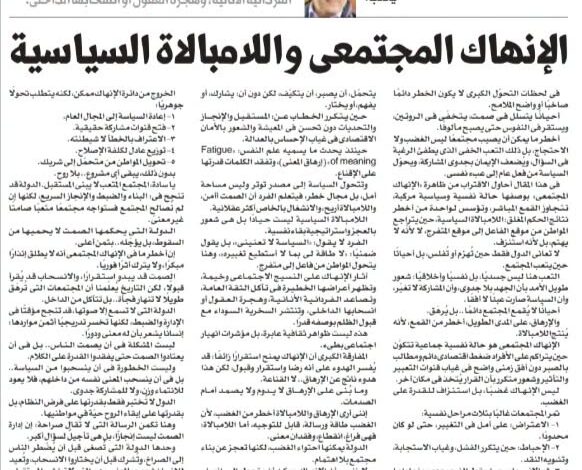
In moments of major transformation, danger is not always loud or clearly visible. Sometimes it slips in quietly, disguises itself within routine, and settles into people’s lives until it becomes familiar.
The most dangerous thing that can happen to a society is not anger or protest, but that hidden exhaustion that extinguishes the desire to ask questions, weakens belief in the value of participation, and turns politics from a public act into a psychological burden.
In this article, I attempt to approach the phenomenon of “social exhaustion” as a complex psychological and political condition that extends beyond direct repression and lays the groundwork for one of the most dangerous outcomes of closed systems of governance: political apathy, where citizens retreat from being active participants to becoming mere spectators—not because they do not care, but because they have been drained.
States do not suffer only when they are defeated or go bankrupt; sometimes they suffer when society itself becomes exhausted.
The exhaustion here is not physical but psychological and moral: a prolonged feeling that effort is pointless, that participation changes nothing, and that politics has become a burden rather than a horizon of possibility.
Sometimes societies are not merely oppressed—they are worn down.
And exhaustion, in the long run, is more dangerous than repression because it produces apathy.
Social exhaustion is a collective psychological state formed when individuals are subjected to accumulated economic pressure, repeated demands for patience without a clear timeline, an absence of channels for expression and influence, and a recurring feeling that decisions are being made elsewhere.
Exhaustion is not anger; it is the depletion of the ability to feel anger.
Societies often pass through three psychological stages:
- Objection — with hope for change, even if limited.
- Frustration — when failure repeats itself, responses are absent, and criticism is discredited.
- Withdrawal — when individuals say:
“Let them do whatever they want… nothing will change.”
This last stage is the most dangerous because it does not immediately alarm authority, yet it empties society of political hope.
States do not necessarily create this exhaustion through direct repression, but through quieter mechanisms: when citizens are repeatedly asked to endure, to be patient, and to adapt, yet are not allowed to participate, understand, or choose.
When rhetoric about the future, achievements, and challenges continues without improvements in living standards, economic security, or a sense of justice, what psychology calls “fatigue of meaning” emerges.
Words lose their power to persuade.
Politics becomes a source of anxiety rather than a space of hope—a field of danger rather than possibility.
People gradually learn that silence is safer, apathy is easier, and focusing on private life is more rational.
Political apathy is not neutrality; it is a feeling of helplessness and a psychological survival strategy.
People do not truly say, “Politics does not concern me.” Rather, they implicitly say:
“I no longer have the energy for what I cannot change.”
At that point, the citizen transforms from an active participant into a spectator.
The effects of exhaustion on the social fabric are severe, manifesting in dangerous symptoms:
- Erosion of public trust
- Rising selfish individualism
- Brain drain or internal withdrawal
- The spread of dark humor
- Acceptance of injustice as fate
These are not temporary cultural phenomena but signs of slow social deterioration.
The great paradox is that exhaustion can create a false sense of stability.
Authorities may interpret silence as satisfaction, stability, and acceptance, when in reality it is merely exhaustion—not conviction.
And what is built on exhaustion neither lasts nor withstands shocks.
I believe exhaustion and apathy are more dangerous than anger because anger is energy and a message—it can be directed and transformed.
Apathy, by contrast, is emptiness, disconnection, and loss of meaning.
A state can contain anger, but it cannot build a society without interest or engagement.
Exhaustion can eventually become collapse—not necessarily through political revolution, but through moral breakdown, social fragmentation, or a silent wave of migration.
And when the explosion finally occurs, it is often unexpected, disorganized, and difficult to contain.
Escaping the cycle of exhaustion is possible, but it requires fundamental transformation:
- Returning politics to the public sphere
- Opening genuine channels for participation
- Acknowledging mistakes instead of demonizing criticism
- Fairly distributing the costs of reform
- Transforming citizens from passive bearers of burdens into partners
Without this, any project remains without spirit.
A tired society cannot build the future.
A state may succeed in construction, control, and rapid achievement, but if it fails to reconcile with society, it will ultimately face a silent, exhausted, and disengaged population.
A state governed by silence is not protected from collapse; it merely postpones it—at a greater cost.
The future is not built only with concrete, bridges, and roads—important as they are—but with people’s ability to dream and participate.
The most dangerous aspect of social exhaustion is that it gives no early warning signs and leaves no immediate traces to alarm decision-makers.
Silence may appear as stability, and withdrawal may be mistaken for acceptance.
But history teaches us that societies exhausted for too long do not suddenly collapse—they slowly erode from within.
A state that hears only its own voice may temporarily succeed in management and control, but it gradually loses its most valuable resource: a human being who feels they have meaning and purpose.
The problem is not that people become silent, but that they become accustomed to silence until they lose the ability to speak.
The danger is not that they withdraw from politics, but that meaning itself withdraws from within them, until belonging loses its weight and participation its purpose.
States are not tested solely by their ability to impose order, but by their ability to keep the human spirit alive among their citizens.
A society exhausted for too long does not collapse when it revolts—it collapses when it no longer has the strength to revolt.
And here lies the unspoken message:
Managing silence is not an achievement; it is merely postponing a larger question.
Stability built on exhausting people resembles a structure that appears solid on the outside while remaining hollow within.
A state that relies only on people’s patience risks discovering—too late—that patience has run out, not in the streets, but within souls.
Only a state that listens before people are forced to shout, that includes people before they choose withdrawal, and that restores their sense of meaning, need not fear the future.
No future can be built upon the exhaustion of people, and no project survives if it lacks participation and justice.
Only a state that restores citizens’ trust, returns meaning to politics, and revives society’s moral energy can endure.
As for the state of silence, it may postpone collapse—but it cannot prevent it.
A state of projects does not endure; a state of citizens builds life.