By a simple calculation and based on statistical sources, the number of children under the age of 15 in 2011 was around 29 million people. Egypt also witnessed 34 million new births between 2011 and 2026.
This means we are now facing a generation of more than 60 million children and young people who know nothing about the questions that were asked in 2011—and then again in 2013.
They did not witness either revolution and will only know them as history eventually records them: words on paper, archival photographs, and numbers representing millions who took to the streets, although many of those now reading were not among them.
But I, having lived through both moments in all their emotions and details, am not writing today to recount what happened—the story itself has been documented extensively, whether truthfully or as seen through different lenses. Rather, I want to speak to you about something deeper: the difference between living through an event and inheriting it.
When I lived through those years, memory alone was not enough for me, so I wrote down every moment as it happened, because I knew memory is naturally deceptive: it reshapes itself over time and sometimes reconciles with what it once rebelled against.
My philosophy has always been: what is not documented does not exist.
Among the things I wrote at the time, one sentence remained untouched by hindsight:
“Authority that does not respect its opponents eventually loses everything.”
I wrote that in June 2013, not knowing whether events would end in hope or in tragedy.
At an earlier point, years after January 2011, I sat with young people who had lived through those events physically and emotionally. I heard one of them say words I never forgot:
“I now live with greater restraints and less freedom… as if we carried out a revolution only to hand it over to political Islam, and then return to where we started.”
As some people who are now in their thirties and forties say:
“It’s as if we lived through two revolutions and now find ourselves nostalgically remembering what we had revolted against before 2011.”
This is the difference between written text and memory: text does not lie, but neither can it give readers the tremor of the public squares, the fear accompanying every decision, or those hours when we stood before the unknown—twice.
There is a paradox here: for those who lived through neither moment, both of them will ultimately become whatever those who experienced them chose to write about them. That places upon those who write history a responsibility no less important than the responsibility of those who made it: to remain truthful even in their contradictions—not to create polished heroism where none existed, nor absolute tragedy where reality was more complex.
And because honesty requires it, I say to whoever reads this: neither January nor June was a battle between two opposing camps, as many now portray them in retrospect. Rather, they were—twice in succession—an examination centered on a single question:
Does a people have the right to say “No” to authority—regardless of the source of its legitimacy, whether that legitimacy comes from ballot boxes or from crowded public squares—
if that authority decides to monopolize truth, silence dissent, and place itself above accountability?
This question does not end with history itself, nor does it belong to a particular party or ideology. It repeats itself with different directors, different scripts, and different actors, in every time and place where those who govern begin to believe they are greater than their own people.
There is also a deeper lesson I learned from both moments together, one that perhaps explains why the same question returns repeatedly:
A revolution, in its academic definition, is an unlawful act against an existing system. If it succeeds, the system becomes criminal and accused; if it fails, the revolutionaries become criminals and lawbreakers.
Heroes and criminals exchange places because history is written only by the victors.
This means that removing a person, a regime, or a group is not a true victory unless it is accompanied by the removal of the vacuum that allows any newcomer to occupy the same position and inherit the same illness: a judiciary that is not fully independent, political parties that do not genuinely organize public opinion but merely fill empty spaces, oversight institutions that fail to hold decision-makers accountable, and the absence—or justification for the absence—of the peaceful transfer of power under the excuse that no alternative exists.
This—not merely changing faces—is what I call the true spring that Egypt still awaits.
And I confess to you something I confess to no one else: I feel that the distance between me and the efforts for reform that I pursued before January, and later during the confrontation with the Muslim Brotherhood’s rule in June, has narrowed for a third time—not because my convictions have weakened, but because the director changed, the actors changed, while the script remained the same:
Whoever possesses power begins to believe they stand above accountability.
And that is exactly what I once warned myself against when I wrote that human beings adapt and become accustomed until they eventually accept what they were once passionate about rejecting.
The true test is not whether I stand with or against a particular side, but whether I can maintain the same distance from truth regardless of who happens to sit in the chair of power.
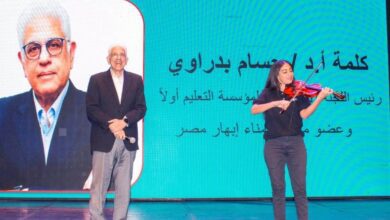
I told another generation, younger in age, during a graduation speech this year before high school students preparing to enter university:
“The real examination is not graded at the moment it is taken; its results emerge years later through countless small accumulated choices.”
And I say to today’s youth: neither January nor June was an examination ending in the success or failure of one generation. It is an examination redistributed to every new generation, with questions that change in form but remain the same in essence.
So do not ask me, “Who was right—the revolutionaries or those who came afterward?”
Instead ask yourselves:
“What truths today require us to speak openly before time passes, as it passed for those before us—twice?”
If I could offer today’s youth only one piece of advice, it would be this:
Political vacuums never remain empty. If the youth and experts of a nation do not fill them through awareness, genuine political organization, and meaningful participation, someone else will fill them in their name.
Do not wait thirteen or fifteen years before writing and recording what you believe today, and before demanding—rightfully so—change within a framework of law and construction rather than destruction.
Begin today, with honesty that does not calculate who may read it later.
For memory that is not written is stolen, and a homeland that is never questioned is eventually lost.
And when another generation reads what you wrote, they will not merely understand the greatness of what you lived through; they will understand, above all else, the sincerity with which you wrote it.