There is one phrase that can instantly silence even the most well-reasoned speaker in an Arab discussion: “You’re just theorizing.” No evidence is needed to refute the argument, nor is a counterargument required. The phrase alone is often enough to dismiss an idea—no matter how coherent—as nothing more than intellectual indulgence with no practical value. How, then, did theorizing become an accusation? And how did the word drift so far from its original meaning that it now resembles an insult more than a description?
In its linguistic roots, the word is entirely innocent of the stigma attached to it. The Arabic root nazar means contemplation and careful reflection, while a theory is not a fantasy detached from reality but an attempt to understand it: a conceptual framework through which scattered facts become comprehensible, interpretable, and even predictable. There is no public policy without an underlying theory, whether acknowledged or not. When a state chooses to invest in education before roads, or in healthcare before military expansion, it is engaging in theorizing because it is embracing a particular vision of national priorities and human development. The problem, therefore, is not theorizing itself, but a particular form of it that, through a long and painful historical experience, has acquired deeply negative connotations.
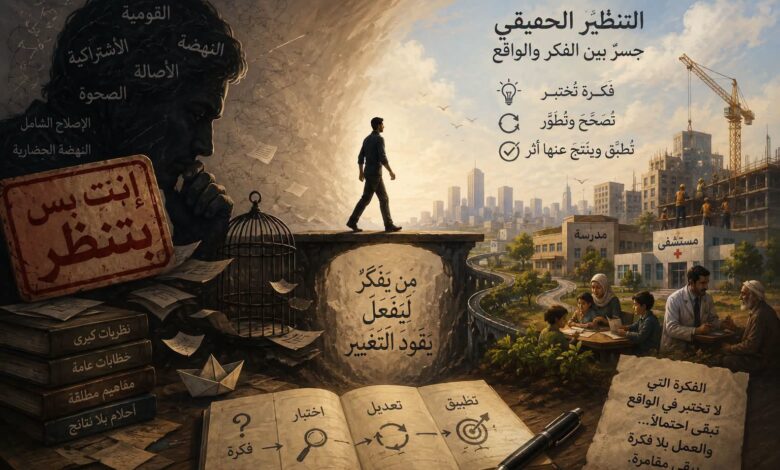
Since the middle of the twentieth century, the Arab world has witnessed waves of “theorists” who saturated political discourse with grand concepts—Arab nationalism, socialism, authenticity, Islamic revival—without translating those concepts into functioning institutions, quality schools, or productive economies. In this context, the intellectual came to be seen as someone who could eloquently diagnose society’s illnesses but possessed neither the ability nor the desire to produce practical remedies. Thus an unfair equation took hold: the more abstract an idea became, the less accountable its author was for its results. Theorizing became a safe refuge for those who wished to appear profound without ever having to answer the simple question: What, exactly, have you done?
Here lies what I believe is the key distinction. There is a form of theorizing that continuously subjects itself to the test of reality, revising its assumptions whenever facts prove them wrong. And there is another form that hides behind abstraction precisely to avoid that test.
The first is exemplified by those who have developed serious visions for educational or healthcare reform. They began with ideas, tested them in practice, learned from experience, and refined them accordingly. The second is represented by those who endlessly speak of “comprehensive reform” or “civilizational renaissance” in the abstract, while treating any question about implementation, financing, or timelines as an insult to the nobility of their vision. The former uses theory as a tool for public action; the latter uses theoretical language as an escape from public responsibility.
Perhaps this is precisely the distinction that Ibn Khaldun sought to make when he differentiated between reports accepted at face value and reports tested against the realities governing the rise and development of civilizations. His insight was that knowledge not measured against the logic of reality and its transformations remains vulnerable to error, however internally consistent it may appear. The same lesson presents itself today whenever we encounter political rhetoric that promises everything because it never intends to be tested against anything.
If theorizing deserves criticism, then let that criticism be directed not at its presence in thought but at its absence from action. The greatest danger to public life is not the person who thinks carefully before acting, but the one who acts without a guiding idea—or worse, acts on shallow ideas and confidently repeats the same mistakes.
Equally dangerous is denying citizens or public officials the right to think aloud on the grounds that “this is a time for action, not talk,” as though action without prior thought were somehow a virtue. In reality, it is often little more than a gamble.
This leaves us with one final question:
When we dismiss “theorists,” are we truly rejecting empty abstraction, or are we, perhaps without realizing it, avoiding ideas that make us uncomfortable simply because we have no answer to them beyond saying, “That’s just theory”?
An honest answer to that question may well be the first step toward a more serious public life and a political discourse that is less afraid of ideas themselves.