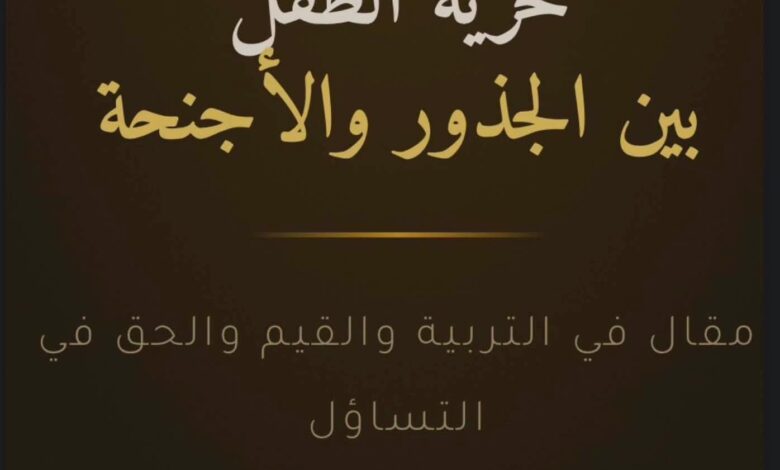
A Child’s Freedom: Between Roots and Wings
An Essay on Parenting, Values, and the Right to Question
By Hossam Badrawi
A child is not a vessel to be filled with whatever we choose, but a seed with its own unique nature, needing fertile soil rather than a mold.
1. What Does Freedom Mean When We Speak of a Child?
When we speak of a child’s freedom, we do not mean setting them loose without limits in an unknown world, nor do we mean subjecting them entirely to the will of those older than they are. We mean something subtler—and more demanding: that the child has a genuine presence in their own life; that their voice is heard, their questions are respected, and they grow up understanding why they are asked to do something, not merely how.
The freedom a child needs is not the freedom of an adult whose intellectual and emotional capacities are fully developed. It is a freedom that evolves with each stage of development: the freedom to explore in early childhood, the freedom to express opinions during the school years, and the gradual freedom to make decisions throughout adolescence. Every stage deserves its own space, and every space deserves its own boundaries.
Healthy boundaries do not imprison a child—they provide the solid ground from which they can leap.
2. Obedience or Commitment?
Our culture often confuses two fundamentally different concepts: obedience and commitment.
Obedience is behavior driven by fear or submission to external authority. Commitment, by contrast, arises from understanding and inner conviction. It remains even when no one is watching.
Blind obedience disappears when the supervisor is gone. A child complies to avoid punishment, not because they believe in the value behind the rule. As parental authority gradually fades with age, so too does their sense of direction.
Thoughtful parenting does not seek a “well-behaved” child in the sense of unquestioning obedience. It seeks an aware child. The difference is profound. When an aware child follows a rule, it is because they have understood—or at least recognized—its purpose. Over time, that understanding becomes character.
3. Curiosity: The Gift We Fear
Few things unsettle parents more than a child who asks difficult questions:
“Why do we pray?”
“Is God really there?”
“Why is our religion the right one?”
Too often these questions are met with irritation or intimidation, when in reality they are signs of healthy intellectual and emotional development.
A child who asks questions is a child who thinks. Such a child is more likely to develop authentic faith than one who simply memorizes answers to questions they never asked.
Curiosity is not a threat to values—it is often the safest path toward them.
Many believe that encouraging curiosity undermines the values we wish to instill. In truth, the opposite is the case. Values that cannot withstand the questions of a seven-year-old deserve to be reexamined. Genuine values, however, become stronger through inquiry, because a child raised in a healthy environment will eventually discover why those values make sense.
4. Do Parents Have the Right to Raise Their Children in Their Religion?
This question often forces people to confront their deepest assumptions. An honest answer requires distinguishing between two closely connected levels.
The first is upbringing.
Every child is inevitably raised within some cultural and spiritual framework. No one is born into a vacuum. A family that does not pass on its religion will inevitably pass on something else—whether materialism, atheism, or simple indifference. Every form of parenting conveys a worldview. In this sense, transmitting one’s religion is not an act of “imposition”; it is an unavoidable part of human upbringing.
The second is method.
The real distinction lies not in what we teach, but how we teach it.
Religion presented through fear and punishment produces superficial compliance. Religion presented through meaning, beauty, and dialogue fosters genuine belonging.
Faith that has never been tested by questions is a faith that has not yet fully matured.
5. A Lesson from History: Gradual Revelation as a Model for Parenting
There is a profound educational insight hidden in religious history—one we rarely consider when raising children.
The Islamic message, for example, was not revealed all at once with its complete set of rituals and laws. It unfolded in two distinct stages: first in Mecca, then in Medina.
For thirteen years in Mecca, the message focused on shaping the human being from within: belief in one God, human dignity, compassion, accountability, and the meaning of existence. Detailed rituals and legal obligations were not yet central. The primary goal was to cultivate the heart and establish spiritual awareness.
Only after those roots had grown deep did the Medinan period introduce detailed obligations, communal organization, and religious practice. Those teachings found fertile ground because the foundation had already been laid.
Revelation itself did not begin with ritual—it began with meaning.
Why, then, do we begin where it ended?
This sequence was not merely practical; it reflected a deep understanding of human nature. People rarely embrace outward discipline unless they first believe in the inner purpose behind it.
Prayer, for someone who understands its meaning and longs for it, is not a burden but a spiritual refuge. Prayer imposed before a child understands its purpose, however, often breeds silent resistance that surfaces later in life.
Stage One: Spiritual Roots
Teach the great values—compassion, honesty, gratitude, dignity.
Avoid fear-based methods or transactional rewards. Instead, let the child witness these values embodied in the people around them and woven into everyday life.
Stage Two: Cultural Belonging
Nurture love for heritage, traditions, stories, celebrations, and identity.
Children develop a sense of belonging before they fully understand it, just as people often love their homeland before studying its history. Emotional belonging provides the fertile ground from which intellectual conviction later grows.
Stage Three: Chosen Practice
As children mature and begin asking “Why?”, they deserve answers that speak to both reason and heart. When they understand, religious practice becomes a conscious act rather than a mechanical habit.
Such commitment is far deeper and more enduring than anything built on coercion or fear.
This approach does not diminish religion; it takes it more seriously. It recognizes that religion is too profound to be reduced to a child mechanically performing rituals without grasping their spirit.
Gradual development is not a compromise with faith. It reflects the belief that when God chose to teach humanity, He began with the heart—not with a checklist.
6. Why Not Let Children Choose When They Grow Up?
At first glance, this seems like a reasonable question. Yet it rests on a hidden assumption: that a child can remain untouched by influence until adulthood and then make a completely neutral choice.
That is impossible.
The human mind never begins from zero. Every child is inevitably shaped by what they see, hear, and experience.
The real question is not whether we shape them, but whether we do so consciously or carelessly.
Neglect is itself a form of shaping—and often the more powerful one.
That said, there is one genuine right that deserves full recognition: every adult has the right to revisit what they were taught and reshape their own convictions.
Parents who truly trust the values they have passed on need not fear such reflection. On the contrary, they should encourage it at the appropriate time, confident that beliefs built on solid foundations will not collapse at the first difficult question.
7. How Do We Give Children Both Roots and Wings?
Perhaps the most beautiful image of parenting is that of a tree.
Its roots run deep, while its branches stretch freely toward every horizon.
The roots are our core values: dignity, compassion, integrity, and spiritual belonging.
The branches are curiosity, questioning, exploration, and the courage to think differently.
The roots do not prevent the branches from reaching outward—they make that growth safer.
A child who knows where they come from is more willing to travel far, because they also know how to return.
In practice, this means answering children’s questions honestly, even when those questions make us uncomfortable. It means admitting, at times, that we do not have every answer. It means teaching values through lived example rather than memorized lists.
Above all, it means becoming living models of the principles we hope to pass on, rather than mere transmitters of inherited beliefs we ourselves have never examined.
There is no contradiction between nurturing values and encouraging curiosity.
The contradiction exists only when we confuse the value itself with the method by which we present it.
A child who is given room to question—within an environment of love, respect, and thoughtful guidance—is the one most likely to embrace authentic values and carry them forward to future generations.
The goal is not a child who merely repeats our words.
The goal is a human being who truly believes them.