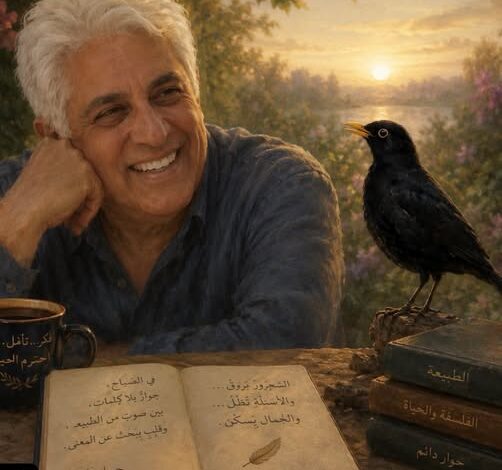
In the early morning, before the world around me awakens, I hear its voice. I do not see it, but I hear it among the leaves of the trees in my garden, singing with a rich, melodious tune, as though it were speaking to me. I whistle back, and it replies. For a few moments, I almost believe we are having a conversation—until I remind myself that it is a bird, and I am a human being, projecting onto the world around me my own longing to understand and to be understood.
I searched for this hidden singer and discovered that it was the Common Blackbird—known in Arabic as Al-Shahrour or Merla. About the size of a dove, it is covered in jet-black plumage, with a beak that ranges from bright orange to deep red. Scientific sources describe it as one of the finest songbirds of the garden. The male begins singing in late winter to establish his territory, and his song grows richer throughout the spring, becoming increasingly varied in melody. Remarkably, he can even imitate sounds he has never heard from members of his own species.
Here begins the question worth asking: Is this song truly “language,” or merely instinct?
Science tells us that the blackbird sings for two principal reasons: to attract a mate and to warn rival males away from its territory. A more complex and varied song signals strength and superior genetic quality, making the male more attractive to females. From a strictly biological perspective, that is all there is to it.
Its song, then, becomes a language of survival and reproduction—nothing more.
Yet, despite its scientific precision, this explanation does not answer the deeper question that has occupied philosophers for decades: Is there “something it is like” to be a bird? Does the bird possess an inner experience, an awareness of what it is doing? Or is it simply a living machine, executing an exquisitely programmed biological script without feeling anything at all?
When the bird sings with no female to hear it and no rival to challenge it, is it doing what an artist does when painting alone—not for applause or admiration, but simply because beauty itself longs to be expressed?
Science tends toward an instinctive explanation: the lingering operation of a biological program, functioning even when no immediate purpose exists.
Philosophy, however, leaves the door slightly open to another possibility—that consciousness may exist in degrees rather than as a sharp boundary between beings that feel and those that do not. Perhaps the bird stands somewhere along that continuum, closer to inner experience than we imagine when we dismiss its song as mere instinct.
As I found myself smiling while conversing with the blackbird, another question crossed my mind:
Do birds smile? Or is smiling an exclusively human trait?
For humans, a smile is not merely the contraction of facial muscles. It is the outward expression of an inner meaning: contentment, affection, irony, embarrassment, or even sorrow disguised behind a cheerful face.
It is the language of emotion when words are no longer enough. Its significance lies not in its physical form but in the intention it conceals.
Birds, as far as we know anatomically, lack the facial muscles needed to produce such an expression. They do not “smile” in the literal sense.
Yet they express themselves in their own ways: through ruffled feathers, a tilted head, and above all, through songs that change with their emotional state.
Perhaps the better question is not, “Do birds smile?” but rather, “Must a creature smile in order to be happy?”
Only human beings complicate the matter, for we alone ask ourselves, Am I happy? We feel compelled to display that happiness upon our faces—and often to prove it to others.
The bird, perhaps, simply inhabits its beautiful moment without questioning it or needing to demonstrate it to anyone—not to itself, and certainly not to others.
Here lies a paradox worthy of long reflection.
The very self-awareness we regard as the crown of our humanity may also be what deprives us of the innocence that a simpler creature still possesses.
Once consciousness awakens, it is no longer satisfied merely to be. It wants to know that it exists. It evaluates its own feelings and seeks confirmation through the eyes of others.
Perhaps this is where human beings truly diverge from the rest of creation: when raw experience transforms into a question about experience itself.
The bird sings, and the song is its own purpose.
The human being sings—and then asks:
Why am I singing?
Is my song beautiful?
Is anyone listening?
It is within these questions, rather than within the sound itself, that what we call meaning is born.
Perhaps this is the essence of the greater story of consciousness.
The universe began in silence. Then came beings capable of hearing. And finally, among those listeners emerged a creature capable of asking what it hears.
The blackbird represents that extraordinary intermediate stage: a creature with a voice, perhaps even with a dim awareness of its own actions, yet without that final turn of consciousness that allows it to step outside itself and contemplate its own experience.
We, on the other hand, have been granted that final turn—with all its burden and all its blessing.
We are capable of experiencing beauty while simultaneously reflecting upon it.
Yet we are also incapable of ceasing to ask questions, even during our purest and most instinctive moments.
Every morning, as I listen to my blackbird, I realize that what captivates me is not merely the beauty of its song, but the mystery surrounding it.
I cannot know whether it is speaking to me—or whether I am simply projecting onto it my own longing to be addressed.
Perhaps that very mystery is one of beauty’s deepest secrets: that some parts of nature remain forever beyond complete explanation, leaving room for wonder and allowing the soul to rise in silent contemplation.
Glory be to the One who created—and created with such perfection.