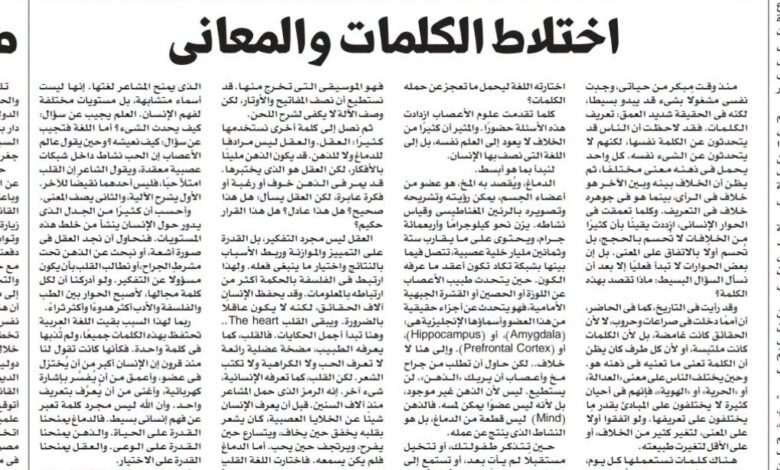
The Brain, the Mind, the Intellect, and the Heart
From an early stage in my life, I found myself preoccupied with something that may seem simple, yet is profoundly deep: the definition of words.
I noticed that people often use the same word while referring to entirely different ideas. Each person carries a different meaning in their mind, then assumes that the disagreement is one of opinion, when in reality it is first a disagreement over definitions.
The more deeply I have engaged in human dialogue, the more convinced I have become that many disagreements are not resolved by arguments alone; they are resolved first by agreeing on what words mean.
Indeed, I believe that some conversations do not truly begin until we ask a simple question:
“What do you mean by this word?”
History, as well as the present, has shown me that nations have entered conflicts—even wars—not because the facts were unclear, but because the words themselves were ambiguous, or because each side assumed that a word meant what it meant in their own mind rather than in the other’s.
When people disagree over concepts such as justice, freedom, or identity, they are often not disagreeing over principles as much as they are disagreeing over definitions.
Had they first agreed on the meaning, much of the conflict might have disappeared—or at least changed in nature.
This is where my journey with words begins.
There are words we use every day until we assume we understand them perfectly.
We say, “Use your brain.”
We say, “My mind is occupied.”
We say, “My heart is telling me…”
Then the physician reminds us that all of these processes take place inside the brain.
And that is where the real question begins.
Is the brain the same as the mind?
Is the mind the same as the intellect?
And is the heart merely a pump for blood, or is it something language has chosen to represent what words alone cannot fully express?
As neuroscience advances, these questions become increasingly relevant. Interestingly, much of the disagreement arises not from science itself, but from the language we use to describe the human being.
Let us begin with what is simplest.
The brain is a physical organ of the body.
It can be seen, dissected, examined through MRI scans, and its activity measured with modern instruments. It weighs about 1.4 kilograms and contains roughly eighty-six billion neurons interconnected through a network that may well be the most complex structure known in the universe.
When neurologists speak of the amygdala, the hippocampus, or the prefrontal cortex, they are referring to real anatomical structures within this organ.
Up to this point, there is little room for disagreement.
But ask a neurosurgeon to show you the mind.
They cannot.
Not because the mind does not exist, but because it is not an organ that can be touched.
The mind is not a part of the brain; it is the activity that emerges from the brain’s functioning.
When you remember your childhood, imagine a future that has not yet arrived, or listen to a piece of music that transports you to a place known only to you, you are not observing the brain at work—you are experiencing what scientists call the mind.
It is the inner subjective experience that cannot itself be photographed, even if the accompanying neural activity can.
The brain, then, is like a piano.
The mind is the music that comes from it.
We may describe every key, every string, and every hammer mechanism, yet describing the instrument alone will never fully explain the melody.
Then we arrive at another familiar word: intellect.
The intellect is neither synonymous with the brain nor with the mind.
The mind may be filled with thoughts, but the intellect is what examines them.
Fear, desire, or a passing idea may arise within the mind, yet the intellect asks:
Is this true?
Is this just?
Is this the wise course of action?
The intellect is not merely the ability to think; it is the capacity to discern, to weigh alternatives, to connect causes with consequences, and to choose what ought to be done.
For this reason, philosophy has always associated intellect more closely with wisdom than with information.
A person may possess vast amounts of knowledge without necessarily being wise.
And then there is the heart.
Here begins one of humanity’s most beautiful stories.
The heart, as understood by medicine, is an extraordinary muscular pump. It neither loves nor hates, nor does it write poetry.
But the heart, as understood by humanity, is something else entirely.
For thousands of years, it has been the symbol through which human beings express emotion.
Long before people understood neurons or brain circuitry, they felt their hearts pound in fear, race with excitement, and tremble in love.
The brain remained silent and imperceptible.
So language chose the heart to become the mirror of emotion.
This was not a scientific mistake so much as a faithful description of human experience.
At this point we realize that these four concepts do not compete with one another; they complete one another.
The brain is the structure.
The mind is the experience.
The intellect is the faculty of judgment.
The heart is the symbol that gives emotion its language.
They are not interchangeable names but distinct levels through which we understand the human person.
Science answers the question:
How does something happen?
Language answers the question:
How is it experienced?
When a neuroscientist explains that love is the product of activity within complex neural networks, and a poet says that the heart is filled with love, neither contradicts the other.
One explains the mechanism.
The other expresses the meaning.
I believe that much of the debate surrounding human nature arises from confusing these different levels.
We attempt to find the intellect on a brain scan, search for the mind beneath a surgeon’s scalpel, or expect the heart to be responsible for reasoning.
If we recognized that each word belongs to its own domain, the dialogue between medicine, philosophy, and literature would become calmer, richer, and more fruitful.
Perhaps this is why the Arabic language has preserved all these distinct words instead of merging them into a single term.
It is almost as if Arabic has been telling us for centuries that the human being is too vast to be reduced to a single organ, too profound to be explained by an electrical impulse alone, and too rich to be defined by one definition.
The brain grants us the capacity for life.
The mind grants us the capacity for consciousness.
The intellect grants us the capacity for choice.
The heart grants our lives the meaning that makes all those capacities worth living.
Perhaps that is the true mystery of being human: we cannot be understood through a single window. Only when science, philosophy, and language come together do we realize that none of them negates the others; each completes the rest.