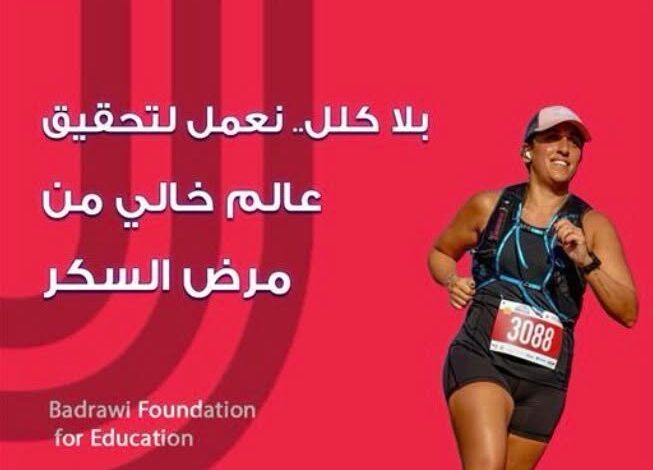
Dear reader, do not be surprised by the title. My daughter, Dalia, has become my role model.
Convention tells us that a father is the role model for his children. What I share with you today is the exception.
Since she was little, I have always called her “My Happy Thoughts.” She has always been an optimistic, smiling soul—beautiful both inside and out.
When she was twenty-five years old—twenty years ago—she was diagnosed with late-onset Type 1 diabetes. Specialists advised her that if she hoped to have a second child, she should not delay pregnancy before the disease progressed further. She followed their advice and became pregnant with Heba while her diabetes was still in its early stages. Thankfully, the pregnancy went smoothly.
Type 1 diabetes is among the most challenging forms of the disease to manage. Within just a few months after giving birth, the disease had advanced to the point where her body no longer produced any insulin at all—the hormone essential for life, energy, and normal activity. Overnight, she found herself facing a lifelong condition requiring a complete transformation of her lifestyle: continuous treatment, insulin injections, constant glucose monitoring, and a radical change in the way she ate.
Suddenly, my daughter—my Happy Thoughts—was a mother of two young girls, a wife, a working woman, and someone who had to rebuild her entire life around a chronic illness.
As only a father can, I found myself wishing with all my heart that it had been me, not her, who had fallen ill.
Her mother, driven by boundless love, chose to give up every food and habit that Dalia herself could no longer enjoy, sharing in her daughter’s struggle in the only way she could.
I watched my young daughter—with all her vitality, education, and promise—enter a stage of life for which no one could ever be prepared, while continuing to shoulder her family and professional responsibilities with remarkable commitment.
Ours has always been a family that reads, learns, and discusses everything openly. Before long, Dalia’s knowledge of diabetes rivaled that of many specialists—perhaps even surpassed some of them. As a physician, I have always believed that half-knowledge can sometimes be more dangerous than ignorance. I therefore encouraged her to pursue every reliable source of information available, helping her develop a deep understanding of the disease that had become her lifelong companion.
To knowledge, she added experience.
She explored different treatment methods, mastered nutritional planning, adopted insulin pump therapy, and traveled to leading medical centers seeking the best ways to prevent complications and live fully despite the disease.
Then Dalia transformed her life through extraordinary determination.
Within a few years, disciplined exercise and healthy nutrition completely reshaped her body and her outlook. She eventually became not only an athlete but also a CrossFit coach, inspiring others and later co-founding a CrossFit training center with friends.
Determined not to let diabetes define her limits, she trained for months to complete the 43-kilometer Paris Marathon—and she did. Then came marathon after marathon across the world.
She pushed herself even further, entering the demanding world of triathlons—swimming, cycling, and running. She climbed mountains across Africa and Europe, and eventually competed in one of the world’s toughest endurance events in Sweden, successfully completing the Ironman competition.
She repeated the achievement in other countries and ultimately qualified for even more demanding races.
Knowledge also transformed her eating habits into a disciplined, healthy, and balanced lifestyle.
At first, she continued teaching music to children, which had been her profession before diabetes. Later, after extensive personal development and professional training, she became a certified life coach.
I vividly remember the day she surprised us by expressing her desire to have a third child despite all the medical challenges.
Only after carefully studying the medical evidence and understanding the risks did she make that decision.
She placed me in one of the most difficult positions of my life when she insisted that I—her father—also be her obstetrician. She trusted both my medical expertise and my judgment, and I had the privilege of delivering both her and her youngest daughter, Sarah, who has since brought immeasurable joy into our lives.
Dalia continued to live with remarkable energy.
She encouraged her daughters to embrace sports alongside her, accompanied them to gymnastics, ballet, and piano lessons, attended every school activity, and actively participated with other parents in their children’s events.
She reads with them, reads to them, and fills her home with warmth, laughter, and happiness.
She is supported every step of the way by a husband whose humanity deserves equal admiration. He moved beyond traditional expectations, standing beside her as a true partner in building a loving, healthy family.
Today, another chapter unfolds.
She is preparing to accompany her eldest daughter, Malak, as she begins university in Austin, Texas.
Malak herself has become a remarkable source of optimism and positive energy for our family, uplifting everyone around her.
At the same time, Dalia accompanies her youngest daughter, Sarah—now twelve years old, whom I delivered myself—to a summer camp in Switzerland, nurturing her curiosity, independence, and love of learning.
Meanwhile, Heba, her gifted sixteen-year-old daughter with a philosophical mind, is spending the summer studying creative writing in Oxford. Dalia remains by her side every step of the way—and even sends me, her grandfather, together with her grandmother, to reassure her heart.
I look at Dalia—my Happy Thoughts—and wonder how fortunate I am to be her father.
Every morning she begins her day at six o’clock with training, whether in Egypt or anywhere else in the world, while continuing to manage the relentless demands of Type 1 diabetes: checking her glucose, analyzing her readings, adjusting her insulin, and carefully balancing every meal.
As a sister to Hassan and an aunt to Kian, she radiates love, friendship, and tenderness. Watching the bond she shares with her brother and his family fills me with pride and deep contentment.
Because she is beautiful in spirit as well as character, she has devoted part of her life to helping children living with diabetes, determined to spare them the devastating complications she knows so well.
Together with me, her aunt Dr. Nadia, and my granddaughter Sarah—a promising young pediatrician—we are establishing a major nonprofit initiative dedicated to providing treatment, insulin, insulin pumps, education, and support for underprivileged children with diabetes and their families. The center will be based in the Sayeda Zeinab district of Cairo.
Joining us in this mission is my friend Dr. Osama Hamdy, the internationally renowned diabetes expert at Harvard University, along with an inspiring group of Egyptian men and women whose dedication to public service deserves the highest respect.
When I look at Dalia, I see a woman worthy of admiration.
She never surrendered.
She never grew complacent.
She never allowed herself to be defeated.
Instead, she persevered, faced every challenge with a smile, and triumphed through determination.
Those around her rarely see the burden she carries. She refuses to weigh her family down with her fears or moments of sadness, though surely she has known many.
She has made peace with herself.
She does not think of herself as a sick person.
To me, she is a true heroine.
Why do I write about her—and why do I write about her again?
Because somewhere, in every town and every country, there is another young woman or young man just like Dalia.
Diabetes affects millions in Egypt, and as a physician I witness its complications every single day.
There are millions of people like my daughter across Egypt and around the world.
My message to them is simple:
Take ownership of your life.
Do not despair.
Do not surrender.
Know that determination, knowledge, discipline, and perseverance can make you a hero—not only in your own eyes, but also in the lives of those who love you.
Dalia is living proof.
My daughter,
I respect you.
I stand beside you.
I support you.
And I am profoundly proud of you.
Signed,
A Proud Father