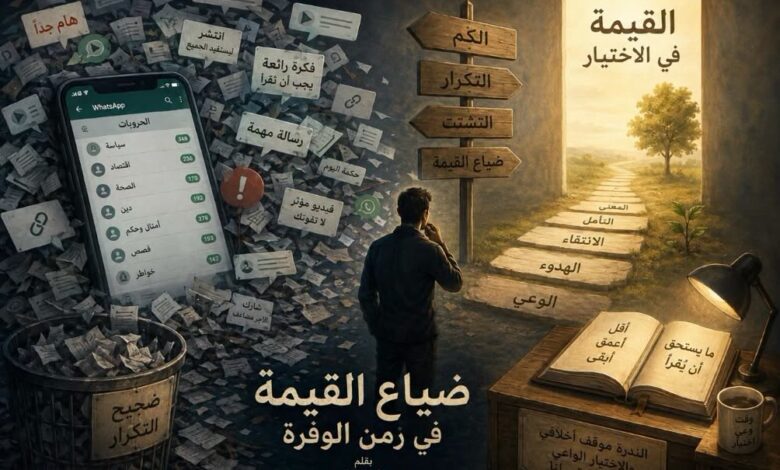
Sometimes I open WhatsApp and find dozens of forwarded messages piling up every day in groups I can no longer remember when I joined.
Some I joined willingly; others somehow found their way to me without my intending it.
They cover every imaginable subject: politics, economics, health, religion, proverbs, stories, and words of wisdom.
All of them are “important.”
All of them “must be read.”
And all of them arrive with the same sense of urgency.
At first, I opened them one by one.
Then I began scrolling through them quickly.
Then I started ignoring most of them.
Today, I feel that their sheer abundance has itself diminished their value.
This is not merely a technological problem. It is a profound cultural phenomenon.
Excessive abundance produces the opposite of what we might expect.
Instead of increasing our knowledge, it scatters our attention.
Instead of giving us better choices, it makes it harder to distinguish among them.
The precious becomes buried beneath mountains of repetition, and the reader struggles to know when to stop, what deserves their time, and what can be passed over without regret.
Repetition itself erodes meaning.
An idea that provoked reflection the first time becomes, by the tenth, nothing more than familiar noise.
A text that has been forwarded dozens of times loses its freshness, even if the original was worthwhile.
Over time, the mind becomes accustomed to moving quickly from one thing to another. It no longer pauses before what is actually worth pausing for.
Here lies the paradox:
We live in an age that gives us access to an enormous quantity of ideas, yet our ability to extract value from them is declining.
Because value does not come from quantity.
It comes from selection.
And selection requires time, calm, and awareness—things that have become scarce in a world of messages flowing endlessly into our lives.
The problem is not limited to WhatsApp.
It reflects a much broader condition in public discourse.
When everything becomes easily available, many things lose their weight.
And when the valuable and the trivial become equally accessible, with the same speed and immediacy, it becomes difficult for the mind to establish a hierarchy of priorities.
The reader gradually transforms from a seeker of meaning into a consumer of content, and from a contemplative thinker into a scroller.
Perhaps the solution is not to withdraw completely, but to rediscover the art of choosing.
To ask ourselves before opening a message:
Is this worth a few minutes of my life?
And to give ourselves permission to ignore most of what reaches us without feeling guilty about it.
True value is not lost because we failed to read everything.
It is lost when we lose the ability to recognize what is worth reading.
In an age of abundance, restraint becomes an ethical position.
And conscious choice may be the last form of control we have over what enters our minds.