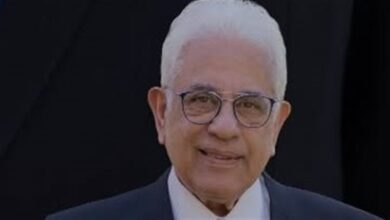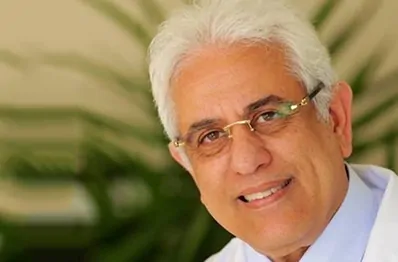
A photograph of my brother Hamdy, who returned from his scholarship at Oxford after earning his PhD and, like many highly educated members of civil society, joined the army in 1971 to raise his country’s flag through knowledge.
[Photograph]As I do every October, I reach out to young people who dream of tomorrow, including the young people in my family, those who work with me in my civil society organizations — particularly the Takatof and Education First Association and the Association for the Dissemination of Culture and Knowledge — as well as my students at the university.
In my most recent conversation with them, we talked about the great October Victory. I told them that October 6 is the greatest day of my life, because anyone who did not experience the humiliation of the 1967 defeat cannot truly appreciate the beauty, impact, and significance of 1973.
I was an undergraduate medical student at Kasr El Aini, and every one of us had a brother, father, friend, or relative serving in the army and fighting for the dignity of our country. We would gather around the radio, our bodies covered in goosebumps, listening to calm and credible military communiqués — unlike what had happened in 1967. The media had learned from the mistakes of the past and was honest with the people. The country’s leaders had learned from the great Egyptian people and had risen to the level of responsibility.
One of the young people, who was born more than thirty years after that day, said to me:
“Not quite like that, Dr. Hossam. There are books and articles saying that Egypt did not actually win that war. Whom are we supposed to believe?”
Another said: “You said the same thing about the 1956 war, and later it turned out that it wasn’t really a victory. Israel occupied Sinai afterward, and it was only because the United States intervened and forced Israel to withdraw that the occupation ended.”
I replied: “That is not correct, because the outcome of a war is determined by who ultimately imposes their will on the other side. In 1956, Egypt imposed its will on Britain, France, and Israel. Each country uses whatever military and diplomatic tools it possesses to achieve its objectives.
“At the end of the war, Egypt maintained control over the Suez Canal and regained Sinai. Therefore, the outcome of the war was a victory for Egypt, as well as the resignation of the Prime Minister of Great Britain.”
As for 1973, we fundamentally believed — and the entire world believed — that crossing the Suez Canal and breaching the Bar Lev Line was impossible. At the time, it was considered one of the strongest defensive lines in military history, while Israel enjoyed technological and strategic superiority in the air. The world believed that this was a permanent reality that could not be changed.
What happened in the end was that our forces crossed the canal through disciplined planning and wise leadership, changing the established military reality. Then came negotiations from a position of strength rather than defeat.
Everything that followed included reopening the Suez Canal to international navigation, the return of the displaced residents of Port Said, Ismailia, and Suez, and the recovery of Sinai.
The October War was part of an integrated strategy to restore dignity and territory, combining military action with diplomatic and legal efforts to recover the last point at Taba. Sinai eventually became fully under Egyptian sovereignty once again.
They said: “But the number of our troops allowed in Sinai was restricted, and recovering Sinai in this manner meant that the victory was incomplete.”
I said: “You and I can go to Taba, Sharm El-Sheikh, Saint Catherine, and every inch of Sinai. Until the Muslim Brotherhood and ISIS terrorism began after 2011, we could go to Al-Arish and travel throughout Sinai as we wished.
“Every gain has a price. We must understand and recognize that the Golan Heights, for example, remain under complete occupation nearly sixty years later, and so does the West Bank. Israel has even brazenly declared the annexation of the Golan Heights, and the world has begun recognizing Israel’s claim to it. The United States has now declared this as well.
“Do not allow those who see nothing but defeat to transfer their negative energy to you. Egypt won — militarily and through negotiation. We changed a geographical and historical reality that could otherwise have become a permanent fait accompli.”
They said: “We have become skeptical about the truth because of all the exaggeration surrounding the events we are living through. How can we be certain about events from the past?”
I replied: “You have a point, and you also have a responsibility.”
I agree with you that media exaggeration, boasting about victory, and hiding mistakes as though we were angels and supermen make people doubt the facts.
Indeed, some narratives have attributed the victory to angels descending to stand beside the army, as though the glory of victory belonged to anyone other than the officers who planned it, the soldiers who carried it out, and the people who brought forth the best in themselves to achieve it.
Our duty is also to investigate, read the memoirs of our heroes and our enemies, and use our minds.
The truth is that our army and our people won after a defeat. We did not surrender. We recovered our land after six years of Israeli occupation, and forty years later the Egyptian people once again demonstrated their civilizational stance by rejecting the Muslim Brotherhood’s occupation of the country on June 30 — an occupation we had feared, God forbid, might become permanent.
The truth is that the army benefited from the expertise of highly educated members of civil society, raising the level of its performance and bringing science into its ranks. And the people, despite their anxiety, impatience, and the internal displacement of a quarter of their population, supported their soldiers, endured their suffering, and ultimately prevailed.
I want to remind you once again that October 6 is truly the greatest day of my life. We were stunned when we saw our army cross the canal and achieve victory. I will never forget the pride and exhilaration I felt. Everyone volunteered according to their abilities, and Egypt truly won.
Another young man said: “Do you believe, Doctor, that many of our classmates do not even know the map of the lands that are still occupied by Israel?”
I replied: “Your observation reminds me that whenever I read a statement listing the Arab territories that remain under Israeli occupation, I find that they are gradually disappearing from the memory of the daily and periodic media. Today, almost nothing is mentioned except the West Bank, while the Golan Heights — and, more recently, Jerusalem as a whole, the sources of the Jordan River, villages in southern Lebanon, and the remaining villages and valleys of Palestine over which Israeli settlements have expanded and continue to expand — are, I would say, almost disappearing from media memory.
“Indeed, there is even a division taking place within Syria itself between Turkey and Israel, along with ethnic divisions. The Golan Heights have drifted out of sight. The same could have happened to Sinai.
“Anyone who lived through and remembers October 1973 must now be over fifty years old. The October War should be taught in our educational curricula from a scientific perspective, rather than through verbal narratives and political grandstanding that ultimately cause students to stop believing the facts.”
There are heroic stories that are rarely told — such as the story of the Egyptian people, whose army returned from the crushing and humiliating defeat of 1967, forcing the country’s president to resign as a consequence of the failure.
The people did not accept his resignation — not as an endorsement of the individual, as I saw it at the time, but as a symbol of Egypt’s refusal to accept defeat.
I remember the jokes and mockery directed at the Egyptian army throughout the world and across the Arab countries. The Egyptian military uniform itself became an object of ridicule in word and deed, while millions of citizens living along the Canal Zone were forced to move deeper into the country.
Here, the Egyptian people demonstrated their civilizational character. They resisted the negative wave directed against the army, raised its morale, and every educated person who had a degree joined the army without knowing when he would return to civilian life. The people welcomed their displaced compatriots into their homes and schools, and restored their army’s dignity and standing.
This is a battle that no one talks about and for which there are no commemorations.
The people of Egypt revived their army after the defeat, and the Egyptian army revived its people through its victory in October.
We must understand that there are lessons to be learned and remembered every October.
The first is that the army and the people are one integrated system. Without the support of civil society for its armed forces, there would have been no victory. All attempts to divide the country by separating the army from the people, or by dividing the people into ideological, religious, or geographic groups, will fail in the face of the civilizational awareness of this great people.
The second is that if we had entered the October War without a fundamental change in the concept of managing the military institution, and without coordination between civilian institutions, diplomacy, and military action, there would have been no victory.
We learned then that it is impossible to keep doing the same thing in the same way and expect different results. The concept of military action that had led to defeat had to change, and it did — producing a new concept that led to victory.
The third is that there is no victory without mistakes and sacrifices, and what is not documented is as though it never happened. Just as we analyze defeat, we must analyze victory.
The defeat of 1967 was devastating — devastating, devastating, devastating. But change took place, experience accumulated, and the victory of 1973 followed.
When the 1967 war occurred, I was in secondary school. As young people, we were under the false impression of strength and were waiting for Tel Aviv to fall by the end of June 5. We had been deceived by flattery toward those in power and by fear of expressing an honest opinion. The people were living in a state of false euphoria until we awoke to reality: our army was returning in retreat, while the enemy was in the skies over Cairo.
It was a lesson I have never forgotten. It created within me a political rejection of one-dimensional thinking and of believing anything without evidence. It became part of my intellectual makeup: a rejection of hypocrisy and a desire for transparency and openness.
It is a lesson I am thinking about now, in 2026, more than fifty years after the October War and fifty-nine years after the devastating defeat of the Egyptian army — and after the remarkable stand of the Egyptian people in supporting its rebuilding and restoring its dignity.
Egypt’s defeat today will not be military. It will be intellectual, economic, and political. And I would spare the Egyptian army the possibility of causing such a defeat by becoming a party to civilian governance, investment, and the economy, or by obstructing the peaceful transfer of power — something that could turn the people’s anger against the very institution that was and will remain the guardian of the nation.
My children, the lesson of October is a profound one, and its conclusions can be applied today by insisting on pluralism, freedom of the press, respect for differences that reveal the truth, construction rather than destruction, positivity, teamwork, and making use of the capabilities of every institution within society — including the armed forces, without special privilege or discrimination.
Happy October to you all.