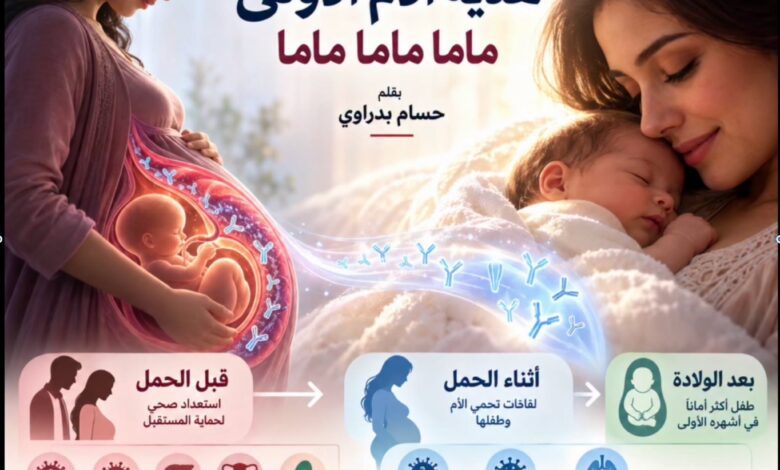
A mother gives to her child before the child even knows how to receive. In the first minute after birth, nearly a third of the baby’s blood can flow to the newborn through the umbilical cord, if we allow one minute to pass before clamping it. But what crosses the placenta over the months of pregnancy is more precious than blood. It is the very memory of immunity: antibodies produced by the mother’s body in response to diseases she has encountered or been vaccinated against. These antibodies pass to the fetus to protect it during its first months of life, when a baby enters the world defenseless, with an immune system not yet capable of protecting it on its own.
And here lies a question that seems simple but carries profound meaning: What does a mother carry in her blood that she can pass on to her child? And do we leave the answer to chance, or do we shape it through informed decisions?
Before Pregnancy: When Timing Is Prevention
Most families in our country prepare for marriage by taking care of everything: the apartment, the furniture, the celebration, and the photographs. Health preparations for pregnancy, however, come last on the list, if they appear at all. The truth is that some of the most important protective measures can only be taken before pregnancy, because they involve live vaccines that cannot be administered to pregnant women.
The first is the rubella vaccine. Rubella may pass through a child’s or adult’s life as nothing more than a transient fever and a mild rash. But if a mother contracts it during the first months of pregnancy, it can leave her baby with hearing loss, cataracts, heart defects, or intellectual developmental delays. A simple blood test can reveal whether a woman is immune. If she is not, she should receive the vaccine and wait one month before attempting to conceive.
The second is the chickenpox vaccine. We tend to think of chickenpox as a harmless childhood illness. In a pregnant woman, however, it can develop into severe pneumonia. It may also cause congenital abnormalities in the fetus or a serious infection in the newborn if the mother contracts it close to delivery. The approach is similar: a blood test, followed by two vaccine doses for women without immunity, and then a one-month wait before pregnancy.
The third is the hepatitis B vaccine. In our country, this is an issue that needs little introduction. When the virus passes from mother to newborn, it becomes a chronic liver infection in the vast majority of cases, potentially leading years later to cirrhosis or even worse complications. The vaccine is safe, and its course can be completed even if pregnancy begins while the doses are being administered.
The human papillomavirus (HPV) vaccine, which helps prevent cervical cancer, should also be considered if the woman has not already received it. The vaccination course should be completed before pregnancy, not during it.
It is wise to begin a preconception medical visit at least three months before trying to conceive. This is also the time to start folic acid, which helps protect the developing fetus against neural tube defects.
During Pregnancy: Three Doses to Protect a Child Not Yet Born
Many people believe that pregnancy is a time when every medication and every injection must be avoided. The truth is that some vaccines are recommended during pregnancy because they protect not only the mother but also her child after birth.
The whooping cough vaccine, given in combination with tetanus and diphtheria protection (Tdap), is recommended during every pregnancy, preferably between weeks 27 and 36. Whooping cough in adults may be an unpleasant respiratory illness, but in an infant’s first weeks of life, it can cause breathing to stop. A baby cannot receive the first dose of the routine whooping cough vaccine until around two months of age. Who protects the baby until then? The mother does, through the antibodies that cross the placenta and reach her child.
The influenza vaccine can be administered during any trimester of pregnancy, ideally ahead of the winter flu season. Pregnant women face a higher risk of severe influenza complications, ranging from pneumonia to premature birth. Infants cannot receive their own influenza vaccine before six months of age, making their vaccinated mothers their first line of protection.
The respiratory syncytial virus (RSV) vaccine is the newest of the three. It is administered between weeks 32 and 36 of pregnancy, according to the applicable vaccination guidance. RSV is one of the leading causes of hospitalization among infants with severe respiratory infections. Studies have shown that maternal RSV vaccination reduces severe cases by approximately four-fifths during the first three months after birth.
The vaccines pregnant women should avoid are the live vaccines, such as those for rubella and chickenpox. That is why timing before pregnancy matters so much.
Between Fear and Knowledge
I know that our society has a longstanding fear of “getting an injection during pregnancy,” and that some of the information circulating on social media amplifies this fear rather than dispelling it.
The physician in me speaks clearly: these vaccines have been studied in tens of thousands of pregnant women around the world. Their side effects are generally limited to pain at the injection site or a mild fever that subsides. What they prevent, however, may be the loss of a child’s life.
Even if an unplanned pregnancy occurs just days after receiving a live vaccine, there is no reason to panic or terminate the pregnancy. International records have not documented a single case of a congenital abnormality caused by the vaccine itself.
A Final Word
Prevention in medicine is no less noble than treatment, though it receives far less recognition. No one thanks a doctor for an illness that never occurred, and no one celebrates a baby who never had to enter the neonatal intensive care unit because the mother was vaccinated. Yet this is one of the noblest expressions of motherhood: protecting a child from a danger the child will never know was once a threat.
I hope that the preconception medical visit becomes part of our culture, just as premarital screening has. I also hope that the scope of free vaccinations available to pregnant women—which currently includes the tetanus vaccine—will expand to cover whooping cough and influenza.
A country that invests in a vaccine dose before birth saves a neonatal intensive care bed afterward. And a nation that begins protecting its children before they are born has understood that the future is shaped in the womb long before it is shaped in the classroom.
Pen and Brush | Hossam Badrawi