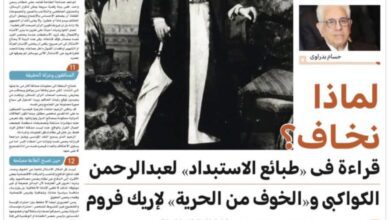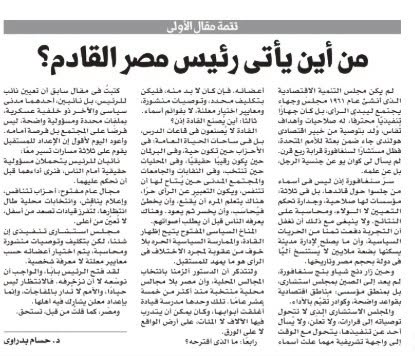
Leaders Are Not Made in Lecture Halls, but in the Arena of Public Life
By Hossam Badrawi
I read with great interest Eng. Salah Diab’s article in Al-Masry Al-Youm about the concept of a “National Call,” and I thank him for including my name among those whose track records he believes merit such a call.
Above all, I share his welcome for the renewed momentum in public life following President Abdel Fattah el-Sisi’s affirmation that the Constitution will not be amended and that he will not seek another presidential term. I have previously written in this space to commend this position, because the peaceful transfer of power is one of the most valuable achievements Egypt gained from the January 2011 Revolution, and because respect for the Constitution is only meaningful when it is applied in full, rather than selectively.
However, the discussion that has now opened deserves to be explored at its roots, rather than left at the surface.
First: The Question of Presidential Succession Is Legitimate, but the Answer Requires Reconsideration
For a head of state to think about who will succeed him is a sign of sound governance, not weakness. Yet the proposed program, as presented, raises legitimate questions that the author was right to highlight. It would involve 200 to 500 doctorate holders between the ages of 40 and 50 undergoing 30 months of training at the Military Academy.
I would add a question that I consider even more important: Who chooses the president in a constitutional state?
The answer lies in the Constitution itself: the people, through a free election.
Any program that becomes, even unintentionally, a gateway to presidential candidacy places an intermediary between citizens and their right to choose. Leadership training is welcome when it is accessible to anyone who wishes to participate. But when it becomes an unwritten requirement, it reproduces the very logic of “selection from above” that we have sought to move beyond.
Moreover, a doctorate is evidence of research ability, not leadership. Both Egyptian and world history offer examples of great leaders who never earned doctoral degrees, as well as doctorate holders who would not be qualified to manage a university department.
Second: The National Call Is a Worthy Idea, but It Answers a Different Question
Eng. Salah Diab’s proposal to establish a presidential advisory council composed of accomplished individuals is a good idea. However, the Singaporean example he cited deserves careful examination, because a closer reading strengthens the argument rather than weakens it.
The Economic Development Board, established in Singapore in 1961, was not a council of prominent figures gathering to offer opinions. It was a professional executive body with defined powers and measurable objectives. It was established following a recommendation by a Dutch economic expert who arrived as part of a United Nations mission and went on to serve as an adviser to Singapore for nearly a quarter of a century.
Lee Kuan Yew did not ask about the man’s nationality. He asked about his expertise.
Singapore’s success, therefore, did not lie in the names of those who sat around its leader, but in three essential principles: institutions with real authority, merit-based appointments rather than loyalty-based ones, and accountability for results.
We must not overlook, however, that Singapore’s experience came at a cost in terms of political freedoms. Nor can a model suited to governing a city-state of a few million people be mechanically replicated in a country of Egypt’s size and historical complexity.
When Deng Xiaoping visited Singapore, he did not return to China with the idea of establishing an advisory council. Instead, he embraced an institutional approach: economic zones governed by clear rules and officials evaluated according to performance.
An advisory council whose recommendations are neither translated into decisions nor published, and whose implementation is subject to no accountability, will eventually become a ceremonial façade, regardless of how distinguished its members may be.
If such a council is to be established, it should have a clearly defined mandate, published recommendations, and transparent selection criteria, rather than simply a list of prominent names.
Third: Where, Then, Are Leaders Made?
Leaders are not made in lecture halls, but in the arena of public life: in political parties when they are vibrant, in parliament when it exercises genuine oversight, in local councils when they are elected, and in professional syndicates, universities, and civil society when they are free to operate and flourish.
It is there that people learn how to persuade others, how to make mistakes and be held accountable, and how to lose before returning to compete again. It is there that the public gets to know them before they ask for its votes.
Let us remember that the Constitution requires the election of local councils, yet Egypt has been without elected local councils for more than 15 years.
That alone represents a school of leadership whose doors have been closed, one that could have trained thousands, rather than hundreds, through real-world experience instead of classroom exercises.
Fourth: What Do I Propose?
In my previous article, I wrote that appointing a vice president—or even two, one a civilian with a political background and the other with a military background—each with clearly defined responsibilities and specific portfolios, would not be an imposition on society but an opportunity for it.
Today, I reiterate that preparing for the future requires three parallel tracks:
1. Two vice presidents with genuine responsibilities and public accountability. Their performance should be visible to the public so that we can assess them before forming our judgments.
2. An open public sphere. Political parties must compete, the media must debate, and long-overdue local elections must take place, allowing leaders to emerge from the grassroots rather than being appointed from above.
3. An executive advisory council, if we choose to establish one. It must operate under a clear mandate, publish its recommendations, and be subject to accountability. Its members should be selected according to transparent criteria, not personal connections.
The President has opened a door, and our duty is to widen it, not merely decorate it.
Waiting is not neutrality, and nations should not be governed through surprises. They must prepare openly for the future, with their people actively involved in the process.
And Egypt, as I have said before, deserves nothing less.