Respect for the constitution is complete when society honours the rights of all its citizens, including their right to run for the presidency.
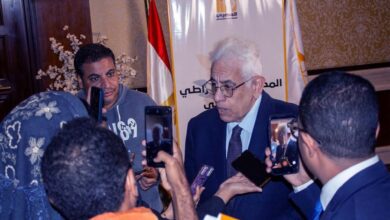
I recently took part in a televised interview on the future of the presidency in Egypt, prompted by President Abdel-Fattah Al-Sisi’s recent announcement that he does not intend to amend the constitution to extend his term beyond 2030.
What struck me was how widely the announcement was celebrated, as if respecting the constitution had become something exceptional and worthy of applause rather than a natural obligation on anyone who holds public office, the president first among them.
I say this in appreciation of the announcement and not to diminish it. The constitution is not a gift from the ruler to the people. It is the nation’s contract and the document that sets out the limits of power, safeguards rights, and guarantees the peaceful transfer of authority.
Respecting it should never come as a surprise. It is violating it that should be impossible.
During the televised discussion, the conversation turned to the president’s proposal to prepare people capable of assuming the presidency, drawn from the holders of advanced academic degrees, through a 30-month training programme at the Military Academy.
My response was clear: preparing leaders is commendable, but we must not confuse qualifying citizens for responsibility with requiring them to pass through a particular institution before they may exercise their constitutional right to stand for office.
Article 141of the constitution sets out the conditions for presidential candidacy, and neither a doctorate nor prior military training is among them. There is a fundamental difference between an optional leadership programme and a mandatory gateway to candidacy.
In a democratic state, a president is not appointed after passing an examination set by the authorities in power; he is chosen by the people in free elections. A doctorate attests to specialisation and research ability, not to political wisdom, integrity, or the capacity to build national consensus. The Military Academy is an institution with its own standing, but the state cannot be reduced to any single institution, civilian or military. The homeland belongs to all its citizens.
Then came a question that opened the door wider than I had expected. The host of the TV programme asked me, “would you accept a Christian as prime minister of Egypt?”
My answer was simple – “why not?” I went further and said that the conditions for running for any office, the presidency included, make no distinction between Muslim and Christian, or between male and female for that matter. What matters is meeting the constitutional and legal requirements, competence, and public acceptance as expressed through free and fair elections.
I was not offering a religious opinion; I was speaking about a constitutional principle: equality of citizenship. Yet the reactions surprised me more than the question itself. People asserted that a woman could not rule Egypt and that a Christian could not become president of the republic. Some even cited the constitution as forbidding it.
It was then that I realised that we are facing not merely a difference of opinion, but a deeper flaw in how we understand the relationship between religion and state and between the constitutional text and social culture.
Article 141 of the constitution sets out the conditions for presidential candidacy. Among them are Egyptian nationality and Egyptian parentage, enjoyment of civil and political rights, completion of military service or legal exemption, a minimum age of 40, and any other conditions specified by law.
It requires neither a doctorate nor prior military training. Nowhere does it require the candidate to be Muslim or male. Article 53 establishes equality before the law and prohibits discrimination on the basis of religion, belief, or sex, while Article 11 affirms the state’s commitment to equality between women and men in civil, political, and other rights.
As for Article 2, which states that Islam is the religion of the state and that the principles of Islamic Sharia are the principal source of legislation, it contains no stipulation that the president must be Muslim. We must distinguish between the constitutional identity of the state and the political rights of its citizens.
Egypt, with its history and its human fabric, belongs to no single community over another, nor to one sex over the other. If Egyptians are equal in their duties, how can some be less than others in their rights?
Citizenship that stops at certain limits is not full citizenship. It is conditional equality.
This raises a philosophical question that goes beyond the legal texts: is democracy merely majority rule, or is it also a system that protects a minority’s right to compete on equal terms?
It is natural for the culture and values of the majority to be reflected in public life, but democracy does not mean turning the majority’s identity into a precondition for monopolising power. The majority chooses who governs, but it has no right to strip a minority of its right to put itself forward for that choice.
There is a vast difference between a voter who rejects a candidate because he is unconvinced by the candidate’s programme or competence and one who believes that, that candidate has no right to run in the first place because of his religion or sex.
The first is democratic practice; the second negates the principle of equality on which the constitutional state rests. The right to run is also not a guarantee of victory.
I am not calling for the election of a Christian because he is Christian, or of a female because she is a woman, just as I am not calling for electing a Muslim because he is Muslim, or a male because he is a man.
I am calling for competence, integrity, and vision to be the criteria, and for the ballot box, not prejudgements about identity, to decide between contenders.
Building democracy, therefore, runs deeper than drafting a good constitution. It requires genuine political parties, independent institutions, a free press, and an education that teaches each generation that the nation rests on the diversity of its citizens, not on a single opinion, a single creed, or a single sex.
Perhaps the most troubling thing that the reactions to what I said in the TV interview revealed was not that some people reject the idea of a Christian or female president. That is a personal preference open to debate.
What troubled me most was their belief that this rejection is written into the constitution, a moment in which what society is used to, becomes confused with what the law prescribes. It is here that the responsibility of intellectuals, educators, and the media lies in not imposing new convictions, but in helping people distinguish between constitutional fact and personal opinion.
Let me return to where I began.
I welcome the president’s affirmation that he will respect the constitutional term. But I hope we reach a day when respecting the constitution needs no celebration, and when talk of a woman’s or a Christian’s right to run for president no longer provokes such astonishment, because equality will have become a natural part of our social culture.
What is required is not that we elect a woman or a Christian as president, but that we do not prevent them from dreaming of it, from seeking it, and from submitting, like everyone else, to the will of the people.
A nation in which duties are equal must be a nation in which rights are equal.
The constitution we respect when power changes hands must be respected just as much when deciding who has the right to hold it.