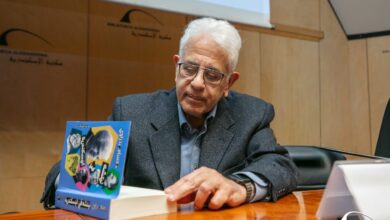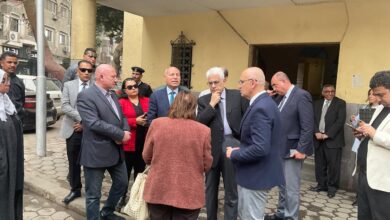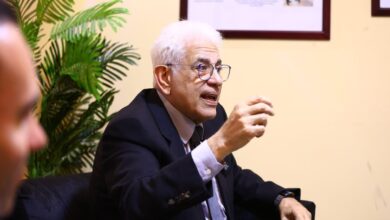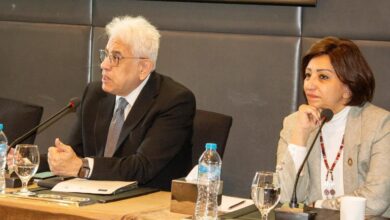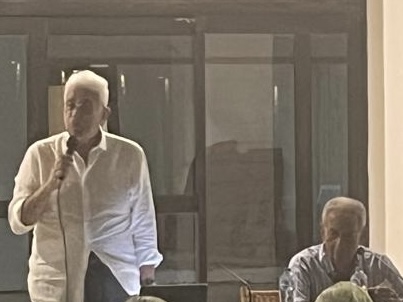
In a wonderful symposium at the Diplomats Village in the North Coast, and at the invitation of the village’s cultural committee—particularly Mr. Amr Moussa, Mounir Fakhry Abdel Nour, and Omar Mohanna—Dr. Hossam Badrawi spoke on the topic: “Diagnosing Egypt’s Reality… and Calling Upon the Best Within It.”
After an introduction by Amr Moussa, Dr. Hossam began by saying:
“When wise people gather, responsibility demands that we call things by their names—not to sugarcoat reality, but also not to drown in its darkness. We must see it as it is, extract the best in it and in our society, and think about what should be.”
Dr. Hossam spoke about being an optimist by genetic makeup and free will—not because he doesn’t see the negatives, but because he also sees the positives and the goodness in others. He emphasized that everyone can choose to do the same.
He added that great challenges reveal the true essence of societies. The genes of civilization shine through in the Egyptian people during certain historic moments that cannot be overlooked.
Yes, there are general negative behaviors and a numbing of responsibility—people act as though they no longer believe their voices make a difference, or that their participation leads to change.
Yes, apathy is rising—whether it’s reckless driving, assaulting public property, or the aggressive verbal attacks on those who are different. All these reflect a loss of moral compass.
Yes, the voice of the middle class is shrinking, polarization is increasing between a wealthy elite and an oppressed base, and dialogue between the two is fading. Political engagement is declining.
There’s a dominance of doubt and erosion of trust in official narratives. People no longer believe what the government says, and sometimes even doubt real achievements.
Rumors, extremism, and mob mentality are seeping into the void left by the absence of awareness. Immunity against incitement and populism is weakening.
There’s a weakness in collective memory—we forget too easily, repeat our mistakes, and live in the moment as if it were fate, not the result of what came before.
But despite all this…
There remains a precious essence in this nation.
The Egyptian people have not lost their humanity. I still see people helping the elderly, smiling through pain, and sharing even when resources are scarce.
We have a deep moral reserve—it may be buried under the rubble of crisis, but it’s not dead. A single spark is enough to reignite the collective conscience.
Our sense of humor, resilience, and natural inclination toward peace are not superficial traits—they are tools of resistance against chaos and nihilism.
He then addressed the audience:
“The thinking elite… you. Yes, you here are proof that awareness still exists, and that the responsibility of shaping the future is still possible.”
He added that Egypt’s youth—despite everything—are still capable of dreaming, if only we give them space, trust, and a measure of hope.
Dr. Hossam challenged the attendees, saying he believes Egypt still possesses the foundations of glory, and that it can return to being a great nation. Why? Because it already has the ingredients of a great state—most importantly, over 65 million youth and children. Within a decade, we can extract the best of their capabilities and let them lead a breakthrough for Egypt in every field.
“We have seas, lakes, beautiful weather, rich history, stunning coastlines, massive renewable energy potential, and an incredible human force.
All we need is competent management of our resources.”
He emphasized:
It’s about education, knowledge, culture, freedom of expression, respect for the constitution, separation of powers, peaceful transfer of power (to prevent tyranny or unaccountable leadership), and above all, firm enforcement of the law—without selectivity or interference.
What should we do?
- Stop colluding through silence. Silence is not neutrality—it’s participation in the wrong.
- Redefine the term “elite”—not as a privilege, but as a duty. An elite that does not act becomes a burden on society.
- Rethink our discourse with people—speak with reason, not indoctrination; with respect, not condescension.
- Restore education and culture to a central priority. Nations are not built by megaprojects, but by sound minds and free consciences.
- Call upon the best within this country. Throughout history, Egypt has always risen from within, not through outside help.
- Egypt cannot be saved through fear, but through trust. It cannot be run through secrecy, but through transparency. It cannot be built with slogans, but with knowledge.
- This nation will only rise when every citizen feels they have dignity, a voice, and a future.
Let’s talk, yes… but let’s act too. A nation doesn’t wait for its elite to simply reflect—it needs them to lead.
A rich dialogue followed with the attendees, discussing what Egypt can achieve through its human potential. Contributions came from Mostafa El Feki, Ambassador Nivine Simaika, Salah Diab, Samihah Fawzy, Amr Moussa, Mounir Abdel Nour, Hatem Seif El Nasr, Mona Aboul-Ezz, Ahmed Zeitoun, and many ambassadors and distinguished guests.