I am often surprised by those who urge me to remain silent when I contemplate religion and the Qur’an or express an opinion on a prophetic hadith, arguing that I’m “not a religious scholar,” as if religion were revealed exclusively for a certain class of people, or as if understanding God’s words and those of His Messenger is only permissible for those officially certified by a religious institution.
Religion, dear readers, was revealed for all people—not in an encrypted format that only experts can decode. In fact, God Almighty addressed human intellect, encouraged reflection, and did not restrict it by degrees or professions.
I possess a mind gifted by God, a spirit that seeks, a heart that engages with divine texts, and an intellect trained in science, critique, and analysis. When I read the Qur’an, I don’t see it as mere recitable letters, but as a call to awareness. When I contemplate hadith, I don’t treat it as a linguistic idol, but as a historical and spiritual discourse requiring understanding of context and purpose.
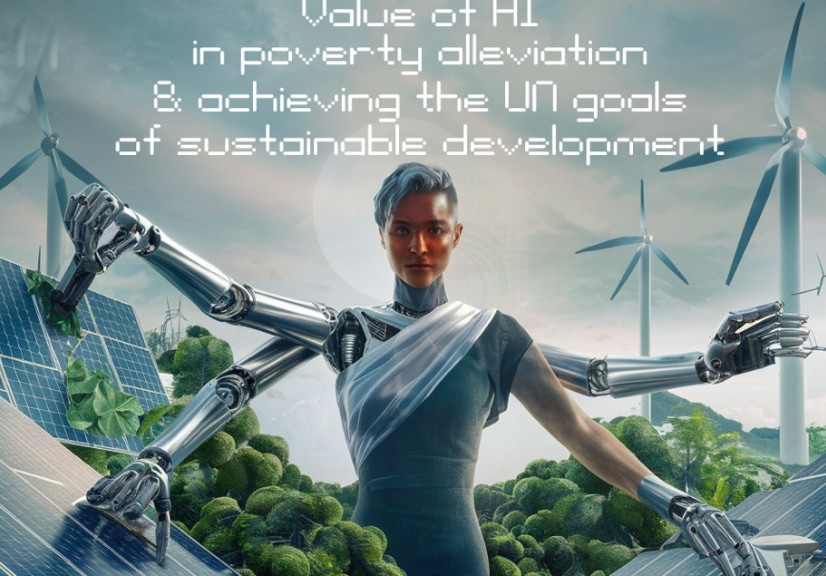
Now, we are facing a development humanity cannot stop: artificial intelligence (AI). We must think, adapt, and reassess values that human civilization has crafted through its journey of maturity—values that may falter or fall if we fail to engage with this new reality.
Given the historical rigidity and resistance to change in general, and reflecting on what happened to thinkers like Ibn Rushd, Ibn Khaldun, Avicenna, Taha Hussein, Muhammad Abduh, and Ali Abdel Raziq—and to anyone who dared to discuss or challenge what’s seen as sacred or unshakable—I realize that this article may face storms of traditionalist rejection. But what is happening now and will happen in the future is far greater and deeper than anything experienced by past intellectuals.
We are witnessing the rise of a new consciousness. Amid a rapid digital revolution, AI is no longer merely a tool that facilitates human life—it has become a cognitive system capable of simulating perception, generating text, analyzing belief systems, and even engaging in seemingly convincing theological debates. Humanity is now confronting a new form of non-organic consciousness, as traditional boundaries between religion, reason, emotion, and technology blur.
Are we on the verge of a shift in patterns of religious belonging?
And will AI influence the form and meaning of faith?
First: AI as a Mirror of New Human Consciousness
AI doesn’t create from nothing; it feeds on human knowledge, then reproduces and analyzes it with tremendous capacity. In doing so, it mirrors us—transcending traditions, revealing contradictions, and facilitating access to alternatives. This has a direct impact on belief systems that were based on submission, indoctrination, and isolation.
For the first time, religions will be instantly comparable. Anyone can now compare the teachings of Buddha, Christ, Prophet Muhammad, Zoroaster, and Lao Tzu within seconds, in a simplified manner, bypassing the filtering of religious institutions.
Religious texts will be subjected to linguistic, historical, and contextual analysis through AI. It can deconstruct sacred texts based on linguistic, historical, and contextual patterns and suggest interpretations that might resonate more with modern minds than traditional exegesis.
Second: From “Inherited Belonging” to “Conscious Belonging”
Humans have traditionally inherited religion from family, treating it as part of national or sectarian identity. But now, the pattern of belonging itself is changing:
1. Individual Reflective Belonging
With open access to knowledge, a generation will emerge that chooses its religion, contemplates it, or rebuilds faith on new intellectual and spiritual foundations. This doesn’t necessarily imply rebellion, but marks a shift from “collective faith” to “individual consciousness.”
2. Selective Belonging
In the future, we may see people drawing from different religions based on what aligns with their values—for instance, embracing Christian mercy, Buddhist asceticism, and Islamic monotheism.
This approach has existed before, but now it will become more apparent thanks to AI tools.
3. The Fall of Religious Monopoly
Religious authority will no longer monopolize interpretation. Anyone can now ask a “virtual mufti” or a “digital saint” and receive instant, well-sourced responses.
Third: Religion vs. Synthetic Consciousness
Can AI create a new religion?
Some speak of “future religions” based on digital mythologies, cosmic codes, or even “superintelligences” granted divine status.
But the deeper question is:
Can a human worship an entity he knows he created?
The answer may be: Yes… if he forgets that what he made is merely a reflection of himself. Some might be deceived by these entities’ ability to respond quickly, learn, and judge, and thus confuse intelligence with wisdom, or capability with holiness.
Many philosophers believe that humans created the image of God in current religions to fulfill their developmental needs.
And all revealed religions are only a few thousand years old—so if humanity has done it before, what’s stopping it from doing it again?
Fourth: The Greater Challenge… Reinterpreting the Sacred
The real challenge of this era is not to abandon religion, but to reinterpret it in light of this new awareness:
- Redefining concepts such as destiny and free will in the context of self-learning algorithms.
- Rethinking the meanings of “revelation” and “miracle” in the age of augmented reality and intelligent systems.
- Exploring the relationship between soul and consciousness: is consciousness a mere biological function, or a metaphysical entity beyond imitation?
Fifth: Is AI a Threat to Religion? Or an Opportunity?
If we cling to rigidity and fear, reject dialogue, and reduce religion to rituals devoid of intellect—then yes, it’s a threat.
But if we treat religion as a space for knowledge, spiritual contemplation, and philosophical reflection—aligned with science and recognizing that revelation awakens the mind rather than opposes it—then AI is an opportunity.
Religion constantly seeks meaning.
AI will change religious tools, forms of belonging, and modes of discourse, but it will never fill the existential void in the human heart.
Some questions remain unanswered by any algorithm (or so we think):
- Who am I?
- Why does humanity exist?
- Is there life after death?
When we ask these questions sincerely, we realize that religion, at its core, is not a closed system, but a continuous human journey toward truth and meaning.
A journey… whose tools may change—but as long as the goal is truth, compassion, and the elevation of humanity and moral virtues, then there’s nothing wrong with change.
I believe what may eventually vanish is the authority of religious institutions and the dominance of governance in the name of religion.
What will evolve is a rational maturity that transcends rigid rituals and formalities—ushering in a new age that is undoubtedly coming.
Let us participate in shaping it, rather than trying to prevent it.
Current Religious Demographics (approximate):
Important notes:
- The Abrahamic religions (Christianity, Islam, Judaism) represent about 55% of the world’s population.
- The major non-Abrahamic religions (Hinduism, Buddhism, and ancient folkloric beliefs) account for about 20–25%.
- Those not affiliated with any religion make up about a quarter of the world’s population.
Within the “Nones” group, there’s a significant distinction between explicit atheists (~7%) and those who identify with unstructured spirituality or reject formal religious categorization.