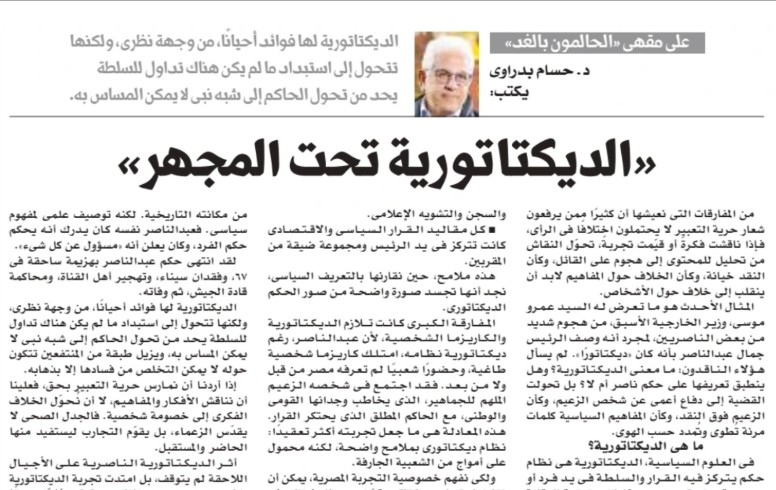
One of the paradoxes we live with is that many who raise the banner of freedom of expression cannot tolerate a difference in opinion. If you discuss an idea or evaluate an experience, the conversation shifts from analyzing the content to attacking the speaker—as if criticism is treason, and as if disagreement over concepts must inevitably turn into conflict between individuals.
The latest example is the fierce attack on Mr. Amr Moussa, former Minister of Foreign Affairs, by some Nasserists simply because he described President Gamal Abdel Nasser as a “dictator.” Those critics did not ask: What does dictatorship mean? And does its definition apply to Nasser’s rule or not? Instead, the issue turned into blind defense of the leader, as if the leader is above criticism and political concepts are elastic words to be stretched and shaped according to one’s whims.
What is dictatorship?
In political science, dictatorship is a system of rule in which decision-making and power are concentrated in the hands of an individual or a small group, without genuine mechanisms for oversight or popular participation. Among its key features:
-
Absence of pluralistic democracy, meaning no real transfer of power through free elections.
-
Control of the media, so that the voice of the authority becomes the only voice, alongside dissolving or weakening political parties and monopolizing the political arena.
-
Restriction of public freedoms—such as the press, assembly, and expression—and security persecution of opponents through arrest, exile, or defamation.
So does this apply to Abdel Nasser’s era?
Let us look without bias at what happened in Egypt in the 1950s and 1960s:
-
All political parties were dissolved after the 1952 revolution and replaced by the “Arab Socialist Union,” a single organization under state control.
-
The media was a unified voice, directed by the state, echoing the leader’s speeches and the regime’s policies.
-
Elections were not genuinely pluralistic; they became referendums with “yes” or “no.”
-
Political opponents—whether from the former capitalist class, the Muslim Brotherhood, communists, or even some of the July revolution’s own members—were subjected to arrest, imprisonment, and media defamation.
-
All political and economic decision-making was concentrated in the hands of the president and a very small circle of close associates.
These features, when compared to the political definition, clearly depict a form of dictatorial rule.
The major paradox: dictatorship + charisma
Despite the dictatorial nature of his regime, Nasser possessed overwhelming personal charisma and a popular presence unmatched before or after. He combined the qualities of an inspiring leader who appealed to national and Arab sentiment with those of an absolute ruler who monopolized decision-making. This duality made his experience more complex: a dictatorial system with clear features, yet carried by waves of immense popular support.
For context, we can compare it to other dictatorial experiences:
-
Franco in Spain (1939–1975): A highly centralized military regime, allied with the Church, imposing decades of political silence. Yet Franco lacked Nasser’s mass charisma.
-
Pinochet in Chile (1973–1990): Seized power through a bloody coup, brutally suppressed the opposition, and was responsible for tens of thousands of deaths and arrests. Despite achieving some economic stability, his rule was defined by fear, not by popular appeal.
Nasser differed from these examples by combining political dictatorship with genuine public affection. His rule relied on a unifying nationalist discourse—Arab unity, anti-colonialism, social justice—which made the masses identify with his authority and even see it as an expression of their aspirations. This is the distinction: Nasser’s dictatorship was not merely repression; it was a blend of absolute power, coercion, and collective dreams.
Describing a system of rule as dictatorial does not negate any economic, social, or national achievements that occurred during its era. Nor does it insult the individual or diminish his historical stature. It is simply a scientific description of a political concept. Nasser himself knew he ruled as a single leader, and he openly said he was “responsible for everything.”
His rule ultimately ended with the devastating defeat of 1967, the loss of Sinai, the displacement of the Canal population, the trial of military leaders, and then his death.
Dictatorship sometimes has benefits, in my view, but it inevitably turns into oppression unless power is transferred periodically. Without the transfer of power, a leader can become a quasi-prophet who cannot be questioned, surrounded by a layer of beneficiaries whose corruption can only be removed by his departure.
If we truly want to practice freedom of expression, we must debate ideas and concepts—not turn intellectual disagreements into personal conflicts. Healthy debate does not sanctify leaders; it evaluates experiences so that the present and future can benefit.
The legacy of Nasser’s dictatorship
The Nasserist dictatorship did not stop with the end of Nasser’s era. It left a deep imprint on Egypt’s style of governance for decades. It entrenched the culture of the single ruler, the absence of real institutions, and the dominance of the state over political and media space.
Even after his death—and despite economic shifts such as Sadat’s openness to the West or Mubarak’s move toward privatization—the core of the political system remained shaped by the legacy of July: one dominant party or a pseudo-dominant party, formalistic elections, and an overwhelmingly official media voice.
Thus, the Nasserist dictatorship was not a passing phase; it became a foundational model for governance in Egypt and the Arab world, where the same features are repeated: the singular leader, hereditary rule, the single party, absence of pluralism, and state control over public life.
Any nation—East or West—that experiences the same dynamics under different names and updated tools, but follows the same philosophy of unchecked personal rule, lack of free expression, lack of opposition, disregard for the constitution, and no transfer of power, is living under dictatorship.
So why are people upset when we simply apply the definition to describe reality?!