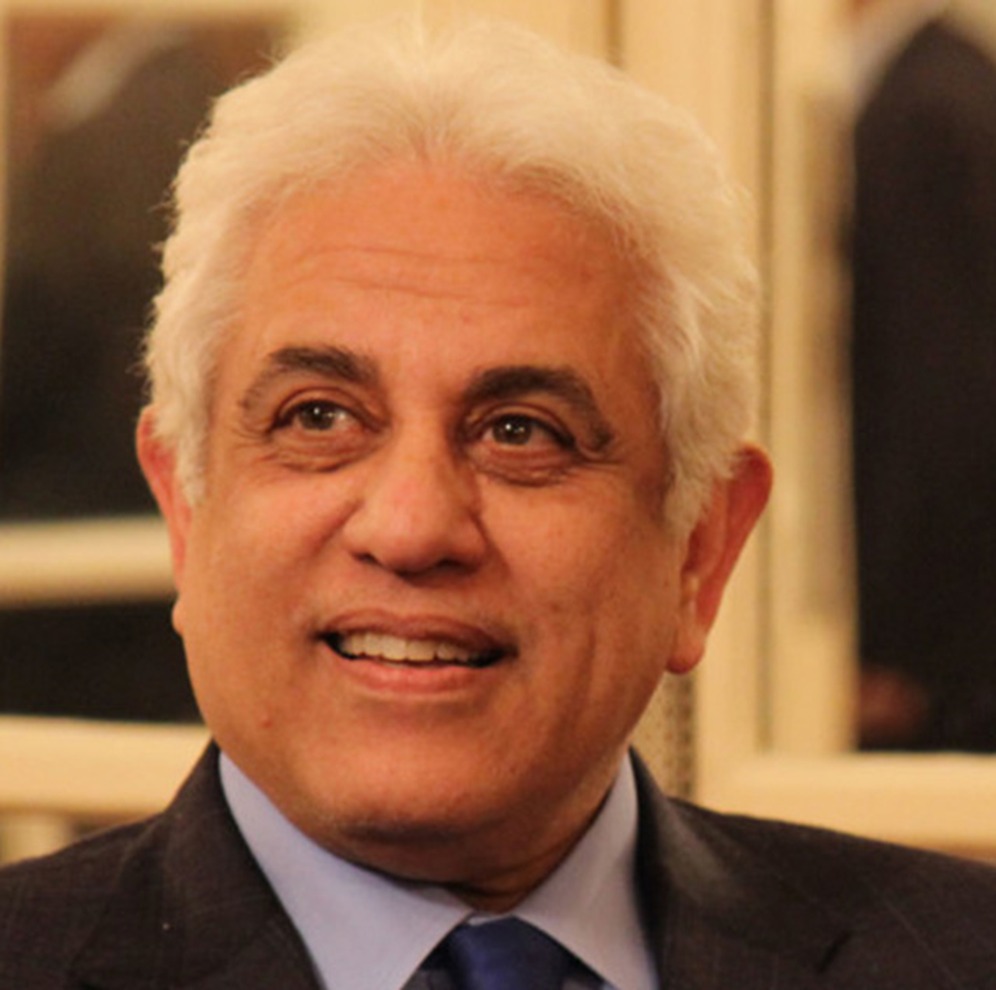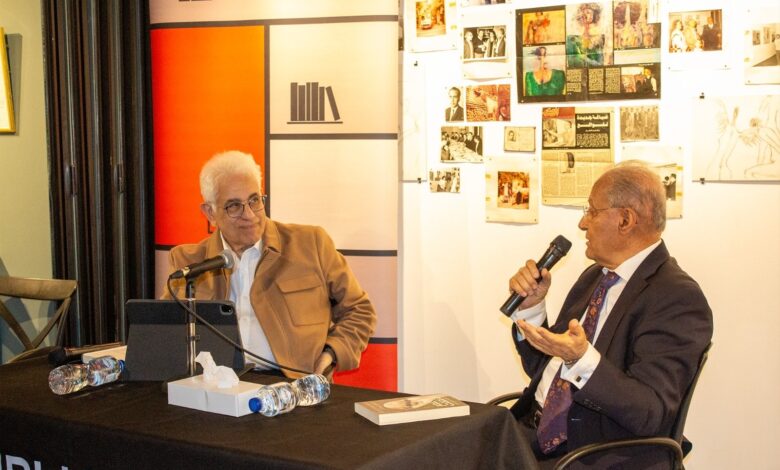
At the invitation of writer and thinker Mansour El-Gennady, former professor at Webster University (USA), and Dar Al-Ain Publishing, headed by Dr. Fatma Al-Boudi, an intellectual seminar was held on Thursday, January 29, 2026, at the Bibliotheca Library. During the event, Dr. Hossam Badrawi discussed the latest publication by Dr. Mansour El-Gennady, The Age of Unraveling.
At the opening of the seminar, Dr. Fatma Al-Boudi introduced the writer and thinker Mansour El-Gennady, expressing her great pleasure in publishing this work, which she described as a valuable and unique book. She praised El-Gennady’s intellectual style, describing his writings as exceptional in their approach and rich with scientific and future-oriented insights capable of stimulating the mind and igniting the imagination.
Dr. Badrawi then introduced the author, Dr. Mansour El-Gennady, saying:
“Today, we meet a book that does not merely describe our world, but places its finger on a shared feeling we all live with—without always having a precise name for it.
The Age of Unraveling: Our Life Today and the Future of Humanity is not a book of technological predictions, nor a record of crises, but a conscious attempt to understand what happens when nature accelerates, science becomes independent of its creator, the economy turns into algorithms, politics loses its compass, and the human being stands at the center of all this asking: Who am I in this changing world?
What distinguishes this book, in my view, is that it does not speak about the human being from above, but with them. It does not confine itself to the coldness of numbers, but insists that human experience—anxiety, alienation, and hope—has a place no less important than equations and models.
We are therefore facing an intellectual project that seeks to grasp the delicate thread between science and wisdom, between progress and unraveling, and between what we are capable of doing… and what we ought to do.
I am pleased to open this dialogue with the author of the book, not as someone offering ready-made answers, but as a partner in posing questions that may shape the contours of our shared future.”
The seminar then unfolded into an intellectual torrent of ideas and knowledge, offering a reflective exploration of the future of humanity and the world and its transformations. This came through a rich discussion between Dr. Hossam Badrawi and Dr. Mansour El-Gennady, marked by depth, intellectual courage, and breadth of perspective.
Dr. Badrawi raised a set of pivotal questions that created moments both shocking and contemplative. Foremost among them was his inquiry into whether the human being himself is the core of the problem in the “Age of Unraveling,” rather than merely a victim of accelerating technology or collapsing systems. He asked: Have we failed ethically before failing scientifically?
The discussion then moved into an even more sensitive territory when Dr. Badrawi posed an existential question about humanity’s right to lead the world, should artificial intelligence and intelligent systems prove capable of managing resources and decisions with efficiency and fairness superior to that of humans. He wondered whether the “Age of Unraveling” might represent a transitional phase preceding the end of human leadership of the planet.
Dr. Badrawi also addressed the profound ethical dimension of the crisis, questioning whether the real danger lies not in the catastrophes themselves, but in humanity’s growing habituation to them and its loss of the ability to feel anger, wonder, and protest. He warned that the most dangerous form of unraveling is collective moral silence.
In this context, the discussion lingered on the concept of “Wisdom 2.0,” proposed by the book—not as a theoretical slogan, but as a tool for human survival in a fast-paced, highly interconnected world, where the consequences of actions extend far beyond immediate intentions.
Dr. Badrawi explained that this form of wisdom is not based on possessing more knowledge, but on the ability to pause, set limits, and think about unintended consequences, emphasizing that the true challenge today is no longer what we are capable of doing, but what we should refrain from doing.
For his part, Dr. Mansour El-Gennady clarified that The Age of Unraveling does not seek to provide final answers as much as it aims to reopen the great questions that humanity has avoided confronting. He argued that the greatest danger facing the world today is not technological acceleration alone, but the absence of a value framework capable of guiding that acceleration. He stressed that the future of humanity will not be decided by technical efficiency alone, but by our ability to reclaim meaning, assume moral responsibility, and shape a wiser relationship with the world we are creating.
The seminar was distinguished by the fact that the questions were not posed as an interrogation of the author, but as an open intellectual partnership with the audience. The dialogue thus became a shared space for thinking about the future as an act we participate in shaping, rather than a predetermined path imposed upon us.