Art and Thought… When the Mind Addresses the Nation’s Conscience
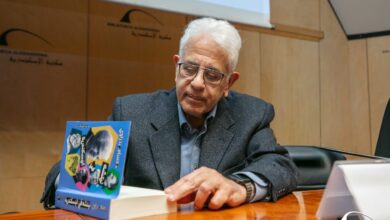
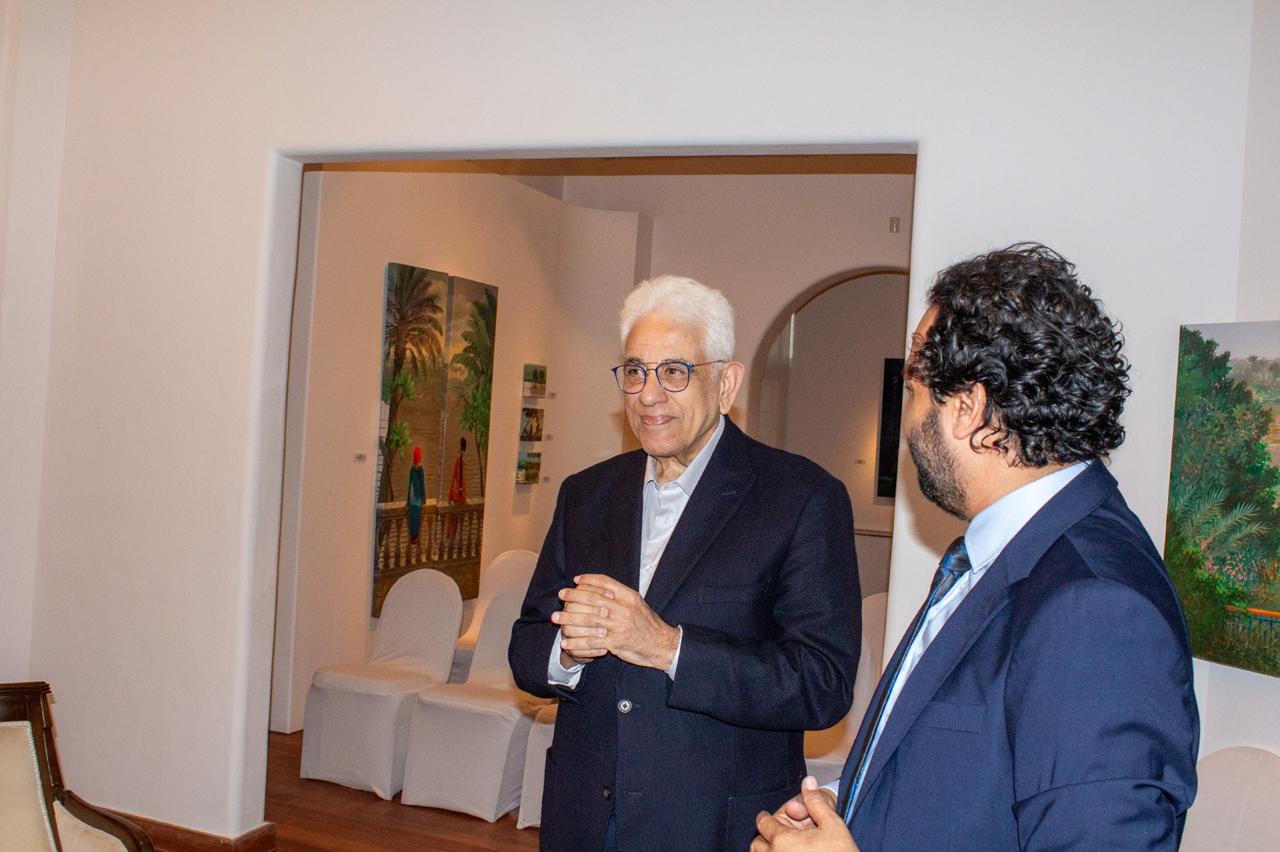
On the evening of Tuesday, June 3, 2025, at the Art Gallery Zamalek, Dr. Hossam Badrawi met with art and thought, beauty and meaning. Amidst the glow of the Nile and the magic of its colors, with art enthusiasts, at the “Lovers of the Nile” exhibition by the esteemed Alexandrian artist Adel Mostafa, who, through his brush, gave us a visual reflection of the serene, contemplative Egyptian identity, deeply rooted in water, soil, and nostalgia.
The exhibition organizers state:
In the presence of the Nile, we cannot find anyone better than Dr. Hossam Badrawi to speak to us about art… about Egypt… about the river as a living entity, about beauty as a path to awareness, and about culture as a soft power that elevates nations.
He is the thinker and the doctor, the politician and the humanitarian, and also the artist who sees with the mind’s eye and feels with the heart of the nation.
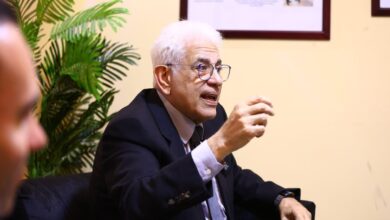
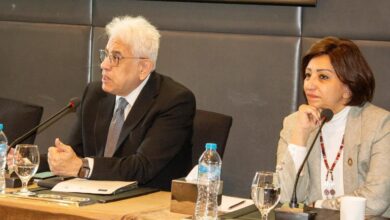
Professor Sylvia El-Naqqadi interviewed Dr. Hossam:
- How does Dr. Hossam Badrawi view the role of art in shaping societal consciousness?
Art is the mirror of consciousness and the generator of collective memory. It is not a luxury or an embellishment of life, but one of the deepest tools for shaping the conscience, creating meaning, and resisting ugliness, violence, and alienation.
Art rearranges priorities within the self, reconciles man with himself, instills in his conscience a sense of beauty, and thereby instills in him a sense of truth.
Societal consciousness is formed not only from school curricula and political speeches, but from the song we memorize, the painting we behold, and the play that stirs a question, a pain, or a dream within us.
Therefore, art is a long-term cultural reform tool, but it is the deepest in impact and the most enduring.
- Can art precede politics in reforming societies? And how?
Yes, sometimes it is the only possible beginning.
Art precedes law because it changes convictions before legislation is enacted.
Art precedes politics because it creates the dream and imagination necessary for any transformative project.
When an artist paints a beautiful homeland, he inspires the politician to strive to build it.
And when you see a painting like Adel Mostafa’s, you recall a calm, humane, reconciled Egypt, and you feel that you want to protect this beauty.
This is how reform begins from within, from the heart, from vision, not from discourse.
- What does the art and cultural scene in Egypt today lack to fulfill its role in comprehensive renaissance?
It lacks space… free and ample space for expression, for experimentation, for risk-taking.
It lacks confidence that art is not an adversary to any authority, but rather a partner in construction.
And most importantly, it lacks the connection between creativity and knowledge.
Art separated from thought turns into a formal display.
And thought separated from feeling becomes dry, without roots.
We need a national cultural project that brings art back to schools, imagination back to education, and beauty back to daily life.
- Can the Nile be a focal point for a contemporary cultural vision upon which artistic and educational projects can be built?
The Nile is not just a waterway that grants life; it is the artery of Egyptians’ collective memory and the spirit of time extending through successive civilizations. Yes, the Nile can be a focal point for a contemporary cultural vision, and it must be. In an era of digital modernity and cultural globalization, we need a reference point through which we can reconnect the past with the future, and the spirit with the body.
The Nile can serve as a basis for educational projects in geography, history, and environment, a source of inspiration in art, music, and literature, and even a platform for dialogue about identity and environmental justice as a living entity, a civilized entity, and a partner in shaping the Egyptian character.
- How did Dr. Hossam Badrawi interpret artist Adel Mostafa’s experience in this exhibition?
I interpreted this experience as an emotional visual journey that restores a lost sense of belonging to us. Artist Adel Mostafa, in his paintings, doesn’t just paint the Nile; he paints nostalgia, he paints the dream, and he paints what remains in our hearts of the purity of life on the riverbanks.
This exhibition is not just an artistic production; it is a cultural project that carries within it what can be built upon as a new narrative of identity. The artist has succeeded in freeing the Nile from its political or geographical symbolism and presenting it as an intimate, personal space that reshapes the relationship between man and place.
I interpreted it as an experience that emulates the “first home” that inhabits us, where the lover and the beloved, the child and the elder, the woman and the water… all drink from the same primary source of life.
- What impression was formed about the idea, the artistic style, and the emotional message of the works?
The first impression is warmth. Adel Mostafa’s paintings don’t shout; they whisper. His colors are not loud, but they speak of serenity. His style blends realism and impressionism, where he condenses form to evoke feeling.
As for the message, it is clear: the Nile is not just geography, but a conscience. In the paintings, there is a deliberate repetition of the duality of man and water, woman and boat, man and shadow… as if painting a perpetual state of waiting, continuous yearning, or a moment of love that is never complete, but overflows with sweetness.
- Did you see in the exhibition a kind of visual documentation of an Egyptian emotional state?
Absolutely. This exhibition documents – not through narrative, but through feeling – a form of Egyptian identity that is almost disappearing in the noise of cities and the pressure of modernity.
The woman in the pink dress, the man with the tarboosh, the tree, the palm tree, the boat – all these elements are not just artistic symbols; they are emotional codes that the soul reads before the eye.
It is a documentation of a romantic, peaceful, self-reconciled Egyptian state, contemplating the river not just as a source of livelihood, but as a mirror of the soul.
What artist Adel Mostafa did is akin to reprinting the Egyptian heart on a canvas of color. And in a time when documentation is associated with cameras and archives, he chose to document human memory with the grace of the brush, and that is more profound.
- If we imagine the Nile “as a person,” what would he be like? And what would he tell us?
If the Nile were a person, he would be a wise old man, who doesn’t speak much, but whispers tales from thousands of years ago, and listens to everyone who sits on his banks…
He would be a compassionate father, or a silent grandfather who knows everything about his grandchildren but only intervenes when he fears for them.
He would speak to us with the sound of water… about kingdoms that rose and fell, about the plows that tilled his soil, about the love that began on his shore, and about the souls that departed life in his hands.
He would speak to us about patience, about continuity, about generosity… because he gives without asking, embraces without tiring, flows without stopping.
- Does Dr. Hossam feel that the Nile has a special wisdom? And if so, what is it?
Yes, the Nile is unlike any other river.
Its profound wisdom lies in constancy amidst change.
The Nile teaches us that life doesn’t need shouting, but continuity.
That you can be soft like water, yet change the shape of rocks.
That you can be silent, yet carve a path in the heart of time.
To give without losing, and to proceed without detaching.
The Nile tells us: “Wisdom is to overflow when asked, and to dry up when insulted.”
- Is the Nile today still as Dr. Hossam knew it in childhood? Or has it changed? And who has truly changed… the river or us?
Geographically, the Nile is the same… but the spirit around it has changed.
The Nile I knew as a child was surrounded by songs, stories, and tranquility.
We looked at it with respect, as if it were a sacred being.
Today, however, we look at it hastily, or with regret, as if we have forgotten it.
I don’t think the river has changed; rather, it is we who have changed.
We have lost our intimate connection with nature, with slow time, with things that cannot be bought.
Perhaps the Nile is waiting for us to return, not as bodies inhabiting its banks, but as hearts that feel its presence.