Our vision for education affirms the importance of building young people’s character — something that can only happen through experience, cultural exchange, engagement with the arts, and practicing hobbies, combined with the joy of learning and the guidance of mentors who understand their role.
University theater is the meeting point of the arts.
It teaches students strict discipline while allowing freedom and creativity at the same time.
They rise to higher levels of mastery, respect for experience, proper speech, language, and facing audiences.
They practice freedom of movement with elegance and beauty.
Thus, education becomes consistent with its vision — and we present an example of how its goals can be achieved without burdening the state.
All of this happens with joy, refinement, and smiles on faces.
This is what we achieve in the University Theater Festival — initiated, organized, and executed by young people themselves, with their minds, hands, and even their own funding.
Oh Egypt, how beautiful you are when you allow your youth the freedom to express themselves and the space for success.
A week of work, joy, innovation, and creativity begins these days.
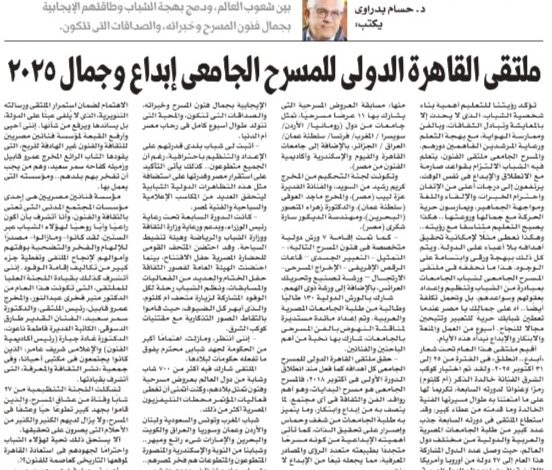
The festival this year was held under the slogan “Create… Break Free,” from 25–31 October 2025.
The great icon of Arabic music, Umm Kulthum, was chosen as the symbol of the seventh edition, in honor of her timeless artistic legacy.
This seventh edition attracted a large number of university students from Egypt, the Arab world, and international institutions.
This year’s participants came from 27 countries across Europe, Latin America, Africa, and the Arab region.
The festival included numerous activities and competitions with over 765 participants of various nationalities.
Among them was the theater competition featuring 11 plays from universities in: Romania, Jordan, Switzerland, Morocco, France, Oman, Iraq, Algeria, as well as Cairo University, Fayoum University, Alexandria University, and the Academy of Arts in Egypt.
Cairo International University Theater Festival — Creativity and Beauty
The jury included:
-
Director Karim Rashid (Sweden)
-
Veteran actress Azza Labib (Egypt)
-
Director Majid Al-Awfi (Oman)
-
Dr. Zahraa Al-Mansour (Bahrain)
-
Set designer Sarah Shokry (Egypt)
Workshops
Seven international specialized workshops in theater arts were held:
acting — physical expression — African dance halls — stage directing — improvisation — puppet design and manipulation — and a workshop for people of determination.
A total of 130 students from Egyptian and Arab universities participated.
A roundtable was held to discuss advancing theater arts in universities, with distinguished researchers and artists participating.
The festival achieved all its goals, as it has since the first edition in 2018.
University theater is the theater of beginnings — a vital source of art and culture in any society, rich in innovation, fueled by the passion and determination of young students.
Its creative importance lies in its ever-renewing nature, its diverse perspectives, and its knowledge sources — making it an endless spring of creativity.
The most beautiful part of the festival is the cultural, artistic, and intellectual exchange among the world’s youth — merging their joy and positive energy with the beauty of theater arts, the friendships formed, and the love that grows throughout a full week in Egypt, the Mother of the World.
The youth proved their ability to organize professionally, despite being volunteers.
This also affirms Egypt’s stability and its ability to host such international youth events, achieving great media, touristic, and artistic benefits.
The seventh edition was held under the patronage of the Prime Minister, and with the support of the Ministry of Culture, the Ministry of Youth and Sports, and the Tourism Promotion Authority.
The National Museum of Egyptian Civilization hosted the opening ceremony, while the General Authority for Cultural Palaces hosted the closing ceremony and many events.
The youth also organized a trip for all delegations to visit the Umm Kulthum Museum, which amazed the guests, who took photos with the iconic singer’s belongings.
I still await greater governmental attention to this remarkable youth effort — an effort exceeding what many governments do for their countries.
More than 700 young men and women participated, presenting theatrical works and artistic performances representing their nations.
I had hoped Egyptian TV channels would cover the festival more extensively.
The youth of Morocco, Tunisia, Saudi Arabia, Lebanon, Jordan, Oman, Syria, Iraq, Kuwait, Bahrain, and the UAE were wonderful and impressive — and our Egyptian youth from Nubia, Alexandria, Mansoura, and the volunteers were a source of pride.
University students from Fayoum, Ain Shams, Mansoura, and Helwan presented refined art and performances that captivated minds.
We need more…