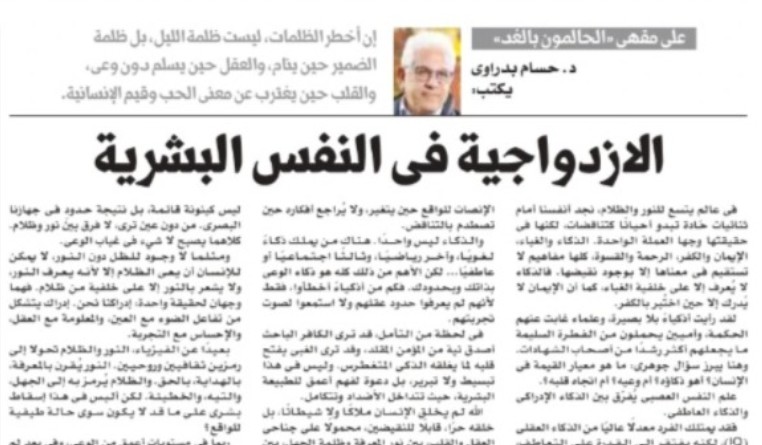
Duality in the Human Soul
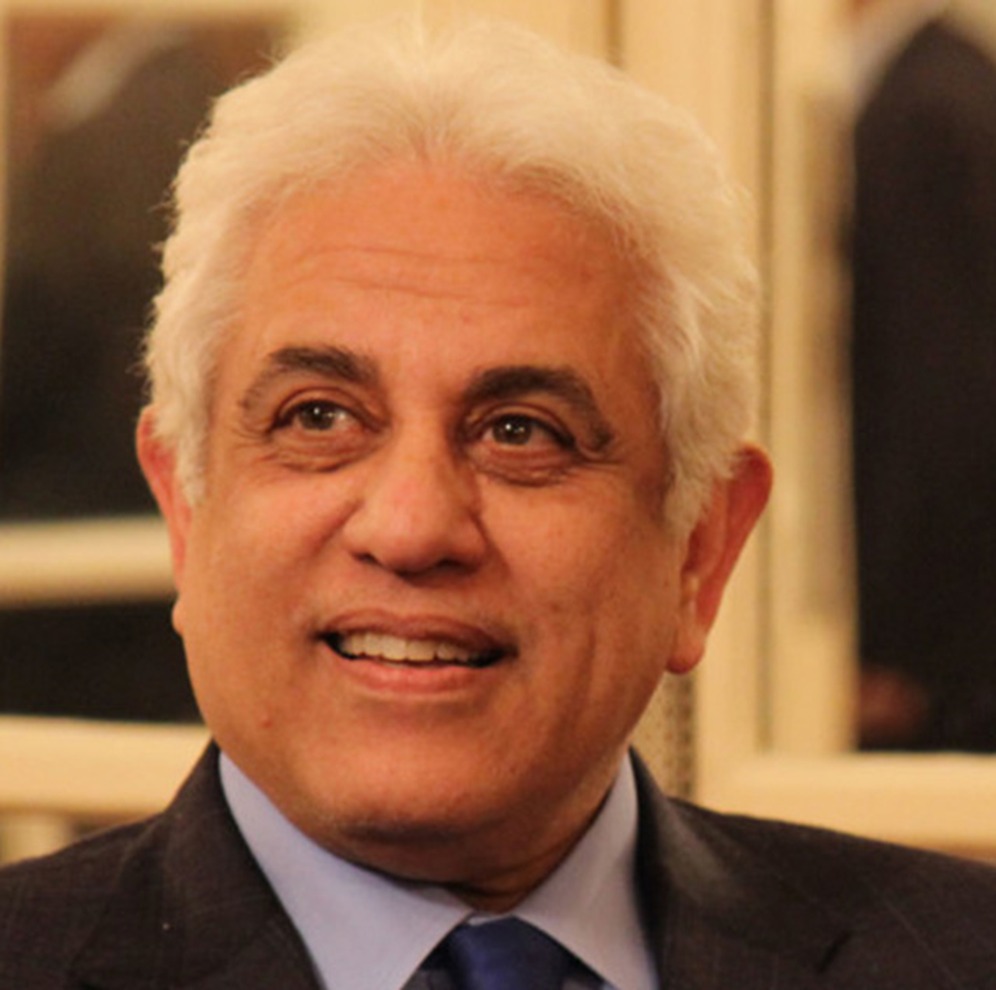
By: Hossam Badrawi
In a world that accommodates both light and darkness, we find ourselves facing sharp dualities that may sometimes seem like contradictions, but in truth, they are two sides of the same coin. Intelligence and foolishness, faith and disbelief, mercy and cruelty — all these concepts derive their meaning through their opposites. Intelligence is only known in the presence of ignorance, and faith is only realized when tested by disbelief.
I have seen intelligent people lacking insight, scientists devoid of wisdom, and illiterate individuals possessing natural intuition that makes them more discerning than degree-holders. This raises a fundamental question: What defines a person’s true value? Is it their intelligence, awareness, or the orientation of their heart?
Neuropsychology distinguishes between cognitive intelligence and emotional intelligence.
A person may have a high IQ but lack empathy, be unable to read others’ emotions, or even understand their own. In such cases, intelligence becomes a cold tool — capable of achievement but void of human depth.
From the perspective of genetics and behavior, a person is born with a certain potential, but that potential doesn’t determine their destiny. Genes may provide predisposition, but they do not dictate the outcome. The true difference lies in willpower, mental environment, and the upbringing that nurtures awareness. This explains how two children raised in the same environment can take completely different paths — one embracing the light of reason, the other choosing darkness.
The Qur’an alludes to this profound truth about human nature:
“And [by] the soul and He who proportioned it. And inspired it [with discernment of] its wickedness and its righteousness.”
It’s as if both wickedness and righteousness are inherently planted within us as possibilities — and the choice is ours.
A person’s intelligence should not be measured only by how quickly they comprehend or how much information they possess, but also by their ability to connect ideas, make thoughtful judgments, and see beyond appearances.
True intelligence is flexible, critical, and humble before the unknown.
Foolishness, on the other hand, is sometimes a form of mental rigidity. It doesn’t necessarily reflect a lack of ability, but perhaps laziness in questioning, or a false certainty that blocks understanding. A fool may be educated, yet fail to listen to reality when it changes, or to revise his beliefs when faced with contradiction.
And intelligence is not a single quality. One may have linguistic intelligence, another mathematical, a third social or emotional. But above all, the most important form is self-awareness — the intelligence of knowing your own limits.
Many intelligent people have erred simply because they didn’t recognize the boundaries of their minds or failed to listen to their own experiences.
In a moment of reflection, you may find a questioning disbeliever more sincere than a conforming believer. You may see a fool open his heart to what the arrogant intellectual has closed off.
This is neither simplification nor justification — it is an invitation to deeper understanding of human nature, where opposites intertwine and complement each other.
God did not create man as an angel or a devil, but as a free being — capable of embodying both extremes — carried on the wings of mind and heart, between the light of knowledge and the darkness of ignorance, between guidance and misguidance, on a journey that ends only at the moment of complete realization.
Perhaps the greatest quality in a human being is not merely to be intelligent or faithful, but to strive — to be aware that life is a constant test, and that as long as one questions, seeks, and contemplates, they are on the path, even if they stumble.
Since the dawn of humanity’s awareness of the world, light and darkness have formed the deepest perceptual dualities in our consciousness. Through them we’ve distinguished day from night, safety from fear, knowledge from ignorance — even life from death.
But… is light and darkness truly a duality in existence? Or are they simply projections of our minds, tied to the nature of our senses and perception?
Light, from a physical standpoint, is a range of electromagnetic waves, of which only a small part is visible to our eyes — what we call “visible light.”
Darkness, on the other hand, is not “something” in itself, but merely the absence of this spectrum from our field of vision. It emits no waves, has no measurable substance — it is a visual void, the silence of light.
But if we reflect deeper… we may find this duality to be a perceptual illusion. The eye doesn’t actually “see” light; it sees its effect when it strikes objects. Darkness is not an entity — it is simply the result of our sensory limitations. Without eyes to perceive, there is no distinction between light and darkness. Both cease to exist without awareness.
Just as there can be no shadow without light, one cannot perceive darkness except through knowing light — and cannot feel light except against a backdrop of darkness. They are two faces of one truth: our perception.
A perception shaped by the interaction of light with the eye, of information with the mind, of emotion with experience.
Beyond physics, light and darkness have become powerful cultural and spiritual symbols. Light is associated with knowledge, guidance, and truth. Darkness is linked to ignorance, confusion, and sin.
But isn’t this merely a human projection onto what may, in reality, be nothing more than different states of energy?
Perhaps at deeper levels of consciousness — in dimensions we’ve yet to access — there is no “light” or “darkness,” only varying intensities of energy or awareness. Just as in quantum mechanics, where particle and wave are simply two states of the same existence — maybe light and darkness are also manifestations of one entity, perceived differently according to the capabilities of our perception.
We do not see the world as it is — we see it as we are.
The boundary between light and darkness may not exist in nature — it may lie within us.
Insight, as the word implies, is not the sight of the eye, but a deeper, truer vision — one that comes from conscious awareness, a living intuition, and an inner connection to truth.
It is the ability to perceive meaning in events, purpose in trials, and a message behind pain.
Negligence is not simply ignorance — it is the absence of internal sensitivity to presence and meaning. The heedless person is not the one who doesn’t know, but the one who doesn’t pay attention, who doesn’t respond — who lives as if asleep while awake.
The greatest light is not the one that lights your path, but the one that helps you see yourself.
And the darkest darkness is not the night, but the slumber of conscience, the surrender of the mind without awareness, and the estrangement of the heart from love and human values.