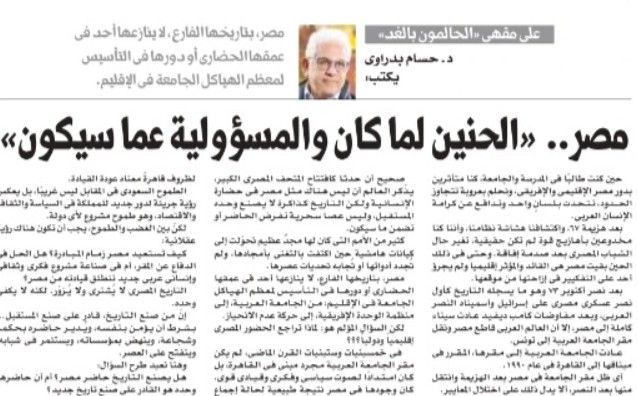
When I was a student in school and university, we were influenced by Egypt’s regional and African leadership and dreamed of an Arab identity beyond borders, speaking with one voice and defending Arab dignity.
After the defeat of 1967, when we discovered the fragility of our system and realized we had been deceived by illusions of strength, young Egyptians woke up in shock. Yet even then, Egypt remained leader and regional influencer; no one dared imagine removing it from its position.
After the victory of October 1973 — the first Egyptian military victory over Israel, recorded in history as the Arab victory — and after Camp David, Sinai returned fully to Egypt. Still, the Arab world boycotted Egypt and moved the Arab League headquarters to Tunisia.
The League returned to Cairo in 1990.
Meaning: it left after victory, not defeat. Does that not show distorted standards?
Today, in a time when spheres of influence are being redrawn and symbols mix with interests, a question emerges:
Do we build our present on our history?
Or must we build a new present to earn a new history?
Is having a civilization extending thousands of years enough to preserve centrality?
Or is effective action in the present the only true source of enduring relevance?
I follow the tense debate about leadership in the Middle East. I do not see mere politics — I hear deeper questions.
Egyptian anger is natural; Egypt’s leadership was not just geography but acknowledgment of its historic role. The new claims for leadership reflect rising ambitions of wealthier states powered by oil wealth.
Is leadership measured by memories or current influence?
Is the fear of losing leadership fear of losing position — or losing ability?
An event like the Grand Egyptian Museum opening reminds the world of Egypt’s unmatched civilizational legacy. Yet history alone does not shape the future.
Many nations of great pasts became marginal when they only sang about glory without renewing themselves.
Egypt’s deep history is uncontested. It founded major regional structures: the Arab League, the Organization of African Unity, the Non-Aligned Movement.
But the painful question: why has Egyptian presence declined regionally and globally?
In the 50s and 60s, the Arab League in Cairo symbolized a strong unified political voice. Egypt had influence, not just heritage or scholars, but a living Arab project.
After the Iraq war and through 2011’s upheavals, Egypt’s role shrank, replaced by actors with wealth, media, and ambition.
Is moving negotiations to Qatar or Saudi Arabia more important than actual influence?
Is the problem location or lack of Egyptian initiative?
Even the Arab League has become weak; talk of relocating it reflects changing capabilities and digital communication, not just politics.
Popular Egyptian anger at marginalization is understandable but must not turn to bitterness.
And when events return to Egypt due to circumstances, it does not automatically mean leadership returned.
Saudi ambition is natural and legitimate — a vision for political, cultural, and economic leadership.
Between anger and ambition, there must be rational vision:
How does Egypt regain initiative?
By defending a building?
Or by creating a new intellectual, cultural, and human Arab project led from Cairo?
History cannot be bought or forged.
But it is not enough alone.
Those who made history can remake it — if they manage the present with wisdom, courage, strong institutions, educated youth, and openness.
So again:
Does history make Egypt’s present?
Or does Egypt’s present make a new history?
The answer is not angry reaction but positive action that restores Egypt’s role through choice — not because others lacked options.
Egypt is not a historical archive.
It is a living spirit in every Arab when they hear Umm Kulthum, read Naguib Mahfouz, Taha Hussein, Al-Aqqad, and Ahmed Shawqi, watch Egyptian cinema, call money “masary,” and embrace Egyptian ideas of justice from Muhammad Abduh to Saad Zaghloul.
Headquarters may move, institutions may shift, but what does not change is the value nations grant themselves.
If we believe we carry not just position but mission — with the unique heritage only we possess — then Egypt’s present, however complex, can redraw history rather than remain captive to it.
We need only awareness, will, management, and a forward-looking vision, built on the strength of our educated youth.