Who Is Evelyne Porret?
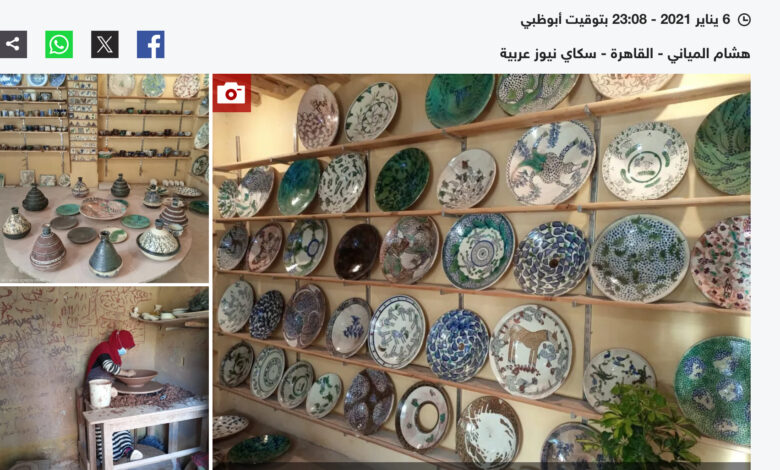
Evelyne Porret is a Swiss ceramic artist who came to Egypt in the 1960s and settled in the village of Tunis overlooking Lake Qarun. She was the first to introduce the art of ceramics and artistic pottery to the village in a systematic way.
She founded a school to teach ceramics to the village’s children and youth, using a simple and humane approach.
Her project was not commercial as much as it was cultural and developmental.
What Did She Create in the Village of Tunis?
She transformed a poor, isolated village into a regional center for ceramic art—a cultural tourism destination and a model of development based on art and education rather than aid.
She graduated generations of artists and artisans who went on to establish their own workshops. Thanks to her, the village today is filled with studios, galleries, and festivals.
Mrs. Evelyne’s experience is a rare example of development and local community empowerment. It demonstrated the role of art in transforming both the economy and collective awareness.
Her experience is now taught as a global model of sustainable cultural development.
Evelyne Porret did not come to the village of Tunis in Fayoum carrying a development roadmap, a UN program, or a discourse about poverty and empowerment. She came with something simpler—and something more dangerous.
She came with a sense of beauty.
Before Evelyne, the village of Tunis was merely a forgotten point on the margins of Lake Qarun—a place resembling thousands of others that the state passes by without seeing, and history passes by without stopping.
But Evelyne saw what was unseen: that there is a soul in clay, creative energy in a child’s hands, and silent salvation in beauty.
She did not teach them how to make pottery. She taught them—without saying it—how a human being discovers himself through creation.
She sat with children the way a sage sits with disciples: no commands, no rigid curricula, only space for wonder.
Clay between the fingers was not a material; it was an existential question:
What can you create?
And who do you become when you create?
And here the real story begins.
Evelyne never spoke about “women’s empowerment,” yet the women of the village became workshop owners.
She never spoke about the “creative economy,” yet the village became a source of dignified livelihood for its people.
She never spoke about “identity,” yet pottery carried the spirit of the place rather than imitating cities.
This is the difference between those who change reality and those who write reports about it. Evelyne did not change the village; she restored people’s confidence in their ability to create.
And here lies the essence.
We are mistaken when we think beauty is a luxury. Beauty is an existential necessity. When a human creates something beautiful, he does not destroy, does not hate, and does not surrender. Beauty refines the soul without preaching and reorganizes the inner self without rhetoric.
What Evelyne did is what great messages do when they succeed: she did not dictate how people should live; she opened a door to meaning.
That is why the village did not need moral police or long sermons. The clay did the work.
The village of Tunis is a witness to a greater idea. Today, it is not merely a tourist destination; it is living proof of a concept we often forget:
Human beings are not built by force, nor saved by aid, but restored through beauty and meaning.
Evelyne was not Egyptian, but she understood Egypt more deeply than many. She understood that this country does not need someone to “save” it, but someone to awaken what is already within it.
Salute to Evelyne—and salute to art. She passed away, but the impact remained. The clay remains as a witness, the children remain artists, and the village quietly tells us:
When you respect the human spirit, people create their own miracles.
This, at its core, is a lesson in awareness, in human creation, and in the meaning of civilization as an act—not a slogan.
Evelyne Porret studied applied arts in Switzerland before emigrating to Egypt in 1965.
In a televised interview with the BBC in 2016, speaking Arabic with a proper Egyptian accent she had mastered after years of living in Egypt, she said that she had always loved rural environments—even in her home country—and spoke of her admiration for rural arts in Egypt.
She added in that interview:
“I like to work in a place where there are beautiful views in front of me that I can draw—like the palm trees here, the animals there, and the beautiful desert scenery around us.”