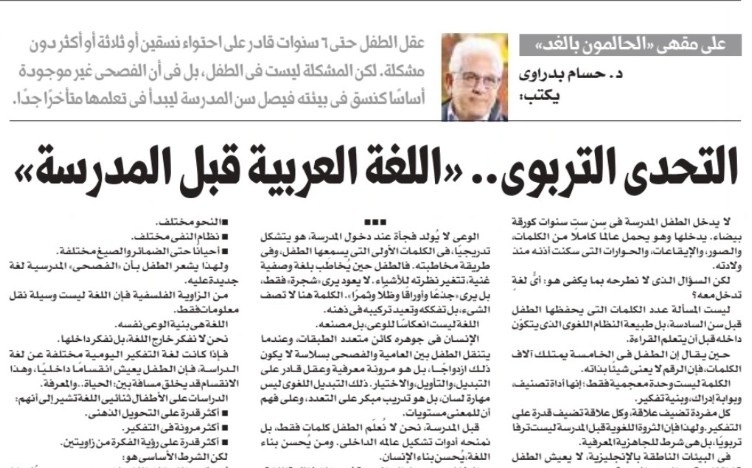
A child does not enter school at the age of six as a blank page.
They enter carrying a whole world of words, images, rhythms, and dialogues that have inhabited their ears since birth.
But the question we do not ask often enough is:
Which language enters with them?
The issue is not the number of words a child knows before the age of six, but the nature of the linguistic system forming inside them before they learn to read.
When we say that a five-year-old possesses thousands of words, the number itself means little.
A word is not merely a lexical unit; it is a tool of classification, a gateway to perception, and a structure of thought.
Every vocabulary item adds a relationship.
Every relationship adds a capacity for thinking.
Thus, linguistic richness before school is not an educational luxury; it is a prerequisite for cognitive readiness.
In English-speaking environments, a child does not experience a linguistic leap between home and school.
The language they hear is the same one they will read.
In the Arab context, however, the situation is fundamentally different.
The Egyptian Arab child lives in a unique state of diglossia:
a daily colloquial… and a standard formal Arabic.
When they enter school, they do not move from one level to another within the same system —
they move from one system to another.
The sound changes.
The structure changes.
The level of abstraction changes.
They are not merely learning to read;
they are learning a new language for reading.
Colloquial Arabic is not a linguistic error. It is a living system, fully functional in its context.
Egyptian colloquial Arabic has clear tense structures, a regular negation system, and recurring syntactic patterns.
It is not chaos; it is a different system.
But the two systems do not serve the same function.
The problem is not diglossia itself —
it is the absence of a bridge between them.
The crisis does not lie in the coexistence of colloquial and formal Arabic, but in leaving the child to cross the gap alone upon entering school.
If the child is not exposed to simplified formal Arabic before school, they find themselves reading in a language they have not heard sufficiently.
Reading then becomes a double task:
first understanding the vocabulary of the language…
then understanding the text.
Here the gap widens.
A child is capable of carrying two systems — if introduced to both early.
Before school, the very structure upon which all thinking will stand is being formed.
Language is not merely a medium of instruction; it is the tool through which human awareness is constructed.
Awareness does not suddenly emerge upon entering school.
It forms gradually in the first words a child hears and in the way they are addressed.
When a child is spoken to in rich descriptive language, their perception changes.
They no longer see merely a “tree,” but a “trunk, leaves, shade, and fruit.”
The word does not just describe the object;
it dismantles and reconstructs it in the mind.
Language is not a reflection of awareness; it is its factory.
The human being is layered by nature.
When a child moves fluidly between colloquial and formal Arabic, this is not confusion but cognitive flexibility — a mind capable of switching, interpreting, and choosing.
This linguistic switching is not merely a skill of the tongue;
it is early training in plurality and in understanding that meaning has levels.
Before school, we are not teaching words;
we are giving tools for shaping the inner world.
Whoever builds language well builds the human being well.
A child who grows up bilingual — speaking Arabic and English, for example — reaches school with two auditory systems already present in the brain, capable of accommodating both.
But the Egyptian child often arrives with only one system: colloquial.
Then we suddenly ask them to think, write, and learn in formal Arabic — a language they have not sufficiently heard.
Here the shock begins.
From an educational neuroscience perspective, children do not merely learn words; they learn:
-
The rhythm of the language
-
Its music
-
Sentence structure
-
Patterns of negation
-
Forms of questioning
This forms what is called the internal auditory system.
A French or English child enters school already hearing the same language at home.
An Egyptian child enters school to begin a new one.
Even if vocabulary sometimes overlaps,
the rhythm differs,
the structure differs,
the morphology differs.
In essence, the Egyptian child does not move to a higher level within the same linguistic system —
they move to an entirely new system.
In Arabic, the gap is wide because:
-
The lexicon differs
-
The grammar differs
-
The negation system differs
-
Even pronouns and verb forms often differ
Thus, formal Arabic feels like a new language.
From a philosophical angle, language is not merely a vehicle of information.
Language is the structure of consciousness itself.
We do not think outside language.
We think within it.
If the language of daily thought differs from the language of learning, the child may experience an internal division — creating distance between life and knowledge.
Research on bilingual children shows they are:
-
More capable of cognitive switching
-
More flexible in thinking
-
Better able to view ideas from multiple perspectives
But the key condition is that both linguistic systems are present auditorily from an early age.
In our case, we do not build balanced bilingualism; we create a transitional gap.
The child does not hear formal Arabic at home nor see it widely in their natural environment, yet is required to understand science in it. Formal Arabic becomes associated with exams — not life.
The solution is not eliminating diglossia, but transforming it into conscious bilingualism.
Let the child hear formal Arabic early — in stories, calm dialogue, simplified explanation without artificiality — until they develop a “formal ear.”
Then formal Arabic will not be merely the language of books, but a higher register of their own language.
The key point:
A child can arrive at school with more than one language — and this is healthy and advisable.
Up to age six, the brain can contain two, three, or even more linguistic systems without difficulty.
The problem is not the child.
The problem is that formal Arabic is absent as a living system in their environment, so they begin learning it too late.
Once again: every language has its own system and vocabulary. A child can acquire six languages — sometimes more — in early childhood. The issue is that formal Arabic is not present in the child’s environment as a system to acquire, because colloquial Arabic is itself a distinct language with its own vocabulary and grammar.
In the next article, I will present an educational policy paper addressing this challenge.