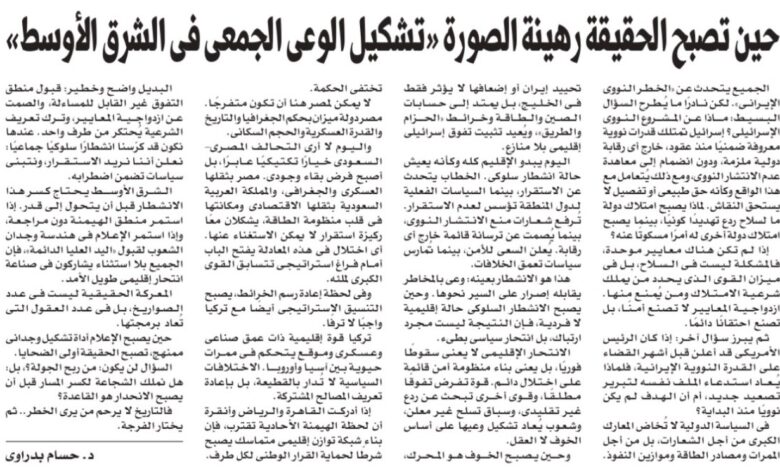
Shaping Collective Consciousness in the Middle East
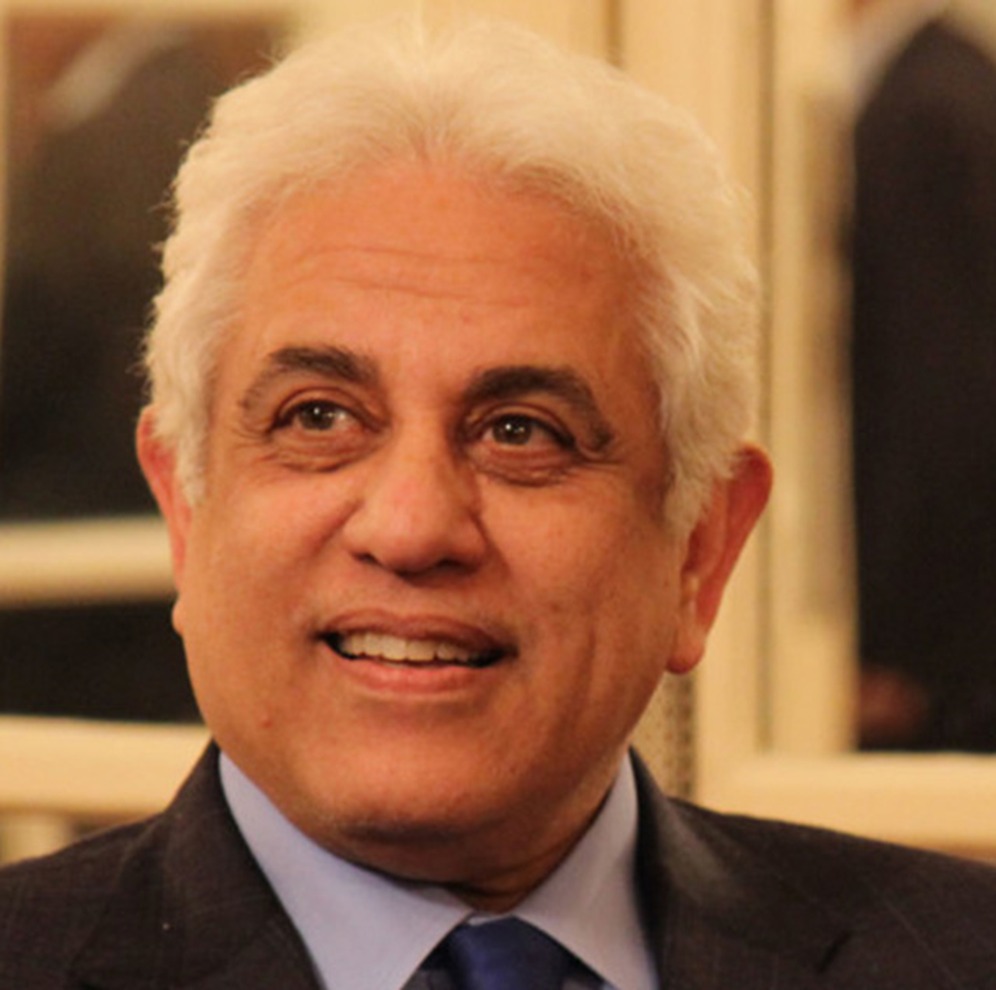
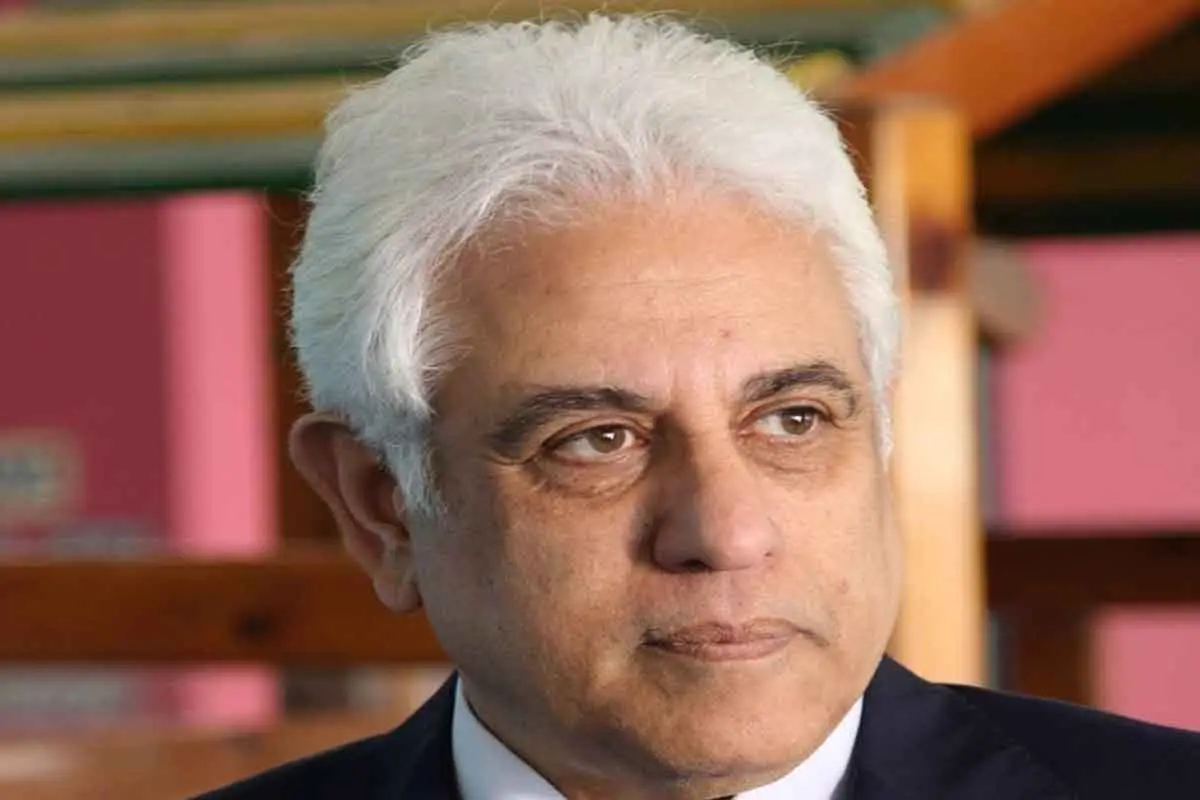
By Hossam Badrawi
In the Middle East, wars do not begin when rockets are launched, but when narratives are crafted.
Israel and the United States announce strikes on Iran and the killing of its leaders in documented and declared military operations, celebrated politically and in the media. Iran responds with targeted strikes toward American bases and Gulf targets.
The media speaks of a “comprehensive war,” yet the number of casualties can be counted on fingers, and the visual imagery does not exceed columns of smoke here and there. Israel shows no significant losses.
So where is the comprehensive war?
Are we facing a major confrontation, or a calculated management of image-building within regional consciousness?
The real defeat does not occur on the battlefield, but in awareness.
The difference between the event and its narrative is no longer a detail. In the age of the image, narrative has become part of the weapon. The military impact may be controlled, but the psychological impact is amplified.
The battle has shifted from rockets to perception: who has the right to define reality?
In classical wars, destruction preceded narrative.
Today, narrative precedes destruction—or may replace it altogether.
The event is presented as a regional earthquake, while the material facts remain relatively limited. No notable Israeli losses. A limited Iranian response. Yet the media language is saturated with existential finality.
This gap between reality and image raises an old philosophical question:
Are we living the event—or its representation?
The battle is no longer only on the ground, but in shaping collective perception.
And the real defeat does not occur on the battlefield, but in awareness.
I am not a supporter of Iran’s clerical regime. I see it as a rigid dictatorship that has often restricted its people and exported its crises. But that does not negate an objective truth: Iran was subjected to the initial military strike and the killing of its leadership. Rejecting authoritarianism does not mean accepting the violation of sovereignty. Political justice is not built on ideological hatred.
Ironically, a wide sector of Arab media focuses insistently on the Iranian response, presenting it as the greater threat.
As if aggression from an ally becomes “preventive action,” while aggression from an adversary becomes an “existential threat.” This is not merely double standards—it is moral reengineering of consciousness.
Everyone speaks of the “Iranian nuclear threat.” Rarely is the simple question asked: what about Israel’s nuclear project? Israel has possessed implicitly acknowledged nuclear capabilities for decades, outside binding international oversight and without joining the Non-Proliferation Treaty, yet this reality is treated as a natural right or an insignificant detail.
Why does one state’s possession of deterrent weapons become a cosmic threat, while another’s becomes an unspoken norm?
If standards are not unified, the problem is not the weapon, but the balance of power that determines who is granted legitimacy to possess it and who is denied.
Double standards do not produce security—they produce permanent tension.
Another question arises: if the U.S. president declared months ago that Iran’s nuclear capability had been eliminated, why is the same file revived to justify new escalation? Or was the objective never nuclear to begin with?
In international politics, major battles are not fought over slogans, but over corridors, energy resources, and balances of influence.
Neutralizing or weakening Iran affects not only the Gulf, but extends to calculations involving China, energy routes, and the Belt and Road map—reconsolidating uncontested Israeli regional superiority.
Today, the region appears to live in behavioral schism. The rhetoric speaks of stability, while actual policies lay the foundations for instability.
Non-proliferation slogans are raised, while an existing arsenal outside oversight remains unspoken. Security is declared as the goal, while policies deepen divisions.
This is schism in its pure form: awareness of risks paired with insistence on moving toward them. When behavioral schism becomes regional rather than individual, the result is not confusion—it is slow political suicide.
Regional suicide does not mean immediate collapse. It means building a security system based on permanent imbalance: one power imposing absolute superiority, others seeking unconventional deterrence, an undeclared arms race, and peoples whose consciousness is reshaped around fear rather than reason.
When fear becomes the driver, wisdom disappears.
Egypt cannot be a spectator here. By geography, history, military capacity, and demographic weight, Egypt is a balance-of-power state.
Today, I see the Egyptian–Saudi alliance not as a temporary tactical option, but as an existential necessity. Egypt, with its military and geographic weight, and Saudi Arabia, with its economic strength and central role in global energy, together form an indispensable pillar of stability. Any disruption in this equation opens the door to a strategic vacuum that major powers will rush to fill.
In this moment of redrawing maps, strategic coordination with Turkey is also a necessity, not a luxury.
Turkey is a regional power with industrial and military depth, and a position controlling vital corridors between Asia and Europe. Political differences are not managed by rupture, but by redefining shared interests.
If Cairo, Riyadh, and Ankara recognize that the moment of unilateral dominance is approaching, then building a cohesive regional balance becomes a condition for protecting each nation’s sovereign decision-making.
The alternative is clear and dangerous: accepting unquestionable supremacy, remaining silent about double standards, and allowing legitimacy to be monopolized by one side.
At that point, we would have institutionalized collective behavioral schism: declaring that we seek stability while adopting policies that guarantee instability.
The Middle East must break this schism before it becomes destiny.
If the logic of hegemony continues unchecked, and if the media continues engineering public emotion to normalize permanent superiority, then everyone—without exception—participates in constructing a long-term regional suicide.
The real battle is not in the number of rockets, but in the number of minds being reprogrammed.
When media becomes an instrument of systematic emotional engineering, truth becomes the first casualty.
The question will not be who won the round—but whether we possess the courage to break the trajectory before decline becomes the norm.
History does not forgive those who see danger—and choose spectatorship.