I opened a dialogue with a group of young dreamers of the future who meet with me weekly. We were discussing the human values that must be deepened.
When the topic of obedience arose as a value representing respect, the youth objected strongly, saying that linking respect with obedience is totally unacceptable. Obedience, they argued, is for slaves, not for free people. We can understand compliance with rules, respectful dialogue, and commitment to agreements — but obedience means abandoning one’s mind and accepting enslavement.
I told them, supporting their point, that the enlightenment of humanity during the dark ages began with rebellion against obedience to religious figures and authorities who sought to control people.
The philosopher Immanuel Kant was an inspiration to his era through his essay “Dare to Know”, emphasizing the importance of emerging from intellectual immaturity and reaching the age of reason. He defined immaturity as dependence on others and the inability to think or act without consulting “guardians.” His call for enlightenment was:
“Use your own reason, O human beings! Have the courage to think for yourselves. Do not remain idle or rely on destiny — act, move, and engage positively and thoughtfully in life.”
Human protection lies in education that enables individuals to become mature and self-reliant, using reason to free themselves from the ignorance inherited through dogma and history.
Obedience gives rise to voluntarism and compliance, yet I have never found a rational justification for demanding that a wife “obey” her husband as if he were her lord and master — a notion my mind cannot accept, and which surely requires reinterpretation.
The truth is that ignorant, male-dominated societies are comfortable commanding women to obey their husbands, believing that women are inferior and not equal to men.
I add: We have long heard the verse “Men are qawwamun (maintainers) over women,” taking it as an unquestionable absolute, though the verse actually says:
“Men are the protectors and maintainers of women because Allah has given some of them more (strength) than others and because they support them from their means.”
In my view, this connects “qiwamah” (maintenance) to superiority in knowledge, intellect, and contribution to society, and to financial responsibility.
Thus, if a woman possesses greater knowledge, benefit, and is the financial provider, she then holds “qiwamah” over the man — an interpretation contrary to patriarchal explanations that claim men are inherently superior and therefore rulers and masters over women.
When the Qur’an grants men qiwamah, it does so based on their spending and their advantage in knowledge and ability — both of which many women now surpass men in.
Obedience is a psychological act — a form of social influence where a person complies with explicit instructions from someone in authority. It differs from conformity (adapting to peers) and compliance (aligning with majority behavior). Depending on context, obedience may be moral — as in military organization — or immoral when tied to domination or exploitation.
Civilization can only be built by free people; enslavement in all political and social forms must be rejected. It differs entirely from lawful compliance with social contracts that apply equally to all — men and women alike — as these regulate freedom and equality.
Ironically, I sometimes find women themselves opposing my views on women’s rights. Yet wisdom and experience tell us: The hardest task in freeing a person from slavery is convincing them that they are not slaves.
Those most willing to submit to rulers or authority figures are often the same who enslave women and the weak — for the “value of obedience” creates both the dictator and the slave at once.
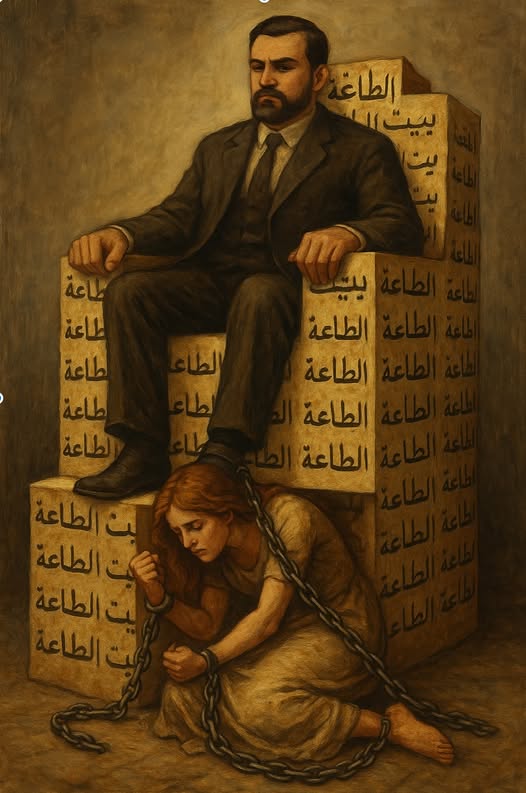
Returning to the main topic — discussing the concept of “House of Obedience” (Bayt al-Ta‘ah) in Egyptian society.
Many believe it has Quranic or religious roots, but in truth, it is the product of patriarchal interpretations and authoritarian practices that infiltrated jurisprudence and law, later inherited by the courts.
The question arises:
How can one human being be forced to live under another’s authority in the name of obedience, when divine obligation itself is founded on freedom of choice?
Even obedience to God — the highest and most sacred — is voluntary, as stated:
“So whoever wills — let him believe; and whoever wills — let him disbelieve.” (Al-Kahf 18:29)
If God did not impose obedience by force, how can humans impose it upon one another in a relationship meant to be based on love and compassion?
The “House of Obedience” is not a Quranic text but a legal article derived from ancient jurisprudence that entrenches male authority. It obliges a wife to return to the marital home even against her will unless she proves harm.
But isn’t this a form of coercion? Can family life truly be built on court orders and enforcement rather than affection and choice?
There is no greater humiliation than forcing a woman to live with a man she no longer wants, and no greater weakness than a man needing the police and the law to keep a woman by his side.
A real family is founded on peace, affection, and mercy — not legal papers and enforcement orders.
Reconsidering the Concept
When we reread Quranic texts free from patriarchal tradition, we find that the relationship between man and woman is one of equality and partnership:
“And among His signs is that He created for you mates from among yourselves so that you may find tranquility in them, and He placed between you affection and mercy.” (Al-Rum 30:21)
Where is affection and mercy in a home to which a woman is dragged by force?
“House of Obedience” is a concept outdated by time — a wound in human conscience before being a clause in law.
What we need today is not enforced obedience, but a revival of freedom and dignity within the most sacred of human relationships: marriage.
For love cannot be achieved through coercion.
What is “House of Obedience” or “Obedience Notice” in Egyptian Law?
When a wife leaves the marital home or refuses to return, the husband has the right to issue her a legal notice (an “obedience summons”) requiring her to return.
The law grants the wife 30 days from the date she receives the notice to either return or file an objection in Family Court.
If she refuses to return without valid legal reason after this period, the husband may file a “disobedience (nushuz) lawsuit” to revoke some of her rights such as alimony.
However, the law stipulates that the home she is summoned to — the so-called “House of Obedience” — must be fit for living, financially and socially appropriate, free of in-laws, and safe for her.
The wife also has the right to object within the legal period, providing reasons such as the home being unsuitable or unsafe — and if proven, the notice becomes invalid.
Modern Challenges and Debates
Some judges and lawyers point out that the “obedience notice” is sometimes used as a pressure tool against women, and courts may issue rulings obliging wives to return even when the home is unsafe.
There is ongoing debate among scholars and academics about the legitimacy of this principle. Some Al-Azhar scholars affirm that “House of Obedience” as a literal term is not prescribed in Sharia, and that what exists is a misapplication of mutual rights and duties — not physical coercion.
Some legal reform advocates call for amending family law to reduce such practices that violate women’s rights, or to reconsider the enforcement of “obedience notices” altogether.