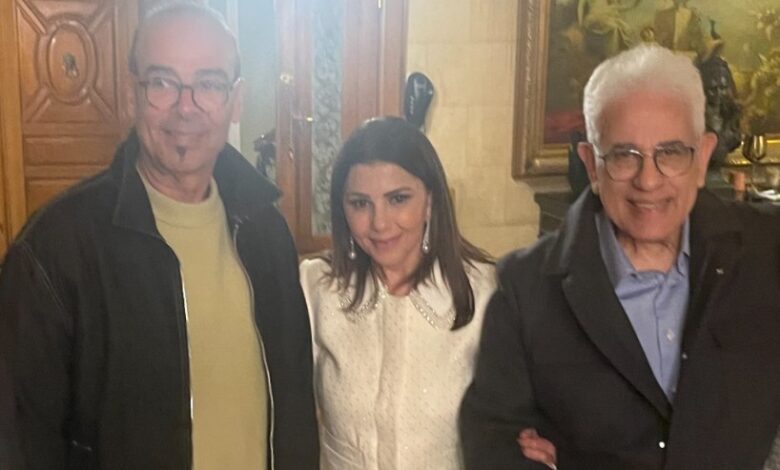
My attendance at the ceremony honoring Magda El Roumi was not merely participation in a social artistic event; it was a living testimony to a deeper meaning: that true art knows no borders, and that beauty—when sincere—explains itself.
A few days ago in Cairo, a distinguished gathering of Egyptian and Lebanese artists assembled, along with members of Arab and international diplomatic bodies, to celebrate an artistic figure who did not merely sing, but shaped an ethical and aesthetic path at the same time.
Before the honoring ceremony, Magda El Roumi had performed a remarkable concert at the Egyptian Opera House, attended by Egypt’s Minister of Culture and conducted by Maestro Nader Abbassi. It was not just a performance, but a meeting of one soul with another.
I did not know—nor did many others—that Magda El Roumi’s mother is Egyptian, and that her father was the great Lebanese poet and composer Halim El Roumi. He was a major figure in Lebanon’s musical life and is credited with discovering and supporting Fairuz in her early career.
When I learned this, everything made sense: her genuine love for Egypt, her passion for the Egyptian audience, and that moment when she held the Egyptian flag while singing “Ya Habibti Ya Masr” (My Beloved Egypt). It was not a protocol gesture nor a passing courtesy; it was an emotional belonging, and a recognition that artistic identity is broader than geography.
Magda El Roumi’s musical choices are not random; they are conscious and responsible. When she sings poems by Nizar Qabbani or other great poets, she does not summon the words merely for their linguistic beauty, but for the human dignity, emotional depth, and respect for intellect and taste they carry.
This is the art I believe in:
art that elevates the listener, not descends to them;
that opens the windows of the soul, not merely stirs instincts.
I side with art when it becomes a bridge between peoples, and when it uplifts the collective conscience. I side with an artist who turned her voice into a message, her choices into a stance, and her presence into enrichment—not noise.
In a time when voices are confused, and fame is reduced to what is fleeting and fast, Magda El Roumi reminds us that art carries responsibility, and that refinement is not a luxury, but a necessity.
Welcome to Egypt, Magda El Roumi.
Welcome to a magnificent voice that knows how to become a homeland, and to an art that transcends borders and—when sincere—elevates the audience’s taste and humanity.
Thanks also to the artists of Egypt who honored her—whether through their presence at the Opera House or through the beautiful tribute ceremony I was invited to the following day.
The soft power of Egypt, Syria, and Lebanon—once a radiant force in the Arab collective conscience and still so today—is a power not to be underestimated. And today, arts from the Maghreb and the Gulf have joined it, transcending political differences and dismantling barriers between us.
Once again, I was delighted by Magda El Roumi in Egypt, and by getting to know her closely. My admiration and appreciation for her grew even more—as a refined human being, in both form and substance.