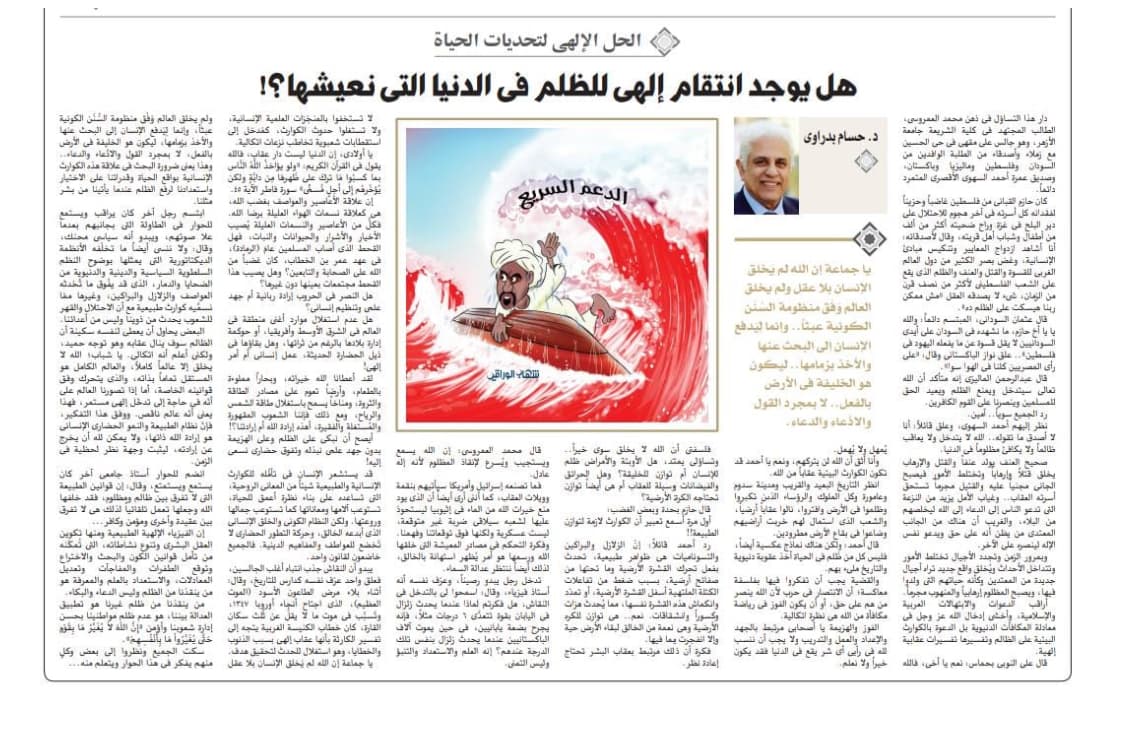
Is there truly divine revenge against injustice in the world we live in?
This question ran through my mind as I watched the double standards and the overturning of human values, as much of the Western world turns a blind eye to the cruelty, killing, violence, and injustice inflicted on the Palestinian people for more than half a century.
Yes, violence breeds violence, killing and terrorism produce more killing and terrorism, and matters become so mixed that the perpetrator appears as a victim, while the murdered is portrayed as a criminal whose family deserves punishment.
The absence of hope strengthens people’s inclination to pray to God to relieve them of suffering. What is strange is that those on the side of the aggressor also believe they are right and pray to the same God to grant them victory over the other.
As time passes and generations change, realities blur, events overlap, and a new reality emerges—one that the new generations of aggressors see as the natural world they were born into. The oppressed becomes labeled a terrorist, and the plundered becomes a criminal.
I watch Arab prayers and pleas for divine revenge, and I fear involving God Almighty in transactional earthly rewards or interpreting environmental disasters as divine punishment for the oppressor.
A passionate young man told me: “Yes, God gives respite but never neglects. I am certain God will not leave them unpunished. And yes, Doctor, environmental disasters are divine punishment.”
I replied:
But there are also opposite examples. Not every wrongdoer in life received worldly punishment. History is full of them.
The issue must be viewed through the opposite philosophy: believing that victory in war is automatically a reward from God, or that winning a sports match is a divine favor, is a dependent and passive mindset.
Victory and defeat depend on effort, preparation, work, and training. In my view, we should not attribute any earthly misfortune to God, for it may be a form of good we do not yet understand. My philosophy is that God creates only good.
My question extends further: Are epidemics and diseases injustices against humanity, or part of the balance of creation? Are fires and floods instruments of punishment, or part of the natural balance needed by the planet?
Why is it that when a 6-magnitude earthquake strikes Japan, only a few people are injured, while similar earthquakes kill thousands in other countries?
The answer is science, preparedness, and forecasting—not wishful thinking.
Do not underestimate humanity’s scientific achievements, and do not exploit disasters as a tool for populist manipulation that feeds on dependency.
The relationship between hurricanes and God’s anger is like the relationship between gentle breezes and God’s pleasure. Both hurricanes and breezes affect the righteous and the wicked, humans, animals, and plants alike.
Is the failure to properly use the resources of the richest region in the world — the Middle East and Africa — or the failure to govern its lands responsibly despite their great wealth, or its lagging behind modern civilization… is that human action, or divine will?
God gifted us abundant blessings: seas full of food, lands floating on energy sources, climates suitable for harnessing solar and wind power, and more and more. Yet we remain oppressed, exploited, and poor.
Is this God’s will — or our own?
A person may find spiritual meaning in contemplating human and natural disasters — meaning that helps build a deeper understanding of life, capable of absorbing suffering just as it appreciates beauty. But the cosmic order and human creation that God designed, and the evolution of civilization, do not follow emotions or religious interpretations. All are subject to the same laws.
During the plague of the Black Death (the Great Mortality), which swept Europe between 1347–1351 and killed at least one-third of its population, the Church framed the catastrophe as divine punishment for sins — exploiting the crisis to serve its agenda.
God did not create humans without reason, nor create the world according to universal laws in vain. Rather, He intended for humans to search for these laws and harness them, so that they become true stewards of the earth — not merely by words, claims, or supplications.
This means we must examine human and natural disasters in light of real-life conditions, our ability to choose, and our preparedness to confront injustice when it comes from other human beings like ourselves.
Let us also remember that the destruction caused by dictatorial regimes — whether religious or secular — often exceeds that caused by storms, earthquakes, volcanoes, and what we call natural disasters… and by occupation and oppression inflicted upon peoples by their own rulers, not their enemies.
Some seek comfort in believing that the oppressor will eventually be punished. This is a positive sentiment, but I know it is also dependent and superficial.
God creates only a perfect world — a world that is fully self-contained and operates according to its own laws. If we imagine that the world constantly needs divine intervention, this implies that it is flawed. According to this perspective, the natural order and the evolution of human civilization are God’s will itself. God does not contradict His own will to prove a point at a specific moment in time.
The laws of nature do not distinguish between oppressor and oppressed. God created these laws and allowed them to operate on their own. They do not differentiate between one belief and another, or between believer and non-believer.
It is the divine physics of nature — including the creation of the human mind and its diverse capacities for contemplation, scientific discovery, invention, prediction, adaptation, and preparation — that saves us from injustice, not prayer and lamentation.
What saves us from the injustice we inflict upon ourselves or others is the application of justice among us, and the refusal to wrong our own citizens through proper governance of our societies.
And I firmly believe:
“Indeed, God does not change the condition of a people until they change what is within themselves.”