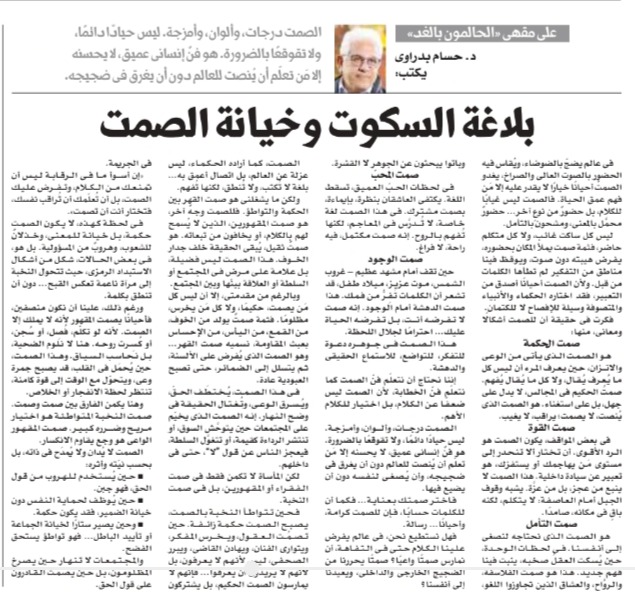
In a world brimming with noise—where presence is measured by loud voices and shouting—silence sometimes becomes a choice only those who grasp the depth of life can afford. Silence is not the absence of speech, but another kind of presence… one laden with meaning and charged with reflection.
Not every silent person is absent, nor every speaker present. There is a silence that fills the space with its weight, imposes awe without a voice, and awakens in us realms of thought untouched by words before. And because silence is sometimes truer than expression, sages, prophets, and mystics have often chosen it—not for concealment, but as a means of disclosure.
I reflected on the fact that silence comes in many forms and meanings, among them:
Silence of Wisdom
It is the silence born of awareness and balance, when one knows that not everything known should be said, nor everything said will be understood. The silence of the wise in gatherings is not ignorance, but sufficiency. It is a silence that listens, not merely refrains; that observes, without disappearing.
Silence of Strength
In some situations, silence is the strongest reply. Choosing not to descend to the level of those who attack or provoke you is an expression of inner sovereignty. This silence springs not from weakness but from dignity. It resembles the mountain standing firm before the storm: it does not speak, yet it remains unmoved.
Silence of Contemplation
It is the silence we need to listen to ourselves. In moments of solitude, when the mind stills its clamor, a new understanding blooms within us. This is the silence of philosophers, wanderers, and lovers who have transcended chatter and now seek essence over surface.
Silence of Love
In moments of profound love, language collapses. Lovers are content with a glance, a gesture, a shared silence. In this silence lies a private language—one not taught in dictionaries but understood by the soul. It is a complete silence, one of comfort, not emptiness.
Silence of Existence
When you stand before something overwhelming—a sunset, the death of a loved one, the birth of a child—you may feel words slip away. This is the silence of awe before existence. It is not imposed by you, but by life itself… out of reverence for the moment’s majesty.
At its core, this silence is a call to reflection, humility, true listening, and wonder.
We must learn the art of silence just as we learn the art of oration—for silence is not inability to speak, but the choice to speak only what matters. Silence has levels, shades, and moods. It is not always neutrality, nor necessarily retreat. It is a profound human art, mastered only by those who learn to listen to the world without drowning in its noise, and to listen to themselves without getting lost in it.
So choose your silence wisely. Just as words are accountable, silence too carries dignity—and sometimes… a message.
But can we, in a world that forces us to speak even of trivialities, practice conscious silence? A silence that frees us from both external and internal clamor, and brings us back to ourselves?
Silence, as the sages sought it, is not separation from the world, but a deeper connection with it… in a language unspoken, unwritten, yet understood.
What concerns me, however, is the silence of oppression—between wisdom and complicity. Silence has another face: the silence of the oppressed, who are forbidden to speak or fear the consequences of speech. This is a heavy silence, keeping truth behind the wall of fear. It is not a virtue, but a sign of sickness—whether in society, in authority, or in their relationship.
And despite my introduction, not everyone who keeps silent is wise, nor everyone silenced a victim. There is a silence born of fear, repression, despair, or the futility of resistance—a silence we call the silence of oppression. It is the silence forced upon tongues, then creeping into consciences, until servitude becomes habit.
In such silence, truth is kidnapped, awareness is stolen, and reality is assassinated in broad daylight. It is the silence that descends on societies when the market becomes savage, mediocrity spreads as a value, or power becomes predatory—leaving people unable to say “no,” even to themselves.
Yet the true tragedy lies not only in the silence of the poor or the oppressed, but in the silence of the elite.
When the elite collude through silence, their quiet becomes false wisdom. When minds go mute, the thinker falls silent, the artist retreats, the judge compromises, the journalist justifies—not because they do not know, but because they refuse to know—this is not wise silence, but participation in crime.
“The worst thing about censorship is not that it prevents you from speaking or forces you into silence, but that it teaches you to censor yourself—so you choose silence.”
At such a moment, silence is no wisdom, but betrayal of meaning, abandonment of peoples, and escape from responsibility. It is, in some cases, a form of symbolic tyranny, where the elite turn into a polished mirror reflecting ugliness… without uttering a word.
Still, fairness requires acknowledging that sometimes the oppressed fall silent because silence is all they have. If they spoke, they would be dismissed, imprisoned, or broken. In this case, we do not blame the victim, but hold the context accountable. This silence, carried in the heart, can become a coal of awareness—transforming, over time, into a latent power awaiting the moment of eruption or liberation.
Here lies the difference between silence and silence: the silence of a colluding elite is a comfortable choice with grave consequences, while the silence of the conscious oppressed is pain resisting defeat.
Silence, then, is neither condemned nor praised in itself, but judged by its intent and effect:
-
When used to evade truth, it is cowardice.
-
When used to protect oneself without betraying conscience, it may be wisdom.
-
When it serves as a veil for betraying the community or endorsing falsehood, it is complicity deserving exposure.
Societies do not collapse when the oppressed cry out, but when those able to speak the truth remain silent.