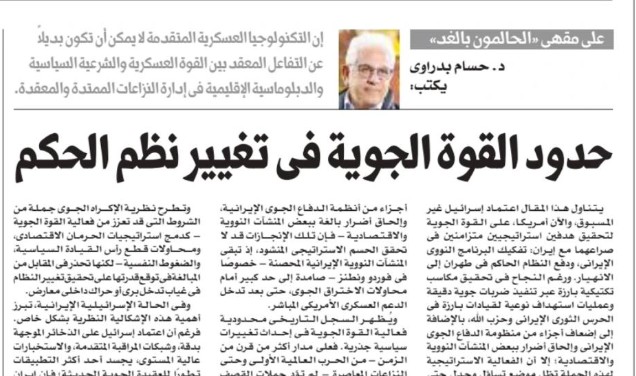
This article examines the unprecedented reliance by Israel — and now the United States — on air power to achieve two simultaneous strategic objectives in their confrontation with Iran: dismantling Iran’s nuclear program and pushing the ruling regime in Tehran toward collapse. Despite notable tactical gains through precise airstrikes and targeted assassinations of high-ranking officials in Iran’s Revolutionary Guard and Hezbollah, as well as the weakening of parts of Iran’s air defense system and damage to nuclear and economic facilities, the strategic effectiveness of this campaign remains questionable — even after U.S. intervention.
Drawing on historical patterns of strategic bombing and regime resilience, the article underscores the limitations of air power in bringing about fundamental political change — particularly when confronting entrenched regimes with fortified nuclear infrastructure. The article also reviews the evolution of Israel’s rhetoric, shifting from a narrative of national security defense to one of defending Western civilization as a whole — an attempt to reshape its strategic position amid growing regional and global complexities.
The emerging geopolitical environment may present strategic opportunities for major regional powers such as Turkey, Saudi Arabia, and Egypt to redefine their roles and contribute to shaping a new balance of power in the Middle East.
Overall, the confrontation between Israel and Iran reflects an unprecedented shift in military strategy. For the first time in modern military history, a state relies solely on air power — without accompanying ground operations. This Israeli campaign, even after U.S. involvement, reflects an ambitious belief — one not supported by historical experience — that technological superiority and the ability to deliver precision strikes backed by advanced intelligence can overcome the deep-rooted political, military, and societal complexities of major conflicts.
Despite limited tactical successes — such as assassinating key figures in the Revolutionary Guard and Hezbollah, disabling parts of Iran’s air defense systems, and damaging key nuclear and economic facilities — these achievements are unlikely to deliver decisive strategic outcomes. Iran’s fortified nuclear sites — especially in Fordow and Natanz — remain largely intact and resistant to air penetration, even after direct U.S. military support.
The historical record shows that air power alone has limited effectiveness in producing fundamental political change. Over more than a century — from World War I to contemporary conflicts — strategic bombing campaigns have failed to spark popular uprisings or topple regimes. On the contrary, foreign aggression often strengthens nationalist sentiment and reinforces authoritarian regimes, as seen in Iraq, Afghanistan, and Gaza.
Accordingly, the current U.S.-Israeli strategy may exemplify what is known as the “smart bomb illusion,” where overreliance on modern technology creates a false sense of strategic confidence, while underestimating the resilience of the opponent’s political and social structures.
Beyond the material consequences of the ongoing military campaign, Israel’s status as an unchallenged regional deterrent has suffered a symbolic blow. Iranian retaliatory strikes — despite their limited precision — have undermined the image of Israel as an invincible power and highlighted its need for direct U.S. military intervention. In response, Israel has sought to reframe its international narrative from one of national self-defense to a broader defensive mission that promotes its role as protector of Western civilization and American interests.
Amid this escalating confrontation, new regional dynamics are emerging that could provide strategic openings for influential regional powers — especially Turkey, Saudi Arabia, and Egypt — to redefine their influence within the evolving balance of power in the region.
Accumulated empirical evidence casts doubt on the notion that coercive air power can reliably achieve political goals, particularly when targeting regimes with solid leadership structures and effective internal suppression mechanisms.
Air coercion theory outlines several conditions that might enhance air power’s effectiveness — such as combining economic deprivation strategies, decapitation of political leadership, and psychological pressure — but it also warns against overestimating its capacity to effect regime change in the absence of ground intervention or internal opposition movements.
In the Israeli-Iranian case, this theoretical dilemma is especially significant. While Israel’s use of precision-guided munitions, advanced surveillance networks, and high-level intelligence represents one of the most sophisticated applications of modern air doctrine, Iran remains a complex target. This is due to the fortification of its nuclear infrastructure, its cohesive centralized regime, and its deeply rooted political culture shaped by decades of external threats.
Israel’s continued reliance on air power alone, without developing a comprehensive political strategy or building solid international alliances, may ultimately heighten its security risks. Iran, on the other hand, may respond to military strikes by accelerating its nuclear development through clandestine means, especially as international oversight mechanisms weaken following military escalation or continued indiscriminate strikes on civilians — which may garner Western media momentum for Israel, even if falsely portrayed.
As for the key regional players — particularly Turkey, Saudi Arabia, and Egypt — current conditions provide an opportunity to recalibrate their strategic roles, provided they adopt multi-dimensional policies balancing security interests with diplomatic engagement. This approach could help contain the escalation and reinforce regional power stability.
Ultimately, this situation serves as a crucial reminder — for both policymakers and scholars — that advanced military technology cannot substitute for the complex interplay of military force, political legitimacy, and regional diplomacy in managing protracted and intricate conflicts.
In any case, a fundamental shift is underway in the political map of the region — a shift whose full implications remain uncertain.