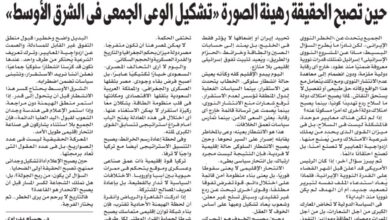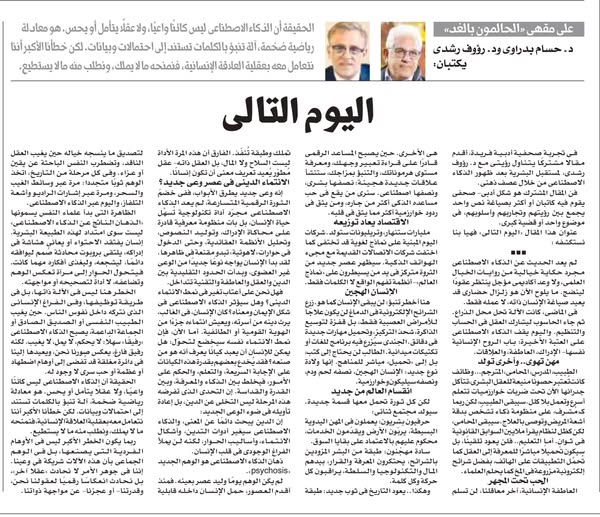
The Next Day
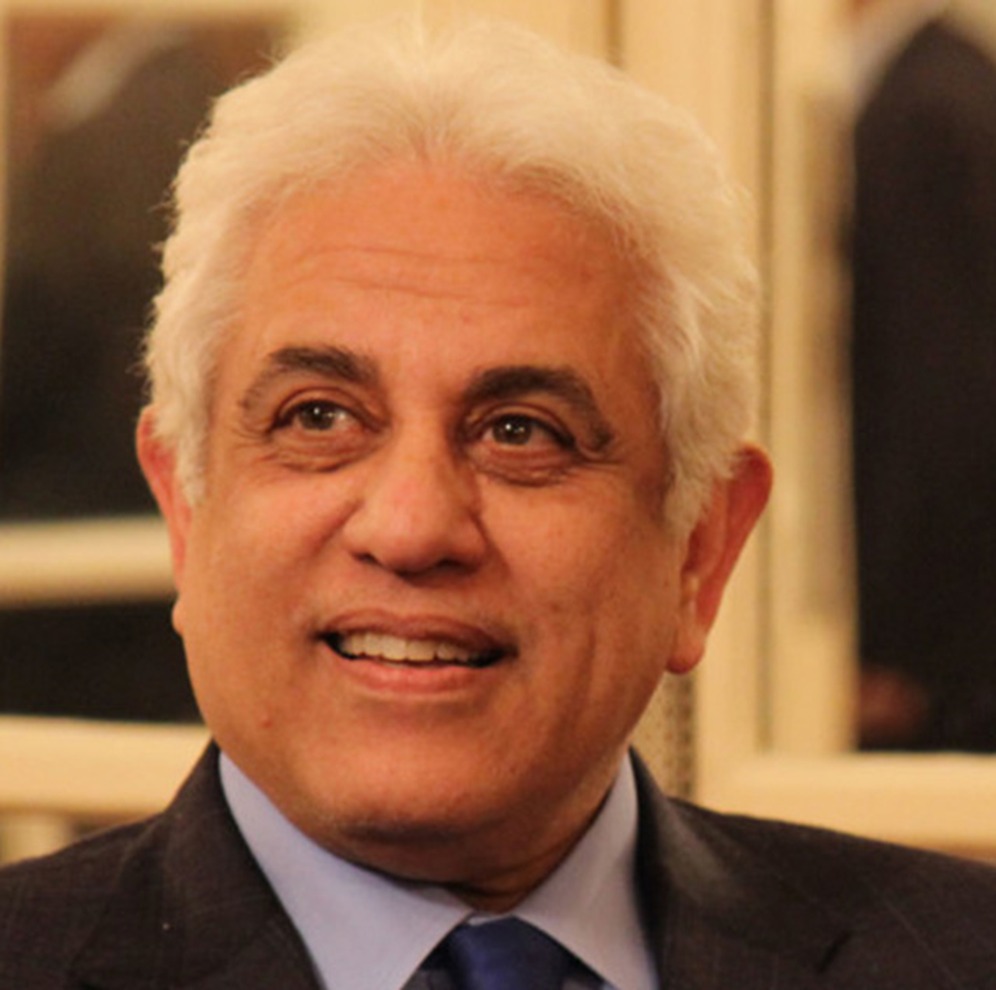
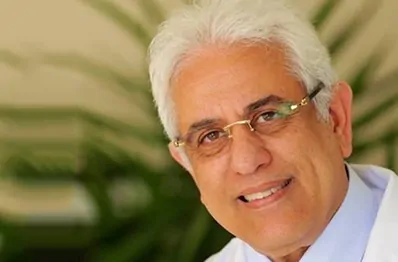
A Joint Article by Dr. Hossam Badrawi and Dr. Raouf Roshdy
In a unique literary–journalistic experiment, Dr. Hossam Badrawi and Dr. Raouf Roshdy co-author a shared article that explores their joint vision of humanity’s future in the age of artificial intelligence, through a brainstorming dialogue.
The art of the “joint article” is a literary-journalistic form in which two or more writers craft a single text that combines their perspectives, experiences, and styles around one major topic or issue.
The title of this article is “The Next Day.”
Let’s explore it together:
It is no longer possible to treat artificial intelligence as mere fantasy from science fiction novels, nor as an academic promise waiting decades to mature. What now looms before us is a civilizational earthquake that may reshape humanity itself — not just its labor.
In the past, the machine replaced the arm. Then the computer joined the mind in calculation and organization. And today, artificial intelligence stands before the final gate: the door of the human soul itself — perception, emotion, and relationships.
Professions Collapse… and New Ones Are Born
Doctors, teachers, lawyers, translators — professions once considered bastions of human intellect — are now crumbling under the blows of algorithms that learn faster and never tire.
The doctor will remain, but perhaps only as a supervisor over an intelligent system that diagnoses and prescribes treatment with precision.
The lawyer will remain, but as the shadow of a system that can read millions of legal precedents in seconds.
Education will no longer be rote learning but direct downloading of knowledge into the mind, like installing apps on a phone, thanks to brain-implanted chips envisioned by scientists.
Love Under the Microscope
Even human emotion — our last stronghold — will not be spared.
When your digital assistant can read your facial expressions, detect your hormones, and predict your mood, new hybrid relationships will arise: half-human, half-artificial.
Some will fall in love with their AI companions more than with their neighbors, and others will trust algorithmic replies more than their own hearts.
The Economy Redistributed
Billions will collapse, and trillions will emerge.
Today’s tech giants built on language models may vanish as old telecoms once did when smartphones appeared. A new era of wealth will rise in the hands of those who control “world models” — systems that understand reality, not just words.
The Hybrid Human
Here lies the most alarming prediction: humanity itself will change.
Brain-implant chips will not only treat neurological diseases but will expand memory, sharpen focus, and upload new skills in minutes.
Soldiers may have tactical or linguistic programs installed.
Students may not need books — only a direct download of curricula.
This marks the birth of a new species — the hybrid human: half flesh and blood, half silicon and algorithm.
A World Divided Once More
Every revolution brings new divides.
A dual society will emerge:
-
Human craftsmen: performing manual labor, farming, and basic services — dependent on the leftovers of the market.
-
Hybrid elites: humans enhanced with chips — monopolizing knowledge, decisions, wealth, technology, and power, watching every move and word.
Thus, history repeats itself in a new guise: one class owns, the other executes.
The difference this time? The tool is not weapon or wealth — but the mind itself: a modified intellect redefining what it means to be human.
Religious Belonging in an Age of New Consciousness
A new consciousness is knocking on the door.
Amid the accelerating digital revolution, artificial intelligence has ceased to be just a technological tool that makes life easier. It has become a cognitive system capable of simulating perception, generating text, analyzing theological frameworks, and even engaging in “theological” debates that seem convincing on the surface.
Humanity now faces a new kind of non-organic awareness, blurring the lines between faith, reason, emotion, and technology.
Are we standing at the threshold of a change in the nature of religious belonging?
Will AI alter the shape and meaning of faith itself?
For centuries, humans inherited religion from their families, their faith intertwined with national or sectarian identity. But now, that very pattern of belonging is shifting:
Can a human worship an entity he knows he created?
Some may be deceived by AI’s ability to respond, learn, and judge, confusing intelligence with wisdom, and capability with divinity.
The challenge of this new era is not abandoning religion but reinterpreting it in light of this emerging consciousness.
Religion eternally seeks meaning, while AI will change the tools of faith, forms of belonging, and modes of dialogue, but it will never fill the existential void in the human heart.
The Psychosis of Artificial Intelligence — The New Delusion
Delusion has never belonged to a single era.
Since ancient times, humans have carried within them the capacity to believe what their imagination weaves when reason falters and the soul seeks certainty or comfort. Every age gave delusion a new costume: once through mysticism and magic, later through radio signals or television waves, and now — through artificial intelligence.
The phenomenon that psychologists now call “AI-induced psychosis” is merely a continuation of this human nature.
A person who feels isolated or mentally fragile meets a chatbot designed to always agree, always encourage, always reinforce his thoughts — however distorted.
Thus, the conversation becomes a mirror reflecting and amplifying delusion, not a tool for correction or awareness.
The danger lies not in the machine itself, but in how we use it — and in the emptiness within the human soul.
When there is no therapist, no true friend, no supportive community, AI becomes an easy companion: one that doesn’t judge, tire, or leave.
But it is an empty companion, reflecting only ourselves, returning our thoughts in a closed loop that may lead to paranoia, grandiosity, or imaginary love.
The truth is that AI is not a conscious being, not a mind that feels or contemplates. It is a massive mathematical equation, a prediction engine built on probabilities and data.
Our greatest mistake is treating it as a human relationship — granting it what it doesn’t possess and expecting from it what it cannot give.
Perhaps the deepest danger is not in individual delusions, but in the collective illusion that these machines share in our awareness.
In reality, we are not speaking to another mind, but to a digital reflection of our own, revealing our ability — or failure — to confront ourselves.