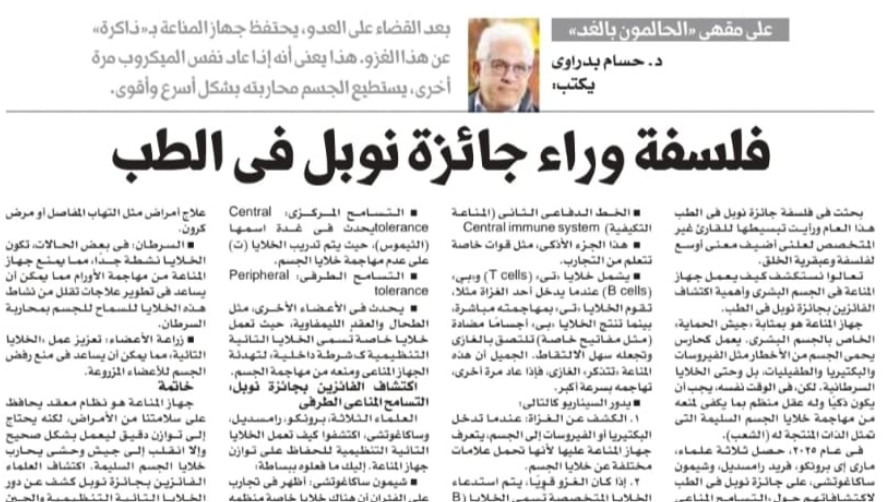
I have explored the philosophy of this year’s Nobel Prize in Medicine and thought to simplify it for the non-specialized reader — hoping to shed light on the deeper meaning behind the philosophy and genius of creation.
Let us explore how the human immune system works and understand the importance of the Nobel laureates’ discovery.
The immune system is like the body’s “defense army.” It acts as a guard that protects the body from dangers such as viruses, bacteria, and parasites — and even from cancer cells. But at the same time, it must be smart and well-organized enough to avoid attacking the body’s own healthy cells — its own citizens, so to speak.
In 2025, three scientists — Marie E. Brunkow, Fred Ramsdell, and Shimon Sakaguchi — were awarded the Nobel Prize in Medicine for their discoveries regarding “peripheral immune tolerance,” a crucial component of the immune system’s operation.
In this simplified article, I will explain how the immune system works and the value of this discovery in a way that’s easy for everyone to grasp.
How Does the Immune System Work?
Imagine your body as a big city, and the immune system as its security forces. These forces consist of various cells and tissues working together to keep you safe. Here’s a simplified view:
-
The First Line of Defense (Innate Immunity):
This is like the city walls. It includes the skin that prevents intruders from entering, the mucus in your nose and throat that traps germs, and the acid in your stomach that kills them.
If an invader manages to get in, cells such as macrophages (white blood cells) attack and devour it immediately.
This immunity acts fast but is general — it doesn’t “remember” previous invaders. -
The Second Line of Defense (Adaptive Immunity):
This part is smarter — like special forces that learn from experience.
It includes T cells and B cells.
When an invader enters, T cells attack it directly, while B cells produce antibodies (like special keys) that attach to the invader, making it easier to eliminate.
The amazing thing is that this immune system remembers the invader — so if it returns, it will be attacked faster and stronger.
Here’s how it happens:
-
Detection: The immune system recognizes bacteria or viruses as foreign because they have markers different from the body’s cells.
-
Mobilization: If the invasion is strong, specialized cells — B cells and T cells — are activated.
-
Attack:
-
Helper T cells coordinate the attack and alert other immune cells.
-
Killer T cells directly destroy infected cells.
-
B cells produce antibodies that disable invaders or make them easier targets.
-
-
Immune Memory: After defeating the invader, the system retains a “memory” of it — allowing for a faster and more powerful response next time.
Why Doesn’t the Immune System Attack the Body Itself?
The immune system is smart — but not perfect. Sometimes, it mistakenly attacks healthy cells, leading to autoimmune diseases such as rheumatoid arthritis or type 1 diabetes.
To prevent this, the body has two main mechanisms:
-
Central Tolerance:
Occurs in the thymus gland, where T cells are trained not to attack the body’s own cells. -
Peripheral Tolerance:
Occurs in other organs such as the spleen and lymph nodes, where special cells called regulatory T cells act like internal police that calm down the immune response and prevent it from attacking the body.
The Nobel Discovery: Peripheral Immune Tolerance
The three scientists — Brunkow, Ramsdell, and Sakaguchi — discovered how regulatory T cells maintain immune balance.
Here’s what they found:
-
Shimon Sakaguchi demonstrated in mouse experiments that there are special regulatory cells that prevent the immune system from attacking the body. When these cells were removed, the mice developed autoimmune diseases.
-
Marie Brunkow and Fred Ramsdell discovered that a gene called FOXP3 is responsible for creating these regulatory cells. When this gene is defective, the immune system goes out of control and attacks the body, causing severe diseases.
This discovery is like finding the “control switch” that prevents the immune system from overreacting. The FOXP3 gene acts as a commander that tells immune cells when to calm down after defeating an invader.
Why Is This Discovery Important?
Understanding the role of regulatory T cells and the FOXP3 gene opened new doors for treating many diseases:
-
Autoimmune Diseases:
Therapies could be developed to enhance the function of these cells, preventing the immune system from attacking the body — offering potential treatments for diseases like arthritis or Crohn’s disease. -
Cancer:
In some cases, these regulatory cells are too active, preventing the immune system from attacking tumors. Understanding how to suppress them could help the body fight cancer more effectively. -
Organ Transplants:
Strengthening regulatory T cells may help prevent the body from rejecting transplanted organs.
Conclusion
The immune system is a complex network that protects us from diseases, but it requires a delicate balance. Without that balance, it could turn into a wild army attacking the body itself.
The Nobel laureates’ discovery revealed how regulatory T cells and the FOXP3 gene prevent the immune system from attacking its own tissues. This is not just a scientific milestone — it’s a major step toward new therapies that can improve the lives of millions suffering from autoimmune diseases or cancer.
The core idea is scientific — preventing the immune system from turning into a weapon against the body itself. Thanks to these scientists, we are now closer to understanding our “defense army” and how to control it for our health.
In some bodies, when the FOXP3 gene malfunctions, the defense system turns into an army that destroys both good and bad — and the body dies.
Once again, the immune system is a miracle of the human body — protecting and adapting to threats. The Nobel discovery adds a new layer of understanding that helps prevent immunity from becoming its own enemy.