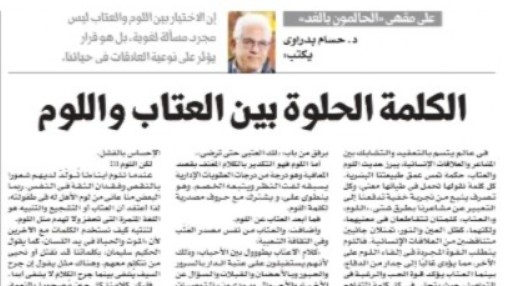
In a world full of complexity and entanglement between emotions and human relationships, the discussion of blame and reproach carries wisdom that touches the depth of our human nature. Every word we say holds meaning within it, and every action stems from hidden experiences that drive us to express our feelings in different ways.
Blame and reproach intersect in meaning, yet like shadow and light, they represent opposite sides of human relationships.
- Blame requires a raw force to place fault on the other, often leading to a defensive wall.
- Reproach, however, emphasizes love and the desire for connection, where each word carries understanding and human warmth.
So, do we truly know when to blame and when to gently reproach in ways that build rather than destroy? That’s what I tried to explore in this article.
A Scene on the Beach
Today, while at the beach with my daughter, some of her friends, and a few mothers, one of the mothers began reproaching her daughter for something she did.
That sparked a thought in my mind, so I opened a conversation with the young people around me: what is the meaning of blame, and how is it different from reproach?
And I asked: Is there really a difference in English between the two words? Or does Arabic carry richer expressive power than English?
In English, لوم translates to blame.
But for عتاب, I couldn’t find a single word that conveys the full meaning—perhaps gentle approach or reproach.
My goal was to share my experience with them without interfering directly.
The Difference Between Blame and Reproach
- Reproach carries affection, love, and positive energy.
- Blame seeks to prove the other’s mistake and score a point against them.
When we hear reproach, we feel loved.
When we hear blame, the other person becomes defensive—and the feeling turns negative.
The difference lies in how the words are said and how the one who blames responds to the reply.
- In blame, the accuser insists on proving the other wrong, digging the wound deeper.
- In reproach among loved ones, any response opens a door to acceptance and builds on positivity.
Voices From Others
One of the mothers, a cultured writer, said to me:
“You’re right. Reproach is the gentle speech of someone who loves, as in the saying: ‘You have my reproach until you are pleased.’
But blame is upsetting, harsh words meant as punishment. In fact, in administrative law, blame is a form of disciplinary action that comes after a warning and before a penalty. It also shares roots with the Arabic word for meanness.”
She continued:
- Reproach comes from the same root ‘atab’. In popular culture:
- “Reproachful words between loved ones last long.”
- People are welcomed on the doorstep (‘atba’) with joy, embraces, and warm wishes.
- Expressions like “Women bring reproach” when a bride brings fortune, or “Reproach is on the eyes” as a gentle apology for an unintentional slight.
- “The doorstep is crystal” symbolizes prosperity and ease of life.
- “No reproach at the threshold”—for it’s not right to reproach guests when welcoming or bidding them farewell.
- “Reproach of the ignoble is best avoided”—since such people don’t deserve the effort of reproach.
All of this and more can be found in M. Taymour Pasha’s Book of Popular Proverbs.
Another friend sent me research by Dr. Fouada Hediya (Professor of Psychology, Ain Shams University), who wrote:
“Blame is an indirect way by which one person asserts control over another, positioning himself as judge and accuser. Many people reject this.”
And Christ himself taught: “Judge not, that you be not judged.”
Scientific studies also confirm that people who are constantly blamed, when they try to change, don’t change for those they love, but only to prove to themselves they aren’t bad people.
Blame vs. Reproach in Family and Life
Sometimes, we blame our children, our spouses, our fate—and often, we even blame God when objecting to circumstances we go through.
- Reproach is a refined language that drives love forward, fuels it with self-confidence, and purifies it from feelings of failure.
- Blame, however…!
When we constantly blame our children, we create in them a sense of deficiency and loss of self-confidence. Many of us may have suffered parental blame in childhood, so I believe reproach—or encouragement and gentle reminders—is the fruitful language that motivates, while blame destroys.
The Power of Words
We must pay attention to how we use words with others, because as the wise Solomon said: “Life and death are in the power of the tongue.” With our words, we can kill or give life to those we speak to.
As another proverb says: “The wound of the sword may heal, but the wound of words never heals.”
So, let our words always be seasoned with grace. Let us replace the language of blame and condemnation with the language of love and encouragement.
A Beautiful Expression
A friend also added to this discussion about “sweet words,” saying:
- It’s nice to say: “I don’t get upset with you.”
- But even nicer to say: “I can’t bear to see you upset.”
Beautiful are the relationships that flow both ways—where people care for each other, can’t bear each other’s sadness, reconcile, comfort, reassure, and support one another.
Such relationships are free of blame; they thrive instead on loving reproach.
Conclusion
From this conversation at the beach, we see that the choice between blame and reproach is not just a matter of language—it’s a decision that shapes the quality of our relationships.
Reproach, when it comes from a place of love and care, can be a bridge connecting hearts and nourishing the spirit of communication. But blame, with its negative tone, plants divisions and may sever bonds.
Let’s learn to use the language of reproach that builds rather than destroys—to bring life to our moments and strengthen our ties. Let’s remember that love opens hearts, and sweet words can unlock them, even in the hardest times.
If our lives are filled with beautiful reproach, then we will have attained the greatest treasure: genuine and pure connection between hearts.
(Contrary to what some may think, even during vacations and beach outings, beautiful and meaningful conversations can happen—it all depends on the family.)