
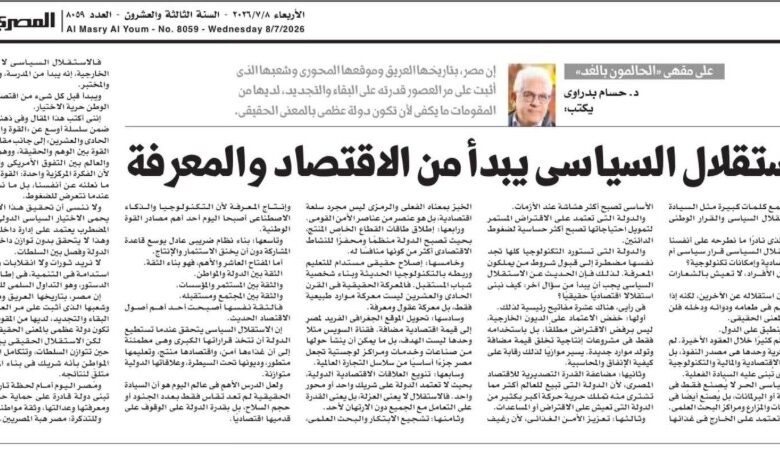
We often hear grand political terms such as national sovereignty, political independence, and an independent national decision. Yet the question we rarely ask ourselves is this:
Is political independence merely a political decision, or is it the outcome of economic strength and technological capability?
Nations, like individuals, cannot live on slogans alone. A person may declare independence from others, but if they still depend on them for food, medicine, or income, they are not truly independent. The same principle applies to countries.
The world has changed dramatically over the past few decades. Military power is no longer the sole source of influence. Today, economic, financial, and technological capabilities form the true foundation upon which genuine sovereignty is built.
A free political decision is not made only in presidential palaces or parliamentary chambers. It is also shaped in factories, universities, farms, and research laboratories.
A country that depends on others for its essential food supplies becomes increasingly vulnerable during times of crisis.
A country that relies continuously on borrowing to finance its needs becomes more susceptible to pressure from creditors.
A country that imports all of its technology inevitably finds itself compelled to accept the terms imposed by those who possess knowledge.
For that reason, any discussion of political independence should begin with a different question:
How do we build genuine economic independence?
In my view, there are ten key pillars.
The first is reducing dependence on external debt—not by rejecting borrowing altogether, but by using it exclusively to finance productive investments that create added value and generate new sources of income. This must be accompanied by strict oversight of public spending and robust accountability.
The second is doubling Egypt’s export capacity. A country that sells more to the world than it buys enjoys far greater freedom of action than one that survives on loans or foreign aid.
The third is strengthening food security. Bread, in both its literal and symbolic sense, is not merely an economic commodity; it is a pillar of national security.
The fourth is unleashing the productive potential of the private sector, allowing the state to act primarily as a regulator and catalyst for economic activity rather than as its competitor.
The fifth is implementing a genuine and sustainable reform of education, linking it to modern technology while cultivating the character and capabilities of future generations. The defining battle of the twenty-first century is no longer one of natural resources alone; it is a battle of minds and knowledge.
The sixth is transforming Egypt’s unique geographic location into tangible economic value. The Suez Canal, for example, should not be viewed as an end in itself, but as the nucleus of industries, services, and logistics hubs that position Egypt as an indispensable link in global trade and supply chains.
The seventh is diversifying international economic partnerships so that the country does not become dependent on any single partner or geopolitical bloc. Independence does not mean isolation; it means the ability to engage with everyone without becoming beholden to anyone.
The eighth is encouraging innovation, scientific research, and knowledge production. In today’s world, technology and artificial intelligence have become among the most important sources of national power.
The ninth is building a fair tax system that broadens participation while avoiding excessive burdens on investment and productive enterprise.
The tenth—and perhaps the most important—is building trust.
Trust between the state and its citizens.
Trust between investors and public institutions.
Trust between society and its future.
Trust itself has become one of the most valuable assets in the modern economy.
Political independence cannot be achieved through passionate speeches or patriotic slogans alone.
It is achieved when a country can make its most consequential decisions with confidence that its food supply is secure, its economy is productive, its education system is modern, its debt is under control, and its international relations are balanced.
Only then does political decision-making become an authentic expression of national will rather than a response to externally imposed economic constraints.
Perhaps the greatest lesson of our time is that genuine sovereignty is no longer measured solely by the size of an army or the sophistication of its weapons. It is measured by a nation’s ability to stand firmly on its own economic feet.
Political independence does not begin at the Ministry of Foreign Affairs. It begins in the classroom, the farm, the factory, and the laboratory.
Above all, it begins with an economy capable of giving the nation the freedom to choose.
I write this article with the intention that it become part of a broader series on “Power and Sovereignty in the Twenty-First Century,” alongside my previous essays on Power Between Illusion and Reality, The Illusion of the Seat of Power, and The World Between American Supremacy and International Fragmentation. The central idea is the same: real power is not what we proclaim about ourselves, but what we are capable of doing when we come under pressure.
We must also remember that achieving the kind of independence that safeguards a nation’s freedom of political choice in today’s turbulent world depends upon strong and decisive domestic governance. Such governance cannot exist without a healthy balance among state institutions and a genuine separation of powers.
I fully recognize the democratic dilemma that Egypt faces. The country needs strong and enlightened leadership—we seek it and aspire to it—but we must also protect that strength from degenerating into authoritarian rule by upholding the peaceful transfer of power as stipulated in the Constitution.
We seek neither revolutions nor coups nor chaos.
We seek sustainable development within the constitutional political framework, founded upon the peaceful transfer of power.
Egypt, with its ancient civilization, strategic location, and people who have repeatedly demonstrated their resilience and capacity for renewal throughout history, possesses all the ingredients required to become a truly great nation—not merely one that appears great in form. But this path can only be followed by those who possess the courage to pursue internal reform before speaking of external independence.
A state that resists accountability, fears oversight, and avoids the peaceful transfer of power does not build sovereignty; it builds a gilded cage and calls it independence.
True independence begins from within—when powers are balanced, institutions complement one another, and citizens feel they are partners in shaping national decisions rather than passive recipients of their consequences.
Today, Egypt stands before a rare historic opportunity: either to build a capable state that safeguards its freedom through a strong economy, knowledge, and justice, or to continue repeating the word sovereignty in speeches devoid of real substance.
Ultimately, this is not a choice for governments alone. It is a choice for a people who know what they want and remain determined to achieve what they deserve.
And let us remember: Egypt is the gift of the Egyptians.