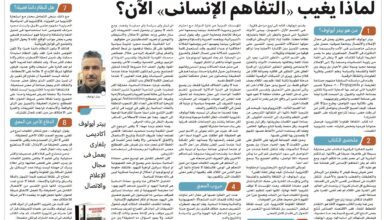

Yesterday, I read in Al-Masry Al-Youm an article by Dr. Amr Hashem Rabie titled, “Abiy Ahmed’s Regime Is Faltering: Should We Throw It a Lifeline?” He is a researcher whose thinking I respect and whose reading of the events around us I value for the alert Egyptian perspective he brings to them.
I agree with him that the government in Addis Ababa is going through its most difficult moment since 2018. Seven armed movements, some of which were fighting one another only yesterday, have come together in an alliance whose objective is to remove the prime minister. The Pretoria Agreement is close to collapse, while the airports of Mekelle, Shire and Axum have fallen out of government control.
The author reminds us that the regime nearly collapsed in 2020, only to survive after “some countries” supplied it with drones. He then calls for preventing another lifeline from being thrown to it, coordinating with Eritrea, Somalia, Djibouti and Sudan, supporting the opposition by all possible means, and even, if temporarily, reconciling the government of Isaias Afwerki with the Tigray People’s Liberation Front.
What prompted me to write, however, is not what the article said, but what some of us may secretly wish for: that the fall of Abiy Ahmed, backed by Israel and an Arab state, might open the door to resolving the Nile crisis and the Grand Ethiopian Renaissance Dam dispute, and lift from Egypt and Sudan a nightmare that has lasted far too long.
I fear this may be more wishful thinking than analysis.
The dam is older than Abiy Ahmed.
The foundation stone of the Grand Ethiopian Renaissance Dam was not laid by Abiy Ahmed, but by Meles Zenawi in the spring of 2011, while Egypt was preoccupied with its revolution.
At the time, Zenawi was the leader of the Tigray People’s Liberation Front—the very same movement that now stands at the heart of the alliance seeking to remove Abiy Ahmed.
In other words, the real “father of the dam” is now sitting among the opposition, not in the presidential palace.
And here lies the paradox:
The opposition that the logic of the article leads us to support “by all possible means” is led by the very movement that laid the foundation stone of the dam.
So are we helping to remove a ruler only to welcome the very people who started the project in the first place?
And on what basis do we assume that whoever enters Addis Ababa on the shoulders of Ethiopia’s competing ethnic groups will be more willing to reach an understanding with us over the Nile?
The author is right to connect the year in which the regime was rescued with the year of the dam’s first filling.
But did the filling stop for even a single year when the government was teetering?
The second, third and fourth fillings went ahead while the war was raging at its height, because the dam was never tied to the fate of one man.
The dam has become a national symbol in the Ethiopian consciousness.
Farmers, employees and expatriates bought its bonds out of their own pockets. It became a stone in the wall of national identity in a country divided by competing ethnicities and with little in common beyond its flag and its river.
There is no indication that any of the opposition forces has made revisiting Ethiopia’s position on the Nile part of its political program.
If anything, the opposite may be closer to the truth.
A government born out of civil war needs something to unite its people. And there is hardly anything easier than an “external adversary” and a “right to water” as tools for creating consensus.
Instability Does Not Weaken the Project… It May Actually Feed It
Earlier this month, the Egyptian Center for Strategic Studies and Thought held a workshop discussing twelve research papers on “the Ethiopian regional project.”
It reached a striking conclusion: Ethiopia’s internal divisions have not weakened either its ability or its determination to pursue its project in the Nile Basin and the Red Sea. On the contrary, they have been among its strongest driving forces.
Domestic crises are exported abroad, and moving forward becomes a policy of escape.
Last August, before the fighting intensified, Addis Ababa was declaring that it did not need anyone’s permission to develop its water resources and was speaking of three new dams on the Blue Nile.
That is the language of a state, not the language of one man.
From One Predicament to Another
Supporting an opposition whose intentions toward us we do not know once it comes to power is not policy. It is a gamble.
The alliance of the seven forces is an alliance of necessity. The head of the Tigray administration himself has openly said that the interests of its members are not identical, and that they share only one objective: removing Abiy Ahmed.
But what happens after that one shared objective has been achieved?
Do we have Egyptian research centers that have studied this possibility specifically?
I looked, and I found serious efforts: the workshop held by the Egyptian Center, and a study by the Pharos Center that outlined three possible trajectories for the opposition alliance: that it succeeds in overthrowing the government; that it disintegrates from within; or that a war of attrition continues without a decisive outcome.
But, in what has been published, I did not find a study addressing the question that concerns us most:
What does each scenario mean for the Nile waters?
Who will manage the dam in each case?
And what do we do if the Ethiopian state descends into chaos and the giant dam ends up in the hands of people we do not know—or in the hands of no one at all?
I fear, then, that we are moving from one predicament over which we had no control—the dam built despite our objections—to another in which we may likewise have neither decision nor influence: Ethiopia after Abiy Ahmed, whatever form it takes.
The difference between a nation that shapes its destiny and one that merely receives it is that the first prepares its scenarios before events occur, while the second writes its analyses afterward.
What Should We Do?
I do not claim expertise in the affairs of the Horn of Africa.
But I am a physician who has learned that diagnosis must come before treatment, and that a doctor does not wait for a patient’s condition to collapse before reading the file.
At a minimum, I believe we need the following:
First: We should not place our bets on individuals.
Rulers change. The river remains.
The real bet must be on a legally binding agreement with the Ethiopian state, regardless of who governs it.
Second: We should open channels of understanding with all Ethiopian forces, both those in government and those in opposition, on the basis that Egypt is a permanent neighbor, and that whoever governs tomorrow should understand that Cairo is not an adversary of the Ethiopian people.
Third: A national research institution should be tasked with preparing “day after” scenarios for Ethiopia, specifically from the perspective of water.
Its conclusions should be made available to the public to the extent that doing so does not compromise national security. A society that understands the challenges is better able to support its state.
Fourth—and most importantly: We must manage the water we already have more effectively.
Every drop we save through more efficient irrigation, every wastewater treatment plant and every desalination facility we build is a source of strength that no one in Addis Ababa can take away from us.
The Nile does not ask for the name of the ruler in Addis Ababa.
It flows from the highlands toward its mouth as it has flowed for thousands of years.
The only thing that changes is the ability of those who live along its banks to understand, prepare and act.
I hope I am wrong.
But even more, I hope that one of our research centers will prove me wrong with a published study saying:
We have thought about this. And we have a plan.