
The End of What We Know, Not the End of Existence
By Hossam Badrawi
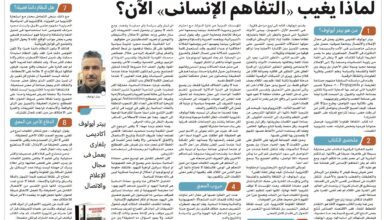
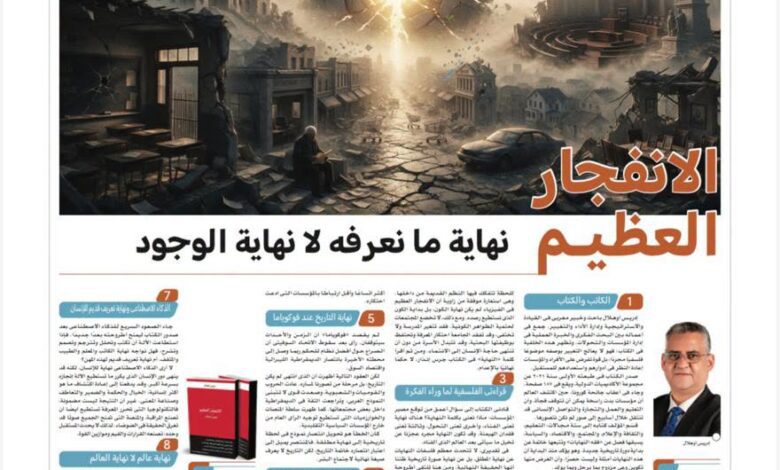
There are books that try to predict what will happen tomorrow, and there are others that look at what is happening before our eyes and then reveal that we have not yet grasped its significance. The Big Bang: The Age of Endings, by Moroccan researcher and thinker Idriss Ouhlal, belongs to the second category.
The book does not offer a prophecy about the end of the world, nor does it speak of another cosmic explosion. Instead, it observes the transformations that have affected institutions and ideas that modern human beings have long regarded as permanent, to the point that we assumed they would remain with us forever. The author speaks of the end of the school and the university, of diplomas, intellectuals and traditional media, of the family, privacy and the middle class, of the market, money and public employment, of politics, leadership and democracy, and ultimately of the end of the West as we have known it.
This list may sound like a declaration of the collapse of the world. Yet Ouhlal places us before the end of one historical cycle and the beginning of another. For him, an ending does not mean annihilation. Rather, it means that old forms are losing their ability to perform their functions in a world whose rules have changed.
The Author and the Book
Idriss Ouhlal is a Moroccan researcher and expert in leadership, strategy, performance management and change. His work combines intellectual research with practical experience in managing institutions and transformations. This background is evident throughout the book: he does not approach change merely as an abstract philosophical subject, but as a force compelling individuals and institutions to reconsider their roles and their readiness for the future.
The book was first published in 2021 by the International Academies Group and consists of 187 pages. It appeared in the aftermath of the COVID-19 pandemic, when the world discovered that institutions that had seemed deeply rooted could suddenly come to a halt, and that education, work, commerce and human communication could shift within weeks into forms we had never imagined.
The author divides the book into six areas: education, culture and media, society, the economy, and politics. These are preceded by a chapter on the “jurisprudence of endings” and followed by a conclusion about the beginning of a new historical cycle. From the outset, he emphasizes that these endings are examples rather than an exhaustive list, and that their purpose is to cultivate a dual awareness of both what is departing and what is being born.
The Central Idea
Ouhlal begins with the observation that many institutions were created under specific historical circumstances. Yet their longevity has led us to treat them as though they were natural facts. The school is not education itself; the university is not knowledge; a diploma is not competence; a newspaper is not journalism; paper money is not value; and parliament does not encompass politics in its entirety.
An institution is a tool invented by human beings to perform a function. When it becomes incapable of fulfilling that function, or when a more efficient tool emerges, it begins to lose its monopoly—even if it remains in existence.
Thus, the end of the school does not mean the disappearance of education. It means the decline of a model that delivers the same content to different students and then measures them through a standardized examination. The end of the university does not mean the disappearance of research, but rather the decline of its monopoly over learning and the recognition of competence. Likewise, the end of media does not mean the disappearance of news; it means the collapse of traditional institutions’ monopoly over producing and distributing it.
The author uses the “Big Bang” as a metaphor for a moment in which old systems begin to disintegrate from within. The metaphor is compelling in one respect: the Big Bang in physics was not the end of the universe, but the beginning of the universe that we are capable of observing.
Yet societies are not governed by the determinism of cosmic phenomena. The school may change without disappearing. The university may lose its monopoly over knowledge while retaining its research function. The family may evolve without eliminating the human need for belonging.
For this reason, I read the word “ending” in the book as an alarm bell, not as a final death sentence.
My Philosophical Reading of What Lies Beyond the Idea
The book led me to a deeper question than predicting the fate of institutions: What do we mean by the word ending?
There is an ending that means annihilation, another that means transformation, and a third that means the loss of dominance. An ending may even simply mean our inability to imagine what comes after the world we have grown accustomed to.
In my view, most philosophies of endings do not speak of the end of the absolute, but of the end of a historical image that we mistakenly believed to be the ultimate truth. From this perspective, Ouhlal’s thesis, despite the difference in context, intersects with two famous ideas: Nietzsche’s “death of God” and Francis Fukuyama’s “end of history.”
Nietzsche’s Death of God
When Nietzsche said, “God is dead,” he was not describing a literal death. The absolute, by definition, neither comes into being nor dies. Rather, he was diagnosing the collapse of the religious and metaphysical frame of reference from which European humanity had derived its understanding of the world and its foundation for morality.
Nietzsche saw that science and critical reason had weakened the authority of the old beliefs, but that humanity had not yet grasped the magnitude of the void they would leave behind. If the source from which people derived their concepts of good, evil and purpose were lost, where would values come from? Could human beings create a new meaning, or would they descend into nihilism?
Thus, the “death of God” was the death of a historical image of the sacred within the Western consciousness, not proof of the end of the absolute. A humanly constructed image of God may collapse while the questions of faith and meaning remain—and perhaps give birth to a broader understanding, less tied to institutions that have claimed a monopoly over them.
The End of History According to Fukuyama
Fukuyama did not mean that time and events themselves would come to a halt. Following the collapse of the Soviet Union, he argued that the struggle over the best system of government might have reached its final stage with the triumph of liberal democracy and the market economy.
Yet the decades that followed demonstrated that what had ended was not history, but a particular phase in our conception of its trajectory. Wars, nationalism and populism returned. Powers that did not embrace the Western model rose. Confidence in democracy declined in some of the societies where it had been established. At the same time, platforms and algorithms emerged with the ability to shape public opinion from outside traditional political institutions.
The mistake was to transform the triumph of a model at a particular historical moment into an absolute ending. The victor tends to regard victory as the conclusion of history. But history knows no final formula for human society.
Means Are Not Truths
This is the key through which I read Ouhlal’s endings.
The end of school is not the end of learning. The end of the university is not the end of knowledge. The end of journalism is not the end of our need to verify facts. The end of the traditional family is not the end of love, care and belonging. Even the difficulties facing democracy do not eliminate the human aspiration for freedom, participation and accountability.
Our problem is that we confuse the tool with the purpose.
We assume that the school is education, that a religious institution is faith, that the state is the homeland, that parliament is democracy, that a diploma is knowledge, and that money is wealth. When the tool begins to crack, we imagine that truth itself has collapsed.
But tools are not truth.
A religious institution may collapse while faith remains. An ideology may fall while the human search for justice remains. A political system may end while the aspiration for freedom survives. What ends each time is a historical embodiment created by human beings—not the value that embodiment attempted to express.
Artificial Intelligence and the End of an Old Definition of Humanity
The rapid rise of artificial intelligence after the book’s publication gives its thesis a new dimension.
If machines can write, analyze, translate, design and explain, are we witnessing the end of the writer, the teacher, the doctor and the intellectual—or the end of an old definition of these professions?
I do not see artificial intelligence as the end of humanity. But it may bring an end to the role of the human being who merely repeats what machines can accomplish more quickly. It may force us to rediscover what is more deeply human: imagination, wisdom, conscience, empathy and the creation of meaning.
Yet the outcome is not guaranteed.
The technology that liberates knowledge can also create surveillance. The platform that gives everyone a voice can drown truth in noise. The future does not simply happen by itself; it is shaped by decisions, values and balances of power.
The End of a World, Not the End of the World
I came away from the book with the conviction that history is a continuous movement in which forms die and others are born.
Nietzsche’s “death of God” was the end of the authority of a historical image of the sacred. Fukuyama’s “end of history” was an imagined end to the struggle over the model of government. Ouhlal’s “Age of Endings” is the fading of institutions that have lost their ability to monopolize the functions they once performed.
All of them speak of the end of what we know, not the end of what can be.
Human beings perceive the absolute through images, definitions and institutions that they create within history. When one of these images ends, truth itself does not end. What ends is our old way of representing and understanding it.
The value of the book, in my view, lies in inviting us to distinguish between what we must preserve and what we should allow to change.
We are not living through the end of the world, but the end of a world to which we had grown accustomed.
We are not witnessing the end of humanity, but the end of a narrow definition of its role.
We are not standing at the end of history, but at the end of one of its chapters.
As for truth, and the human longing for knowledge, freedom, love and meaning, they do not end when the tools through which they have been expressed come to an end.
In every age, they search for new forms in which they can be born again.