
Nations are not merely maps drawn on paper, borders guarded by weapons, or numbers announced in government reports.
At their core, nations are states of consciousness.
When a nation becomes ill, the illness does not first appear in its economy or politics. It appears in its relationship with itself, with time, and with the meaning for which it lives.
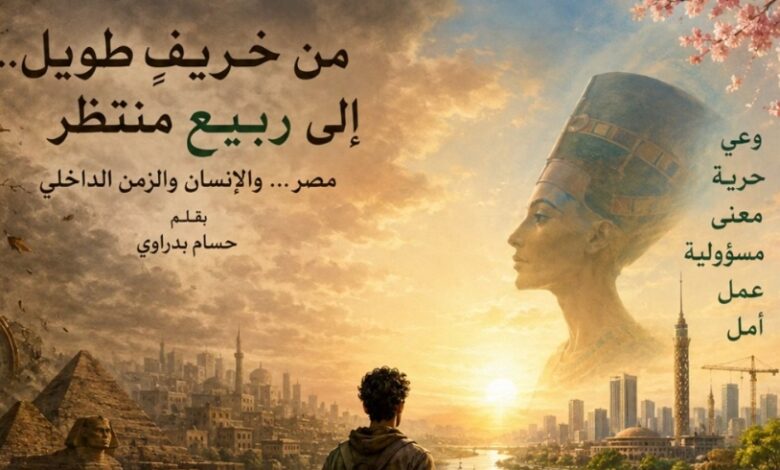
Egypt—that land which taught ancient humanity how to confront death through civilization, how to transform stone into meaning and time into eternity—seems today to be living through a painful paradox:
A glorious history it knows, a confusing present it lives, and a future it fears more than it anticipates.
Between these three dimensions of time stands the Egyptian citizen, exhausted—as though time within him no longer moves in a single direction.
It is a long autumn.
But in nature, autumn is not death.
It is life retreating into the roots in preparation for a new spring.
Perhaps Egypt’s real crisis is not that it has lost its ability to rise, but that it has temporarily forgotten where that ability resides.
First: The Inner Autumn
Egypt’s crisis is not a scarcity of resources.
The Nile still flows, the sun still rises, the land remains capable of giving, and youth continues to renew itself with every generation.
But nations do not decline only when they lose resources.
They decline when their people lose meaning.
When people lose the meaning of what they do, they do not stop moving—they simply move without direction.
They work without knowing why.
They strive without knowing where they are going.
They spend their days in a prolonged struggle for survival until they forget the most important question:
Where is my life actually heading?
And thus the leaves begin to fall—
Not because the wind is stronger than the tree, but because the tree itself has temporarily forgotten that it is a tree.
Today, many Egyptians carry a painful contradiction within themselves:
They take pride in a past they did not create, are burdened by a present they cannot change, and fear a future for which they do not yet possess the tools.
When these three dimensions of time become disconnected within a person’s consciousness, the inner autumn begins.
Autumn is not merely poverty, corruption, or bureaucracy.
These are symptoms that can affect any society.
The deeper wound is when people lose their authentic connection with themselves.
When they stop asking:
- Why do I work?
- Why do I learn?
- Why do I live?
- What will I leave behind?
At that moment, society becomes a vast movement without a compass.
People move because everyone else moves.
They remain silent because silence feels safer.
They adapt because adaptation appears less costly than change.
Generations accumulate upon generations—not while building the future, but while inheriting the same exhaustion, the same fears, and the same postponed questions.
Second: The Egyptian and Time
Perhaps Egypt’s troubled relationship with time is one of the deepest crises of consciousness in modern Egypt.
The Egyptian lives beneath the shadow of an immense history.
A history that cannot be forgotten, yet sometimes transforms—without us noticing—from a source of inspiration into a psychological burden.
Egyptians have grown accustomed to hearing that they are the descendants of a great civilization.
The descendants of the pyramids, the Nile, and the oldest state known to history.
Yet they rarely pause to ask the more difficult question:
How can I be great—today?
Here lies the challenge.
When the past becomes a place we inhabit instead of a source of energy for building the future, history becomes a sedative rather than a driving force.
Living societies do not dwell within ancient glories.
They use them as roots from which new branches grow.
Societies that stare too long into the old mirror gradually lose the ability to see the road ahead.
Deep within, the Egyptian experiences a sharp temporal division:
Emotionally attached to a past seen as greater than the present, living each day as a battle of exhaustion, and viewing the future with anxiety rather than hope.
Thus time itself becomes a burden on the soul.
Yet the deeper truth is that time alone does not heal nations.
Time builds nothing unless it becomes consciousness.
Years create no renaissance if people continue moving in the same circle.
The problem has never been the passage of time over Egypt, but how Egyptians have lived that time:
Have they lived it as makers of history—or merely spectators of it?
Third: The Deep Wound
Modern science tells us that we inherit not only genes, but also the ways in which those genes are expressed.
Environment, experience, fear, hope, and the meanings we live by all influence how our biological inheritance operates.
In other words:
Human beings are not entirely prisoners of their makeup.
They are partners in shaping themselves.
What applies to individuals applies to nations.
Egypt suffers not from a shortage of potential, but from an inherited pattern of consciousness—a pattern that sees the past as completed glory, the present as a heavy burden, and the future as an uncertain destiny rather than a project to be built.
Yet consciousness, unlike genes, can change.
And here true freedom begins.
Freedom is not merely the ability to speak.
It is the ability to think without fear, to question without anxiety, and to choose without guardianship.
A person who has never learned to ask questions cannot truly choose.
And a person who cannot choose cannot build.
Such a person always lives inside a life designed by others.
Thus the deepest wound in Egypt is not merely the absence of external freedom, but the erosion of internal freedom:
The freedom to think independently, dream in one’s own voice, disagree without fear, and see oneself as a responsible individual rather than merely a follower within a larger group.
Yet however long autumn lasts, it always carries within it the seeds of spring.
Hope and Dream
Hope is not an illusion embraced by the weak.
It is the first act through which the strong begin every renaissance.
And Egypt—in its depths, beyond what statistics can measure—still possesses every ingredient of spring:
Young people who ask questions and reject ready-made answers.
Women who carry more than their share of burdens.
Minds that think beyond borders and quietly create what has not yet become visible amid the noise.
Renewal does not arrive all at once like an earthquake.
It comes like dawn—gradual and faint at first, until, once complete, no one remembers exactly when it began.
The sign of the coming spring will not be found in a political speech or an economic indicator.
It will appear in the moment when an Egyptian—at home, in a classroom, at work, or on a small neighborhood street—decides to act as though what they do matters.
Because it truly does matter.