
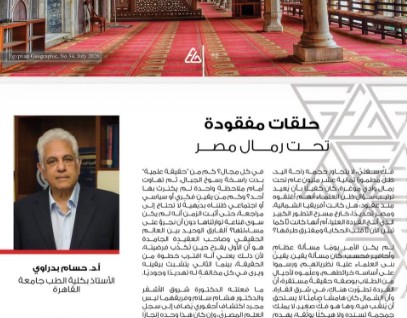
A lower jawbone, no larger than the palm of a hand, lay buried beneath the sands of Wadi Moghra for eighteen million years. Yet this tiny fossil was enough to reopen a question that scientists believed they had settled decades ago: Was North Africa—and Egypt in particular—outside the great evolutionary stage that gave rise to the great apes? Or was it, as now appears to be the case, at the very heart of the story and a crucial crossroads in their evolution?
This was never merely a matter of bones and fossils. It was a matter of certainty.
For years, scientists built theories upon that certainty, drew maps around it, and taught generations of students that it represented established scientific fact: that the great apes evolved in East Africa, while the north of the continent was little more than a silent periphery, scarcely worth investigating. And now, a small jawbone—with neither a skull to support it nor a complete skeleton to validate it—has overturned that certainty from its foundations, reminding us of a lesson as old as knowledge itself: science is not a collection of immutable truths, but a continual exercise in intellectual humility before all that remains unknown.
This is the paradox that deserves more than a passing celebration of discovery: the more certain the human mind becomes, the more cautious it ought to be. Once certainty hardens into dogma, it ceases to be science.
True science, contrary to popular belief, is not built upon the accumulation of certainties but upon a constant willingness to abandon them whenever reality presents evidence to the contrary. Aegyptopithecus—or rather, this newly identified genus, Aegyptopithecus‘s distant relative, Aegyptopithecus? No. Masrypithecus—is not simply another branch added to the tree of life. It is living testimony that the gaps in our knowledge are not empty voids, but unexplored spaces awaiting those courageous enough to examine them with eyes unafraid to challenge conventional wisdom.
Here lies a lesson that extends far beyond paleontology into the philosophy of knowledge itself.
As human beings, we naturally seek comfort within familiar frameworks. We construct certainties that spare us the burden of perpetual questioning. We do this in science just as we do in politics, religion, and philosophy. We convince ourselves that the map is complete, that every line has been drawn, and that all that remains is to fill in a few minor details around the margins.
Then a discovery, an idea, or even a simple question arrives, shaking those certainties to their very foundations and returning us to the state of uncertainty we believed we had long since left behind.
Is this not the story of the human mind in every field?
How many “scientific facts” once appeared as immovable as mountains, only to collapse in the face of a single overlooked observation? How many political, intellectual, or social convictions did we regard as self-evident, requiring no reconsideration, until time revealed them to be little more than inherited assumptions we had never dared to question?
The only real difference between a genuine scientist and the guardian of rigid dogma is this: the scientist welcomes evidence that disproves a hypothesis, because it represents another step closer to the truth. The dogmatist clings to certainty, seeing every challenge as an existential threat.
What Dr. Shorouk El Ashkar, Dr. Hesham Sallam, and their research team have accomplished is far more than the discovery of another fossil worthy of inclusion in Egypt’s scientific record—remarkable though that achievement certainly is.
They have embodied a rare scientific mindset: one that refused to accept absence of evidence as evidence of absence. They understood that an unanswered question is not a closed one, but an open invitation to search where no one has previously thought to look.
Five years of painstaking doubt. Seasons spent amid scorching heat, shifting sands, and repeated disappointment. Then, at last, perseverance was rewarded by a single small jawbone capable of rewriting an entire chapter in the history of life on Earth.
Perhaps the greatest beauty of this discovery is that it offers us not a new certainty, but a deeper question:
How many other “missing links” still lie hidden beneath the sands of our land—or beneath the layers of our own consciousness—waiting for someone courageous enough to question accepted assumptions?
For Egypt, which the world has long viewed primarily through the lens of its pyramids and pharaohs, now reveals itself as the setting for a decisive chapter in the epic of life itself—a chapter that unfolded over millions of years before the first written word of recorded history.
In the end, Masrypithecus teaches us more than the evolutionary story of the great apes.
It teaches us something about ourselves.
The greatest virtue of the human mind is its capacity to remain astonished.
The greatest danger facing knowledge is the belief that it is complete.
For the more we learn, the more deeply we realize how much remains unknown.
That—not merely the discovery of a fossil—is the true lesson worthy of being shared in the pages of Egyptian Geographic.